

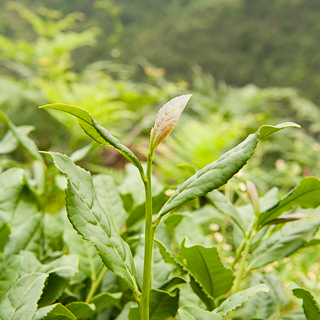
It could be said that Tie Guan Yin oolong is the quintessential “slow tea of China.”
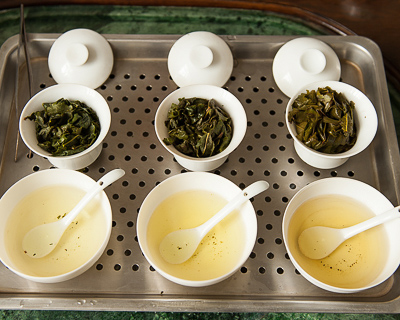
Slow: this tea is known for its refined taste and exquisite aroma, but is one of the most difficult and time consuming to produce. To aid the development of aroma and taste compounds under varying weather conditions, tea masters need to be extremely attentive, especially during the prolonged withering process, to use their sense of smell, touch, and sight to monitor the leaves and adjust methods. Slow: because Tie Guan Yin is meant to be steeped multiple times and savored slowly, with nuanced differences in each infusion. The leaves being thicker than most other oolong cultivars and the finished leaf’s compact, “dragonfly-head” shape, both contribute to the gradual releasing of this tea’s layered flavors. In Anxi, Fujian Province, the birthplace of Tie Guan Yin (also known as Tieguanyin, Ti Kuan Yin, or Iron Goddess of Mercy), the people are fiercely proud of their oolongs—and organic oolong tea producer Rong Feng Wang is no exception.
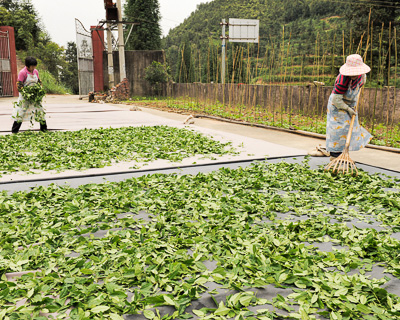
During the tea season, whenever there’s a glimpse of sunshine that breaks through the clouds, the local tea producers in village after village happily pull out the tarps and carefully scatter the freshly harvested leaves over them to let the leaves wither before further processing begins indoors. The rows of bright green leaves by the roadsides are like a greeting to the visitors heading up to the mountains and into the fields.
Wang’s ancestors settled in the area several hundred years ago. Many among them were tea farmers. Since graduating from university, Wang has worked alongside his father at Xing Xi Tea, managing and caring for the tea estate. Founded by his father in the mid-1980s, Xing Xi Tea has been a certified organic tea company for more than a decade. Initially certified by the Chinese authorities in 2003, it has since received international certification in 2009 and is recertified annually by Germany’s Kiwa BCS, in accordance with the standards set by the European Union and the United States Department of Agriculture’s National Organic Program (NOP).
The garden’s main crop is Tie Guan Yin, but it also grows plants used to make three other traditionally local oolong teas: the popular and intensely floral Huang Jin Gui (Golden Osmanthus), the thick-leaved but milder-tasting Ben Shan, and the downy and lightly sweet Mao Xie (Hairy Crab). This mix of crops helps provide stability for the workers because the first day of harvest for each tea differs by a few weeks, which means many seasonal workers won’t have to look for work elsewhere constantly.
Wang has a lot of respect for his father, who was born into an impoverished family of nine children. The elder Wang left school with only a fifth-grade education to work on a tea farm and then became an apprentice on a bee farm at the age of 15. Life was very difficult but he worked hard, and the hands-on experience gained during his youth was invaluable in his path to creating Xing Xi. “Back then, farmers reaped what the land offered but also gave back to it, to keep it naturally fertile,” explains Wang. “The traditional farming methods my father learned then—being in tune with the land, respecting and learning everything about it, including how to utilize and recycle its natural resources—were, in fact, truly organic.”
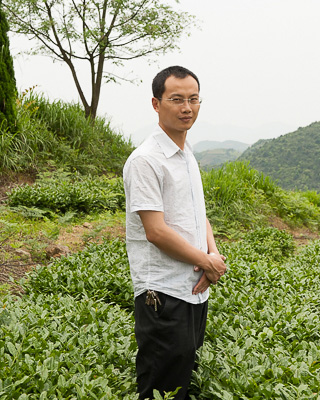
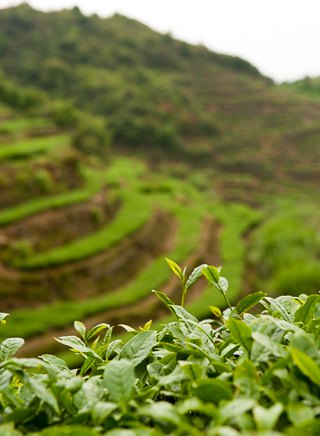
The family’s organic tea garden is on an isolated mountain, away from Anxi city center and at a much higher altitude. This helps it avoid contamination from urban pollution and non-organic gardens. The blowing wind, fluttering leaves, chirping crickets, singing birds, and occasional butterflies hovering over the field, all contribute to making the place feel very alive. The many trees around the plot and the absence of pesticides mean there are more birds to catch insects and add bird droppings to enrich the soil.
“It’s almost like a mini zoo sometimes, especially around dawn or dusk,” says Wang. “Often I see small rodents, rabbits, muntjacs, or even wild boars. And it should be like this. It shouldn’t be us squeezing the earth for a single crop, to the exclusion of everything else. I see organic farming and Chinese medicine as sharing similar philosophical roots. It’s about balance. Chinese medicine tries to find ways to restore a person’s natural balance.”
More than a decade ago, Wang’s family was among the very first to advocate organic tea growing in Anxi. Now, when Wang’s friends get together for a meal, they love to mock his nagging all these years about why one should “go organic.” They would jokingly point to the food: “You can’t eat this, Wang! It’s not organic!” However, they all respect his conviction and agree that for the sake of future generations, it’s important to find ways to lessen the impact of farming practices on the environment.
In many ways, the family’s own journey closely mirrors the economic development of the country itself. When farming became more mechanized, Wang’s father learned to drive tractors and then trucks. He eventually became a long-haul truck driver, working long hours on the road, transporting tea from Anxi to places such as Shenzhen in Guangdong, and bringing back other goods on the return trip. Due to its proximity to Hong Kong, Shenzhen was designated as a special economic zone (SEZ) by the central government in the early 1980s and was a place bustling with international traders.
Truck driving brought in a higher income and created contacts with the business world, but the long hours and regular diet of only two meals a day took a toll on his health. He had to sell the truck at the end of 1984 to return home. Due to tea being the main crop of Anxi and his love for tea, he decided to invest the proceeds into tea production and cultivation, with a focus on export.
It’s amazing to think that today’s lush tea garden grew out of a lone truck on a long dusty road.
Just like his father, Wang has lived through more than three decades of extraordinary changes brought on by economic reforms and the opening up of China after 1978, and he remembers it well. In his youth, he walked to school barefoot because his family had no money for shoes. Yet even though they couldn’t afford much, tea was always an important element of family life.
Whenever they visited his father’s ancestral home in Lutian Zhen, everyone would go into the field to pick some leaves, and his grandmother would use a wok to fry the leaves, making some fresh tea for all to enjoy and take back home.
At university, Wang majored in English and dreamed of furthering his studies in Australia one day. After graduating, being the dutiful son he was and the firstborn, meant putting his own dream of traveling aside to focus on expanding the family business instead. His education was an asset here: due to their language skills, it was foreign language rather than business majors who were among the first wave of exporters following the opening of China.
Looking back now, he sees his past less as a sacrifice and more as life having a way of coming full circle. Organic farming is so important for the environment and a sustainable future, not only for his beloved hometown, Anxi, but also for his country. Because of this, he is glad that what he does is meaningful and he takes pride in it. And he doesn’t want to let the difficulties of finding perfect solutions to life’s challenges stop him—he works hard to find alternative solutions.
For example, now, it’s nearly impossible to find new land for organic farming in Anxi. The solution he and his family devised was to organize and now manage a local tea cooperative. They worked tirelessly and were able to obtain the Ethical Tea Partnership (ETP) certification. This means adhering to standards and rules (health and safety, agrochemicals, labor rights, environmental management, and soil, ecosystem, and water conservation, etc.) specified by ETP. It may not be a “perfect” solution like a certified organic farm, but it gives the local growers a way to cultivate by following international standards and enables small growers to get better pricing for their teas. Furthermore, it gives the soil and the local ecosystem a chance to recover.
“My favorite subject at school was history, studying the rise and fall of each dynasty and the lessons to be learned,” Wang reflects. “Ever since the end of the Qing Dynasty, China was weak. We lost just about every war in every foreign invasion and were forced to give up territories. After that, it was World War II and the civil war, and the country stayed poor for many years until the last few decades. The ordinary people suffered terribly, and the Chinese and China were looked down upon by the rest of the world. When Canadians, the British, French, or Japanese tell people where they are from, there is an instinctive good impression about their country and its people… I desire the same for us Chinese too…”
Wang never made it to Australia. The family reinvested all the profits back into improving the tea estate, and financial investment for organic tea gardens is much higher than for non-organic ones. For this reason, it was only in recent years that he finally got to travel outside China for the first time, to attend major trade shows, after almost two decades in the business.
“All these years I’ve worked hard, exporting our tea to Japan, Germany, the U.S., and so on. But to me, it was never about conquering the world with our tea or anything like that. Although I hadn’t then set foot outside China, I had always dreamed that by working hard and doing a good job, the day when I did finally get to visit a foreign land, I would say to people, ‘I’m Chinese from China,’ and many of them would think to themselves: ‘Wow, Chinese. Good people. Great country.’”
Photos by Arris Han.



3 Comments
Leave a Comment
You must be logged in to post a comment.
So happy to read your article,
Alan Wang is my tea friend since many years ago,
we met in China during a tea travel trip with people from UK, USA, Germany and Canada, and myself, from France, and we have met again in the UK during an international tea expo, and every time Wang Rongfeng’s lovely teas win awards;
he does a very good job and deserves all tea connoisseurs appreciation!
Hi, Madame Dufrene,
Thank you for the comments. I’m very glad that you were happy reading my article about Mr. Wang. Indeed, he and his family produce some of the finest oolongs I’ve ever tasted, not to mention that they are good people who also care about the environment.
The best oolongs come from Fujian, China, where Mr. Wang is based, and Taiwan. If you are interested, here is a great small-batch artisanal tea producer in Taiwan:
https://teajourney.pub/taiwan-alishan-zhulu-wulong-tea/
I wish you a wonderful time traveling and tasting teas. Happy tea time. Bonne dégustatio!
Hi Arris,
Thank you for your article, and it’s very interesting to similar developing path in terms of the cultivar choices. The most widely planted tea trees in Taiwan are ChinShin Oolong, of which’s predecessor is the same as TieGuanYin, and its harvest time is also slower than other cultivars. For now, we have different cultivars suitable for making Oolong, and the best part is that the harvest time can be scheduled differently, and it makes our life much easier, since we can start our production session from mid of March and go to higher estates to make the next lots without any overlapping. :))