


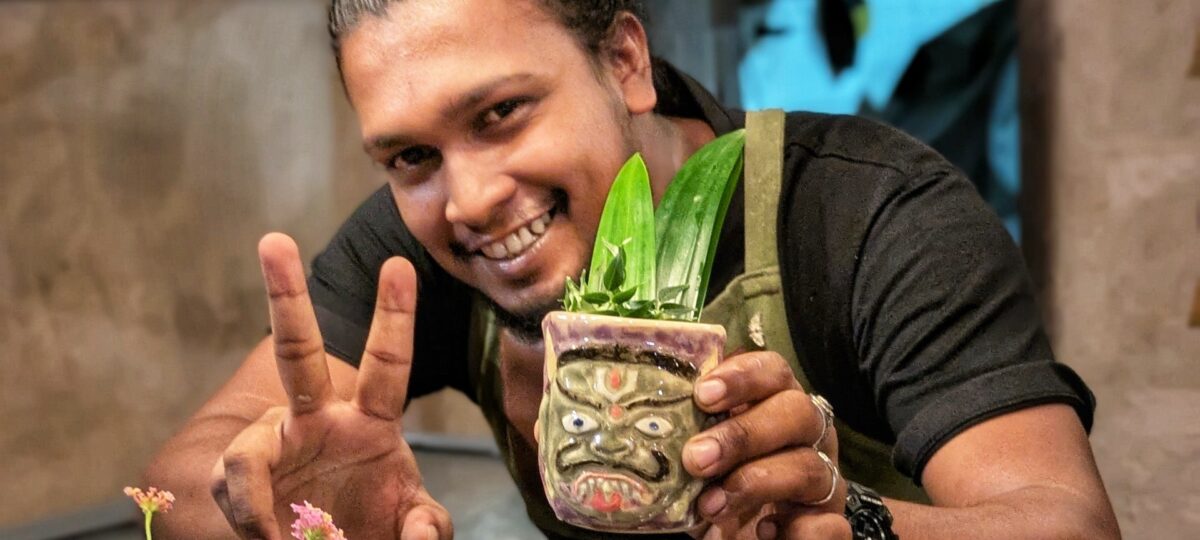
Nestled between swaying coconut palms, with panoramic views of the Indian Ocean, the internationally renowned bar Smoke & Bitters serves some of the world’s most delicious tea-infused cocktails—innovative drinks made with tea supplied by the trailblazing brand Peekoh Tea. Daring to be different, both businesses have set new industry standards and brought much-deserved recognition for Sri Lanka’s exceptional products and bold flavors.
Building a Brand Based on Values
Walk into any trendy Colombo cafe or breezy coastal eatery in Sri Lanka, and Peekoh Tea will likely be on the menu. Created by friends Vinod Malwatte and Trevin de Silva, Peekoh Tea specializes in providing Sri Lankan businesses with fresh, high-quality teas. Peekoh offers locals the opportunity to experience a higher level of Ceylon tea, usually reserved for foreign markets.

From thirsty surfers to caffeine-craving students and small business owners, Peekoh’s commitment to sourcing the finest, environmentally friendly teas, herbs, and spices has earned them a fiercely loyal following.
After working in the tea industry for over a decade, Trevin de Silva saw a massive gap in the domestic market. According to the Sri Lanka Tea Board, approximately 18% of the tea grown in Sri Lanka is consumed domestically (45 million kilos in 2024). The remaining 82% is exported. De Silva and Malwatte believed that not enough high-quality Sri Lankan tea was being showcased to the local population.
“We decided to start a tea company that makes good Sri Lankan tea accessible to local customers,” said Malwatte. “We wanted to focus on loose-leaf tea and slowing down. It would enable us to introduce Sri Lankans to the ritualistic side of tea drinking. where it takes time to brew a cup of tea and move away from ‘on the go’, overly sweetened tea bag culture.”
Instead of rushing to create a product and ramp up sales, Malwatte and de Silva took time to think about what mattered to them and based Peekoh Tea on a solid foundation of values. “We put a lot of effort into building the pillars and foundations of the brand,” adds de Silva. “We didn’t focus too much on sales in the beginning; we focused on creating a high-quality product first.”
Malwatte’s background in environmental conservation and de Silva’s firsthand knowledge of the social and ecological challenges facing the modern tea industry meant that sustainability had to be a key part of the brand. “We wanted to be as ethical and environmentally sensitive as possible,” explains Malwatte.


Farm Fresh Teas
Rather than purchasing tea from Colombo brokers at auction, Peekoh buys straight from the estates and factories. “We found a system that worked for Peekoh,” Malwatte continues. “Using Trevin’s extensive network of estates and people in the tea industry allows us to source the best quality tea available directly from the estates. We work with small batches because we don’t want to compromise on freshness.”
Cutting out the middleman puts more money in the hands of the estates, allowing them to pay their workers higher wages. It also gives Peekoh the opportunity to select the finest batches, order smaller quantities, and ensure they buy from Rainforest Alliance and Fair Trade-certified estates.

Building Close Relationships with Factories
“We source directly from the factories because there’s a huge gap between production and when a consumer receives the tea—sometimes, that can be 2 or 3 months,” says de Silva. “Transporting tea from a cool climate like the hill country to a hot tropical climate like Colombo significantly affects the quality of the tea. If it’s not stored properly, the aromatics decline, and the flavors drop.”
Reducing that gap enables Peekoh to produce a higher-quality product. “When someone tries our teas, it’s almost as if the leaves were plucked a couple of days ago,” de Silva says. “By doing that, we can offer a product to Sri Lankans that wasn’t easily available to them 5 or 6 years ago.”
De Silva’s experience working in the tea industry, spanning roles such as taster, seller, purchaser, and factory manager, enables him to identify which estates strive to produce superior teas.
“I’ve built close relationships with the factories and estates,” de Silva explains. “So I know them very well. For example, we work with the Pedro Tea Estate in Nuwara Eliya, which produces very nice high-grown teas. We also source exceptional teas from the award-winning Avissawella Tea Factory in the Subaragamuwa region. We make sure to select suppliers who value what they’re doing. Those who really want to put out good products and take the time to develop them carefully. That’s very important to us because we want our quality to stand out.”
In 2019, Malwatte and de Silva started selling Peekoh Tea in glass jars at the Saturday Good Market in Colombo. “We went every Saturday to set up our stall, sell our teas, and expand our reach,” says Malwatte. “Then, we slowly started reaching out to the cafe network and friends who were part of the restaurant scene in Colombo and along the south coast, which was starting to grow at that time. Peekoh became known for selling locally grown, high-quality loose-leaf tea.”

Valuable Partnerships
A few years later, Kelly Winter joined the Peekoh team to help with expansion. Winter’s experience as a yoga instructor and wellness practitioner led to the development of the brand’s popular “Seasons of the Womb” herbal tisane range.
“Growing up, my mum was into homeopathic remedies,” Winter explains. “So I’ve always been exposed to a more natural way of living and really trusting plants to heal. I’ve studied a lot, spoken with a lot of people here, and experimented with the plants myself. That’s how the ‘Seasons of the Womb’ range was born.” Sri Lanka’s expanding yoga and Ayurvedic communities attract more and more travelers every year. This makes Winter’s healthy herbal tisanes some of Peekoh’s best sellers.

Education is also a key component of Peekoh’s success. Brewing loose-leaf teas is not as common in Sri Lanka as in other tea-producing countries. So, the Peekoh team educates their clients and trains staff on how to brew and serve their teas properly. They also check in regularly to ensure the teas are still being made correctly.
“If they’re not doing it right, then we meet up with them and talk to them. You can have a great product, but if it’s not made the right way, that will reflect poorly on you,” says de Silva.
Businesses wanting to differentiate themselves from traditional places see the value in partnering with a brand like Peekoh Tea. Peekoh doesn’t just supply tea. They collaborate by searching out unique flavors and creating custom blends that fit their clients’ needs perfectly. Values like these and the exceptional quality of Peekoh’s products eventually attracted the owners of the island’s best bar, Smoke & Bitters, leading to a prolific partnership.
Necessity is the Mother of Invention
Serving inventive made-from-scratch tropical cocktails and mouthwatering dishes that are both modern and authentic to the island’s flavors has earned Smoke & Bitters international acclaim. As the first and only establishment in the country to be ranked in both the World’s 100 Best Bars and Asia’s 50 Best Bars lists, S&B demonstrates how much talent and potential Sri Lanka has.

Refusing to limit themselves to pre-made syrups, expensive imported spirits, and foreign ingredients challenges owners, Don Ranasinghe and Lahiru Perera, to think outside the box and get creative. “We were looking for solutions—for ways to create an interesting, progressive, and forward-thinking cocktail program that’s also sustainable,” says Ranasinghe.
The duo spent a year conceptualizing and experimenting with different ingredients and flavor combinations. They focused on figuring out how to create innovative cocktails and food recipes using only the items at hand. They even worked on building their own equipment, such as sous vide machines (immersion circulators) and smokers, that function in Sri Lanka’s intense heat and monsoons.
“The backbone of Smoke & Bitters consists of things we could make or grow ourselves,” says Ranasinghe. “This is a necessity because sourcing basic cocktail mixers like Angostura bitters and certain restaurant equipment—things considered standard everywhere else are extremely difficult to find here and expensive to import.”
Focus on Homegrown Ingredients

Smoke & Bitters’ dedication to spotlighting homegrown ingredients and locally distilled spirits also extends to its hiring practices. They recruit most of their staff from local villages and provide them with extensive training, education, and advancement. Opportunities to travel abroad are also provided. These are things typically not available to the average Sri Lankan.
“That was another one of the issues that we wanted to address,” Ranasinghe explains. “A cocktail program, or a bar program, is not just about the ingredients or the drinks. It’s also about the people who are working there and the training they receive.”
Anyone who’s spent a night at Smoke & Bitters cannot help but marvel as the talented staff seamlessly work together to produce flawless, complex cocktails consistently and artfully presented dishes.
Tropical Island Flavors
“When we were initially conceptualizing the S&B drinks program, I wanted to represent the old Tiki culture of Don the Beachcomber and Trader Vic’s,” Ranasinghe explains. “It’s something I’ve always loved. Going back to your Mai Tais and your Zombies from the 1930s, you realize they actually made some incredible things.”
Once immensely popular for their fresh flavors, tropical cocktails eventually became mass-produced, artificially colored, and overly sweet concoctions. Beach bars around the world started serving piña coladas and daiquiris with mixes manufactured in factories hundreds of miles away.
“We wanted to represent tropical drinks culture because we are on a beautiful island surrounded by palm trees and all these incredible natural and organic ingredients that aren’t available anywhere else,” adds Ranasinghe.
S&B started making their own bitters using local herbs and spices such as cinnamon, cardamom, cloves, nutmeg, and dried chilies. Various types of citrus, like green-skinned oranges, pomelos, and limes, also grow abundantly on the island—excellent for infusions and extracts.
“That journey of experimenting and making our own bitters led us to making our own liqueurs, syrups, and extracts,” Ranasinghe says. “We really used that time to play with our flavors and experiment like mad scientists, but we were still looking for something to tie it all together.”
Peekoh Tea Sets the Tone
From the beginning, Ranasinghe and Perera wanted to use Ceylon tea in their recipes. However, they encountered the same barriers that Trevin de Silva also saw in the tea industry. The bigger tea companies weren’t interested in selling smaller quantities or diverting tea destined for export.
Searching for inspiration, Ranasinghe came across a sample of Peekoh Tea’s Blend #10. Consisting of strong low-grown black tea and spices like cardamom, cloves, ginger, and black pepper from Ruhuna, an area bordering the nearby Sinharaja rainforest, Blend #10 represents the pure essence of Sri Lanka.

“I was looking for a way to put a Sri Lankan twist on the classic Mai Tai,” Ranasinghe remembers. “Having a Mai Tai on the menu was really important to me. I wanted to create a drink that everyone understands and knows is tropical by nature. But I also wanted to use locally sourced organic ingredients. That’s when I discovered Peekoh Tea’s Blend #10 and finally worked out the perfect recipe for our signature drink, the Mai Chai.”
Tea and spices growing near the lush and humid Sinharaja rainforest reflect the richness of that biodiverse soil. They add depth and complexity to the Mai Chai.
“Blend #10 was a ‘eureka!’ moment for us,” he declares. “It really put all of those ideas and ingredients into one deliverable drink…you can feel that in the drink itself. It’s super flavorful—a flavor bomb of a variation of a Mai Tai. Definitely finding Blend #10 was a moment when we created this one drink, which then set the tone for the rest of the menu and the drinks program to come.”
Collaborating to Create New Flavor Combinations
Peekoh Tea’s eagerness to collaborate offers Smoke & Bitters endless opportunities to play with new flavor combinations, resulting in more awe-inspiring tea cocktails, such as;

Sippin on Gin ‘n’ Juice: This delectable drink infuses locally distilled Rockland Gin with the tantalizingly tart notes of Blend #4’s hibiscus and rosehips. Perfectly balanced and smooth, Sippin on Gin ‘n’ Juice goes down way too easily.
Silvertip White Negroni: Negronis are all about the gin, and this one is no exception. Distilled with curry leaves and other local aromatics, Colombo 07 gin mixes beautifully with silvertip white tea-infused vermouth. It creates a refreshing cocktail that invigorates the palate.
Old & Smoked: This showstopping play on the popular Old Fashioned swaps out bourbon for Sri Lankan arrack. This arrack is a spirit made from the sap of the coconut palm flower. It then gets sweetened with a Blend #10 simple syrup, and is served with a jaw-dropping cinnamon and halmilla wood-smoked flourish that mesmerizes the senses.
“Working with Peekoh Tea is so important to us because they’re a small-batch supplier,” adds Ranasinghe. “They love to get creative and are always searching for exciting new ingredients. Meeting them set the standard for the kind of partners we look to work with in the future. So that was an integral part of our drinks program.”
S&B’s hard work and devotion to quality and innovation have led to invitations from other influential bars and restaurants worldwide to host collaborative pop-ups and guest shifts. This has enabled them to introduce people around the world to the beauty of Sri Lankan ingredients, culture, and tea.
Lifting Sri Lanka Up
Peekoh Tea and Smoke & Bitters saw what was missing from the Sri Lankan tea and hospitality industries. Finding new solutions for old problems, they built groundbreaking businesses to fill those gaps, creating galvanizing partnerships along the way.
“Smoke & Bitters were one of our earliest clients,” says de Silva. “Working with them has honestly been amazing. We genuinely love what they do. Their creativity and attention to detail are incredible, especially how they’ve transformed our tea blends into such unique cocktails. We started around the same time, and it’s been great seeing how both our businesses have grown side by side. We truly value our relationship with them, and it’s always special when the people you work with become friends.”
Smoke & Bitters Mai Chai Cocktail
This spicy twist on a classic Mai Tai celebrates the flavors of Sri Lanka by infusing dark rum with Peekoh Tea’s Blend #10. The blend is a bold mix of strong, low-grown southern black tea, cardamom, ginger, cloves, and black pepper. The drink that started it all – the Mai Chai’s unique mix of tropical Tiki elements and locally sourced Sri Lankan ingredients inspired the innovative bar program at Smoke & Bitters.
Mai Chai
50ml Chai Infused Rum
10ml Triple Sec
15ml Chai Simple Syrup
15ml Orgeat (a sweet almond syrup made with orange blossom water)
20ml lime juice (freshly squeezed)
4 dashes of Tiki Bitters (Angostura Bitters, or a spiced bitters)
Chai-infused Rum:
Infuse 30g of Blend #10 from Peekoh Tea or a different loose-leaf spiced chai black tea in 750 ml of dark rum. Infuse for 12 hours, then taste. If necessary, infuse for another 6-12 hours, then strain out the tea.
Chai Tea Simple Syrup
30g of tea
2 cups water
1 cup sugar
Steep the tea in hot water for 7-10 minutes, then strain it and add 1 cup of demerara sugar. Stir until the sugar dissolves. Cool the syrup before using.
To Make the Mai Chai:

Smoke & Bitters Mai Chai
Ingredients
Method
- Fill a cocktail shaker with ice
- Add the lime juice, bitters, Orgeat, Triple Sec, and chai-infused rum
- Shake until the outside of the shaker becomes cold and frosty
- Strain into a bucket or a rocks glass filled with ice
- Garnish with a wedge of lime, a cinnamon stick, or a sprig of fresh mint, and a dehydrated orange wheel

Rather than using the Tiki aesthetic, which comes from Polynesian and Pacific Island cultures, Smoke & Bitters turned towards Sri Lanka’s unique heritage and artistic culture by depicting Raksha Masks on their cups. Raksha masks are traditional wooden ceremonial masks used during dances and festivals to ward off evil spirits. The vibrantly colored masks depict dynamic demons with bulging eyes and protruding tongues.


3 Comments
Leave a Comment
You must be logged in to post a comment.
Truly enjoyed this piece. Diana, your storytelling beautifully captures the spirit of innovation in tea. Loved the way you highlighted Peekoh’s unique approach!
Everyone remembers their first true tropical drink made with real juice/mixes as opposed to the processed stuff—mine was in Hawaii at the age of 30, sad how I had to go all those years with the processed stuff. I cannot wait to try the Mai Chai!
I am inspired to visit Sri Lanka and to try some of those cocktails.