



This edition of the newsletter is sponsored by

Hello everyone,
This week, Tea Journey writer Horacio Bustos shares his POV on the sensory experience of having tea and its close ties to one’s culture. In his article, Horacio talks about how our senses of sight, smell, and taste are educated and shaped by our cultural contexts, revealing that tasting tea is a culturally cultivated skill and less of a pure instinct.
You can read the whole article in this email. Keep scrolling.
Also, Tea Journey is raising funds to relocate to the tea lands in 2025. Investors will receive a share of the annual profits and unlimited access to hundreds of premium articles and podcast segments. Fill out this quick three-question survey to register your interest here. There is no obligation to invest. Completing this survey just lets us know that you are interested in learning more about how you can support our move.
Don’t forget to share the stories with your friends, family, colleagues, or anyone who you feel would enjoy reading them.
Yours in tea,

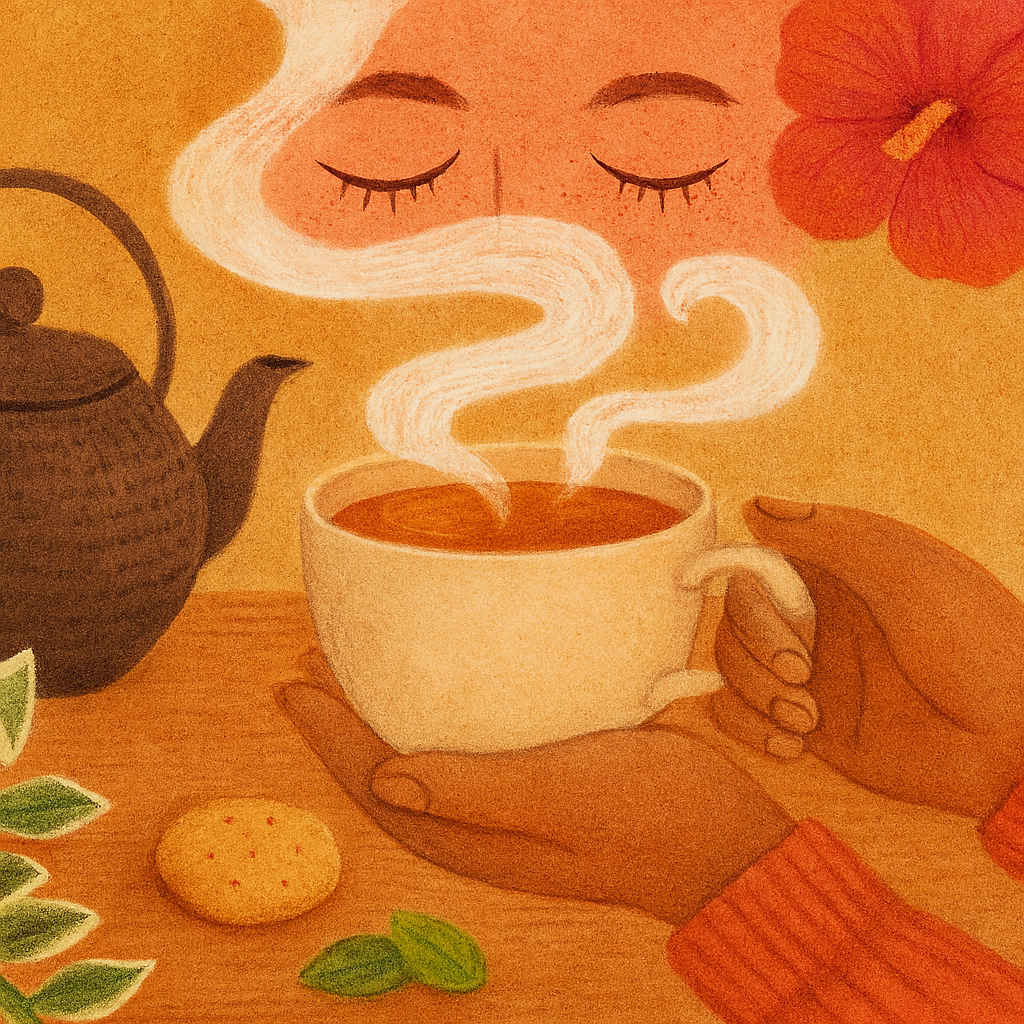
The Culture of the Sense: Tea and the Sensory Experience
It is essential to begin this discussion with the senses, understanding our relationship with the world, to connect with it through comprehension, attention, distance, and control. Precisely through the conscious observation of everything around us, since, starting with the sense of sight, we do not perceive it neutrally, but with all kinds of conditioning, given the idea of supremacy over the senses of smell, taste, and touch, which were historically regarded as secondary, almost instinctive in nature.
Sight and Tea: Educating the Gaze
Michel Foucault describes the panopticon as an architectural design of control based on the principle of the gaze: seeing without being seen provides a means of domination. The eye of power watches, organizes, classifies, and represses, as Foucault emphasized. Symbolized as ‘the all-seeing eye’ or the ‘eye of God,’ with all that this implies in terms of surveillance, attention, and control. Sight, unlike taste, smell, or touch, allows one to take a distance from the world – the other senses involve greater closeness and immersion.
It is important to emphasize that, just as art or prehistoric hunting trains the eye, the culture of tea also educates us with a “specialized view” to appreciate visual qualities that others might overlook. Thus, the education of the eye is also reflected in the world of tea. Someone who has not received specific training may only see dry leaves or an infusion of mahogany or yellow color; however, a taster, a producer, or an experienced enthusiast visually interprets a great deal of information.

The “Specialized View”: What Experts See in the Leaf
For example, in Japan, people associate the brightness and shape of the shoots and leaves of a Gyokuro with its freshness and the quality of its shade-grown cultivation. In China, a tea master will observe the twist and color of a Longjing leaf to identify its origin and drying method. In Morocco, the clarity and green hue of gunpowder tea are key indicators of its purity. It is prepared with mint and sugar in the traditional Moroccan ceremony.
Each country and its tea culture define which visual aspects are most relevant. The intense emerald tone may be a sign of excellence in one country, while in another, what matters most may be the uniformity of the rolling or the shine provided by its polyphenols. Thus, learning, experience, and cultural context shape the visual aspect of tea, as in art.
How Commerce and Culture Train the Eye
We can also observe this in other countries, such as India and Argentina, where a long-standing commercial and cultural tradition trains both consumers and producers to value tea according to criteria that reflect it. In Assam and Darjeeling black teas, the size and uniformity of the leaves, the proportion of golden tips, and the consistent shine are all evident signs of quality. Experienced buyers can visually identify the harvest, altitude, and even the specific batch they are purchasing. People hone their visual education over generations in a context where tea is a significant product and economic driver in many of the major tea-producing countries.
In Argentina, the industrial purpose of tea has historically influenced its visual perception. Most producers gear production towards black tea. For them, the color and granularity of the crushed tea are the leading indicators of quality for export. In recent years, with the growth of gourmet and artisanal tea in Misiones, people are developing a new “visual education”. They value the appearance of the whole leaf, its color, the twist of the roll, and the clarity of the infusion. They are following parameters similar to those used in international tastings.
In India and Argentina, sight is not a neutral sense: new production requirements, consumer habits, and cultural traditions train and shape it. What an Indian taster or an Argentine taster considers ‘visual quality’ in tea is the result of collective learning, transmitted through experience and the values of their environment.
The Sense of Smell and Tea: Identity and Memory
Regarding the sense of smell, anthropologist David Le Breton emphasizes that, although the sense of smell is currently essential for daily life, Western tradition has historically neglected it, considering it unruly, rudimentary, and irrational. He suggests that it is more important to relate it to matters of affection, knowledge, identity, and as a symbol of cultural structures, that is, far beyond strictly physiological aspects.
With the development of rationalism and hygienist medicine, people stigmatized and combated everything related to the body and its odors. Believing the body should not smell natural, or with animalistic odors, they began associating smell with the irrational, the popular, the sexual, and base instincts. In contrast, they considered sight and hearing “noble” senses linked to reason and knowledge.
Following this, people began developing deodorization projects, and industries started producing perfumes in contemporary cities. This project became an urban policy, making perfumes, detergents, and cosmetics the permitted scents. Society came to consider natural odors from animals, the body, the earth, and food as pollutants.

Tea Aroma as Cultural Signature: Identity in the Cup
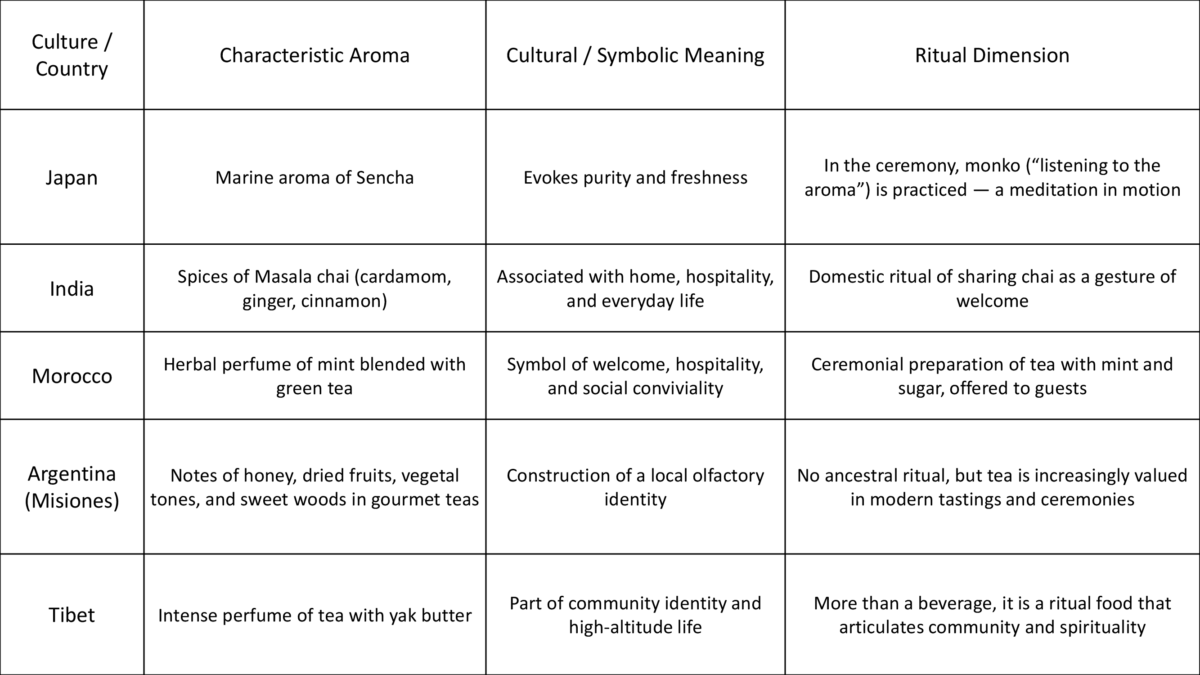
In everyday life related to tea, aroma occupies a place similar to that of perfume. It is both a sign of quality, an aesthetic resource, and a marker of a specific cultural identity. The unmistakable marine aroma of a spring Sencha evokes an ideal of freshness and purity in Japan. In India, the spiced notes of Masala chai are part of the olfactory identity of a home. It is associated with hospitality and well-being. In Morocco, the herbal scent of mint, combined with green tea, is a sensory delight and a symbol of welcome.
The Ritual of Scent: Aroma, Memory, and Sacred Connection
Like perfume, the aroma of tea can be a personal “signature” or a collective stamp. A master roaster in China imparts a unique aromatic profile to his Da Hong Pao oolong tea. This would be a profile that connoisseurs recognize without seeing it. Certain gourmet teas from Misiones in Argentina are beginning to develop their own olfactory identity. These are marked by notes of honey, dried fruits, vegetables, or sweet woods.
As is often the case in religious traditions with incense or oils, the aroma of tea can also serve a ritual function. In the Japanese ceremony, participants first consciously “listen to the aroma” (monko). This is a form of connection with the present that evokes the sacred. They consider this act a moving meditation. In Tibetan contexts, surrounded by the heights of the Himalayas, tea with yak butter releases an intense fragrance. It is not only a source of nourishment but also part of a symbolic system that intertwines community and spirituality.
The smell in tea, and everything that its aromatic descriptors imply, is not simply a sensory experience. It is also a cultural construct that speaks to us about an identity and a certain sense of belonging. It is based on memory, and that can, in certain contexts, open a channel of connection with the invisible and the affective, as Le Breton points out for other uses of aroma.
Taste and Tea: Culture and Belonging
Rationalism and the teachings of Christianity associated the sense of taste with the body, desire, the lower, animalistic, and sinful aspects. Gluttony was associated with vice, while fasting was regarded as virtuous. Eating and all the pleasure it entails were considered an obstacle to reason or spirituality. The culture repressed the act of eating and judged the body based on what it consumed. A process of homogenization of taste would begin, introduced by agribusiness through globalized food chains, fast food, and supermarkets. This would go against the entire cultural, symbolic, social, and emotional experience of different peoples and nations.
It is worth clarifying that taste is not only biological but also a cultural construct that influences how tea is savored in different places and contexts. Taste, flavor, far from being a minor sense, occupies a central place in everything related to the culture of tea. The act of savoring and tasting a bowl or cup of tea is not merely the detection of sweet, bitter, or astringent notes, or a multiplicity of different flavors: it brings together personal history, sensory education, emotional bonds, and the traditions of the place.
In India, the palate is shaped from childhood around intense and persistent flavors, so a black tea like those from Assam is perceived as “natural” and comforting. On the other hand, in Japan, a taste for umami and its subtle flavors prepares consumers to appreciate the smoothness and depth of a Gyokuro or a spring Matcha. In Argentina, for decades, the consumption of industrial black tea with sugar has shaped the collective palate. Today, the rise of artisanal teas and gourmet blends from Misiones is diversifying taste education toward more complex and less sweet profiles. This creates a different sense of belonging.
Senses Shape Tea Cultures
Tasting a tea also involves a dialogue with emotional memory. Sharing a first-harvest Darjeeling can transport us to a visit to the Himalayan mountains. An oolong Tieguanyin with its floral characteristics can evoke a trip to Taiwan. A tea with citrus or minty notes can bring back the feeling of having dessert at grandma’s house. In his novel, “In Search of Lost Time,” Marcel Proust refers to a sensory experience, such as tasting a pastry, which evokes memories. Like Proust’s “madeleines dipped in tea,” the tea alone can awaken intense memories without the need for words.
Just as an art expert perceives nuances invisible to the uninitiated, a tea taster distinguishes flavors and aromas that are often overlooked. Each tea tradition and culture develops its own vocabulary to describe and distinguish nuances. In China, subtlety and aromatic complexity may be valued. Japan may value vegetal freshness. In India, malty identities are appreciated, while Argentina appreciates vegetal characteristics and fresh dried fruits.
In all tea cultures, there are flavors for everyday life. Some are infusions for calm, and others for stimulation, and some are recipes that mark moments in life. Taste in tea defines a sense of belonging. It functions as a marker of identity, distinguishing styles. And, it creates bridges between individual biography and collective history. Thus, tasting tea is seeing with the eyes. It is also with the nose and the tongue, a culturally cultivated skill, not a purely instinctive act.
Bibliography
- Foucault, M. (1977). Discipline and Punish: The Birth of the Prison (A. Sheridan, Trans.) Pantheon Books. (Original work published 1975 as Surveiller et punir: Naissance de la prison.)
- Hall, S. (1996). Cultural Identity and Diaspora. In P. Mongia (Ed.)
- Contemporary Postcolonial Theory: A Reader (pp. 110–121). Arnold Publishers. Hall, S. (1997)
- Representation: Cultural Representations and Signifying Practices. Sage Publications. Le Breton, D. (2011)
- The Sociology of the Senses. Routledge. (Originally published in French, 2006, as La saveur du monde: Une anthropologie des sens.)

We will be back again with more interesting stories. Meanwhile, if you aren’t already, please follow us on LinkedIn, Instagram, and YouTube.
It means a lot to us!
Until next time.





Share this newsletter with a friend
Subscribe now and save 30% for unlimited access to Tea Journey Magazine.
Copyright © 2025 Mystic Media Custom Publishing
Tea Journey Magazine | Tea Biz Blog | Podcast
21 Roslyn Road | Suite 1108 | Winnipeg | MB R3L 2S8 | Canada | +1 204 230-7125
You are receiving this email because you signed up through our website or participated in a promotion.




Bhavi Patel
Bhavi Patel, known as Banjaran Foodie, is a distinguished tea and coffee expert with a background in dairy technology and brand building. As a trusted writer for renowned publications including Perfect Daily Grind, Barista, and STiR Magazines, she combines scientific expertise with storytelling to explore specialty beverages.