

Ian Chun’s visual spectrum reframes how buyers understand matcha quality, making it the world’s fastest-growing tea category.
The global boom in matcha has created an unusual paradox: demand is skyrocketing while the language used to describe quality becomes more unclear.
Terms like ceremonial grade, premium, and culinary are common in Western markets, but they often lack clear meaning. Producers use them loosely. Retailers use them strategically. Buyers are cautious around them. And consumers rarely understand what the labels actually mean.
Into this confusion, tea merchant and educator Ian Chun, founder of Yunomi Life and Yunomi.Cafe has proposed something deceptively simple: a visual standard.
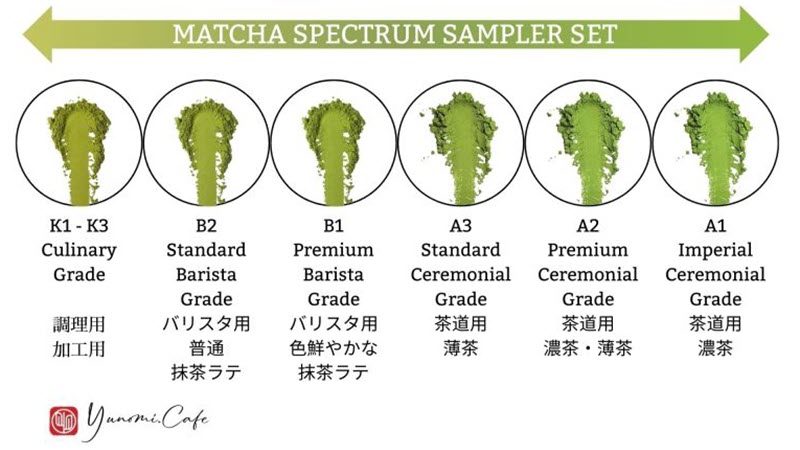
The Matcha Spectrum Sampler, a chart that maps matcha across a color and use spectrum—from culinary powders through barista grades to imperial ceremonial tea—attempts to bring clarity to the category. The illustration organizes matcha into functional grades labeled K, B, and A tiers, each associated with how the powder performs in the bowl, the whisk, or the blender.
The graphic itself is simple. The implications are not.
What began as a visual teaching tool quickly opens a deeper conversation about how matcha quality is defined—and why the industry’s language around it became so confusing in the first place.
A Language Built on Production
According to Chun, the roots of today’s confusion lie in the way Japanese tea has historically been described.
“The Japanese have always used production methods as a marketing tool,” he explains. “Or rather, they have rarely used marketing tools.” Tea names traditionally describe how a tea is processed, not how it tastes or how prestigious it is.
“Sencha is not a flowery name,” Chun says. “It literally describes how you prepare the tea. The ‘sen’ means to decoct or infuse.”
The same pattern appears across Japanese tea terminology.
“Hojicha is literally roasted tea,” he notes. “Kamairicha means pan-roasted tea.”
Even matcha itself reflects this linguistic logic. The ‘ma’ in matcha refers to powdered tea derived from ground leaves.
Within Japan’s domestic tea trade, this method-based vocabulary works well because buyers and sellers understand the deeper details behind the shorthand.
“One aspect of the production is chosen to represent the tea,” Chun says. But the system also creates ambiguities. “Even in Japan, it creates confusion,” he explains. “Bancha technically means late-grown leaf, but very often it is roasted.”
Regional usage further complicates matters.
“In Kansai, around Kyoto, when people say bancha, they often mean roasted tea. In Kanto, around Tokyo, they mean unroasted tea.”
The terminology simplifies communication in some situations but obscures detail in others.
“It makes things clear in some cases,” Chun says, “but it obfuscates details in others.”
When Shorthand Meets Global Demand
For most of its history, Japan’s tea industry operated as a largely domestic ecosystem with knowledgeable participants.
“With this terminology tradition, it became natural in a largely closed industry to simply use production techniques as indicators,” Chun says. “Buyers and sellers were sophisticated enough to dig deeper when necessary.”
That system began to break down as matcha moved from niche export to global beverage phenomenon. International buyers needed simplified explanations. Translators often lacked specialized tea knowledge. Marketing departments filled the gap.
“To explain everything to incoming global buyers was impossible through non-expert interpreters,” Chun explains. “So, the details were generalized, left unexplained, and in the end warped into the situation we have now globally.”
The result is a widespread assumption that certain production cues automatically signal superior quality:
- stone-milled equals refined
- handpicked equals ceremonial
- Uji origin equals premium
Those correlations sometimes hold true. But they are not guarantees.
A poorly shaded leaf can still be stone-milled.
An over-mature harvest can still be handpicked.
A prestigious origin does not prevent bitterness.
Production methods influence quality, but they do not determine it.
A Functional Approach to Matcha Quality Grading
Chun’s spectrum proposes a more practical framework: evaluate matcha according to how it performs.
At one end of the scale are culinary powders, labeled K-grades. These teas are designed for cooking applications where color and flavor intensity matter more than subtle aroma.
Moving up the spectrum are B-grades—matcha formulated for milk drinks and café service. These barista powders typically contain more bitterness and a stronger vegetal flavor, so they remain viable in lattes.
The highest tier includes ceremonial grades intended for traditional preparation. Within this range, Chun identifies three functional levels.
A3 – standard ceremonial matcha balances umami and bitterness for everyday preparation.
A2 – premium ceremonial matcha offers higher amino acid sweetness and a finer texture.
A1 – Imperial ceremonial matcha delivers the dense umami and softness expected for thick koicha preparation.
The classification does not attempt to romanticize production techniques. Instead, it focuses on how the powder behaves in the bowl. That distinction is crucial for professional buyers.
A matcha designed for koicha should not be judged by latte standards.
A latte powder should not be criticized for lacking delicate sweetness.
A Market Facing New Realities
Chun’s spectrum also reflects a rapidly evolving supply landscape.
Despite persistent rumors in the trade, Japanese tencha production—the leaf used to make matcha—is not entirely locked under contract.
“Not all Japanese-grown tencha is under contract,” Chun says. “There is still, and will still be, a lot available.” The bigger challenge is consistency at scale.
Large beverage chains may require hundreds of tons of matcha annually, volumes that can be difficult to assemble from Japan’s fragmented production base.
“You might have 100 tons available,” Chun explains, “but from 50 different producers who have produced it all differently. So, it’s not 100 tons of a single consistent product.”
For multinational beverage companies, that fragmentation complicates procurement and quality control.
Toward Matcha Literacy
Chun’s visual spectrum does not claim to solve every grading question. But it provides a useful starting point for a more disciplined conversation about matcha quality.
As global demand accelerates—from specialty tea shops to fast-food chains experimenting with green tea beverages—the industry is entering a stage where informal terminology is no longer sufficient.
Coffee and wine evolved similar classification systems only after global markets demanded transparency.
Matcha may be reaching that moment now.
A beautifully packaged tin can promise heritage, craftsmanship, and rarity. But in the end, quality is revealed not by labels or production claims.
It is revealed in the bowl, by color, aroma, foam, and finish.
Chun’s spectrum simply gives buyers a clearer way to see the difference.
The global matcha trade has no formal grading standard. Terms such as ceremonial, premium, and culinary are widely used but rarely defined in technical terms.
Tea merchant Ian Chun of Yunomi Life proposes a practical framework that classifies matcha by how it performs in the bowl or the kitchen, rather than relying solely on production claims.
Ceremonial Grades
A1 – Imperial Ceremonial: Ultra-rich umami, virtually no bitterness or astringency. Intended for thick koicha in the tea ceremony.
A2 – Premium Ceremonial: High amino acid sweetness with very low bitterness. Suitable for both koicha and refined usucha.
A3 – Standard Ceremonial: Balanced umami and mild bitterness. Designed for everyday whisked matcha.
Barista Grades
B1 – Premium Barista: Bright green color and moderate bitterness that remains visible in milk drinks.
B2 – Standard Barista: Stronger bitterness and acceptable color for café service. Culinary Grades K1
K3 – Culinary Powders are primarily used as flavoring ingredients in desserts, baked goods, and confectionery.
Chun also recommends separating the production method from the grade. Techniques such as stone milling or hand harvesting influence flavor but do not guarantee quality.
See Related
The Global Matcha Revolution: From Zen Temples to Powerhouses | Bhavi Patel
Urasenke Ceremony at Nagoya’s Sanshotei Tea House | Greg Goodmacher