
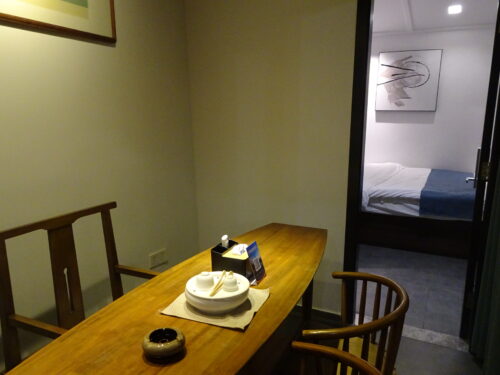
The first thing I noticed when I opened the door to my room was the ceramic gongfu cha set. It sat ready on a dedicated tea table in an antechamber to the bedroom, arm’s reach from the kettle. I was delighted, of course, because I was in Chaozhou for tea. This was yet another affirmation that I had come to the right place.
However, despite a trip to the Phoenix Mountains to witness Dan Cong (单枞) oolong production, explore the tea museum there, and visit a major teapot studio and gallery, it was the streets that gave me an authentic taste of the tea culture of Chaozhou.
I stayed in a traditional house in the ancient Paifang district. Cars are banned here, and two-wheeled vehicles rule the lanes. One morning, our group of eight meandered towards the Kaiyuan Temple, poking our heads into the ajar gates of surrounding houses, some of which had been converted into shops. Even if the shop had nothing to do with tea, there was a tea table in a prime position, a gaiwan warm from the shopkeeper’s earlier brew.
During this exploration, we happened upon the compound of the Chaozhou Opera. Though there were no rehearsals that day, a handful of singers were having tea. One of our group members, who had trained in opera, sang Puccini’s “O Mio Babbino Caro” in the courtyard, which prompted immediate invitations to the tea table. A handful of leaves from a large foil sack landed in the gaiwan as the singers engaged the sound system to showcase both the home and visitors’ talents. We were then treated to a Chaozhou opera song as we sipped Dan Cong, brewed strong as the locals preferred.
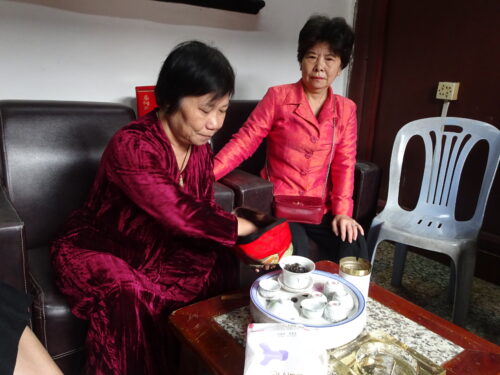
A few doors down, a woman invited us to tea in the front room of her family home and gestured that we should take a look around. Rooms in the classic style surrounded three courtyards, and everywhere you could pause, there was a table on which sat a kettle and a gongfu cha set, as if tea could happen anywhere in the house, at any time.<p>By the time we reached the temple, we had spent more than two hours travelling less than one kilometer, thanks to the tea crawl. And if I had not experienced it myself, seen all those tea sets in all those houses and businesses with my own eyes, I might not have truly understood how ingrained tea-drinking was in the local culture.
Gongfu Cha Beyond Chaozhou
The standard Chaozhou method of gongfu cha features a porcelain or ceramic gaiwan and cups atop a ceramic tray with a deep catchment. Rinse the gaiwan and cups in hot water. Add a handful of tea to the gaiwan and flash steep, pouring the liquor quickly and evenly into the cups. The catchment will catch any accidental drips. After you drink, return the cups to the tray. Before every infusion, you douse the cups in hot water again.It is this rhythm of brewing, serving, and drinking that fosters a connection between everyone at the tea table, says Zoey Lee, who serves people from all over China and the world at Liushun Teahouse (六順茶館), located by Chaozhou’s West Lake. Most of these guests come from areas where the daily habit is to drink green tea from large glasses.
“The first time, they were very curious why we only use very small cups. If you just serve one big glass of green tea, you cannot connect easily. You feel separate. When you are brewing tea, when you are serving tea, and then when you are washing the teacup, every step connects people more, ” she says.
During the COVID-19 pandemic, people were stuck in their homes and took an interest in gongfu brewing. “Social media made it easier for people to get to know the lifestyles of different regions”, says Lee. “They found that Chaozhou tea brewing is quite different from the other tea brewing methods. It let them calm down, like meditation. More and more people slowed down and had time to enjoy a cup of tea – a real cup of tea, not just for a beverage, not just for thirst.”
The method works in tandem with the region’s specialty, Dan Cong oolong, which benefits from a journey of many steeps. Local drinking habits have not changed much over the years. However, the quality of tea the average family can afford has improved. “The economy is better than a few decades ago,” says Lee. “But they were always drinking tea because it is a lifestyle, no matter the tea quality. In every family house, the tea table is like the center of the house.”
While most families prefer a simple gaiwan, richer ones invest in specialty teapots and other fancy teaware, both for collection and daily use. “The [production] trend now is for high floral fragrance, and a teapot is not as good as a gaiwan, but for more roasted, traditional styles, the teapot is more suitable,” Lee explains. “ The vintage teapot is thicker, not as thin as nowadays. You can see the trend from this side – you can know that the tea processing is different, it is changing.”
Another trend that has made Chaozhou famous is as the birthplace of the provocatively named Ya Shi Xiang (duck shit fragrance) oolong. Curiosity piqued, younger tea drinkers in particular seek out the bubble tea or lemon tea version. And some make it to the oolong on its own. “We only have the pure tea, and customers are often very sad. But I will let them try the tea first,” says Lee. “Most think that pure tea is bitter, but after they drink it, they can accept it. They are still getting an experience even if it’s not the one that they want.”
Chaozhou Heritage
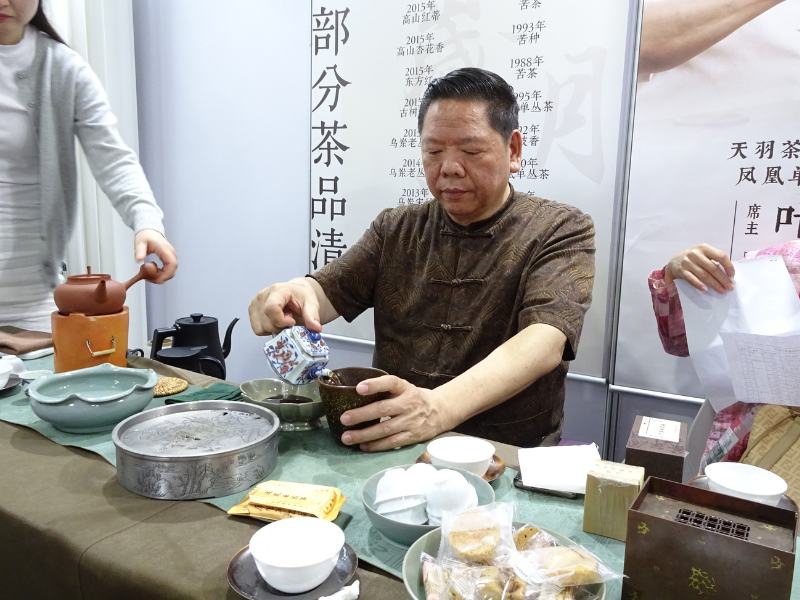
A few days later, at the Guangzhou Tea Expo, I sit at the tea table of Ye Hanzhong (叶汉钟), an Inheritor of Chaozhou Gongfu Tea Art. This Chinese title recognizes cultural ambassadors and mentors who pass on intangible practices – in this case, the Chaozhou brewing method. Ye’s business, Tianyu Tea Store (天羽茶倉), sells in-season Chaozhou tea, but his specialty is aged oolongs. Once upon a time, when a state-owned tea facility shut down, his family bought some leftover stock. Today, what was a standard Dan Cong from 1982 retails for a few hundred Renminbi for a five-gram packet.
My first impression of Ye is of a serious man with thick ‘prosperity’ earlobes. I have spent a sizeable sum on a sought-after seat. Ye is using a square Ming Dynasty teapot for the occasion. For the first infusion of each tea, Ye leaves the teapot lid off and pours water through the spout to ‘let the impurities out’ via evaporation. I am not sure if science backs this, but I cannot argue with someone who has decades of experience.
Initially, we treat the first few infusions with reverence and quiet appreciation. We soon realize that Ye is much more playful than his initial demeanor implies. For starters, he casually hands the teapot around for us to view the tea leaves, as if it were not a precious antique. Later, he shows us a video of a Tibetan meadow. It shows the footage of a serene vista panning down to a cow pat where he has planted an iris.
The conversation is in Mandarin, so I catch little, but the mood is jovial. Instead, I focus on taking tasting notes, though they become increasingly enigmatic the more I drink. “Running through the forest intoxicated” is how I described the second infusion of a 1997 Wu Dong Shui Xian. On the sixth, I wrote “nap in a bower”. It is an intriguing coda to a weeklong exploration of Chaozhou tea that teaches me the more I learn, the more I find out how much there is still to learn.
Isn’t that true of all tea culture?
See Related
Pioneering Organic Tea in the Phoenix Mountains | Adeline Teoh
Pear-Shaped Pottery: Teapot Maker Carries Chaozhou Traditions into a New Era | Adeline Teoh