
The Northwest Tea Festival, held each year at Seattle Center’s Exhibition Hall, features tastings, workshops, and lectures. It brings together tea enthusiasts of all skill levels to discover global traditions and modern innovations. Visitors enjoy interactive experiences, meet vendors, and deepen their appreciation for the culture, artistry, and community of tea in a friendly and engaging setting. In this episode, festival coordinator Andrew Goodman previews the activities at this year’s event, scheduled for Sept. 27 and 28. Admission is $25, which includes entry for both days.
Hours: 10 am – 6 pm, Saturday, Sept. 27
10 am – 4 pm, Sunday, Sept. 28
Location: Seattle Center Exhibition Hall
Website: Northwest Tea Festival
Email: info@nwteafestival.com
$25 Two Day PassPurchase Tickets
Program
All programming is free with paid admission. Stage presentations and The Tea Bar require no pre-registration. Each workshop is limited to 20 people and requires pre-registration online. To allow for the maximum participation by all festival attendees, there is a one workshop per person limit. Once a workshop is filled, further registration will be closed. All workshops are full!
Saturday
How to Select Herbal Tea According to Your Ayurvedic Constitution | Presenter(s): Khulan Enkhtaivan
From Leaf to Cup: An Inside Look at Japanese Green Tea Production | Presenter(s): Kyohei Sugimoto
Why Hasn’t Tea Had Its Specialty Boom Like Coffee and Craft Beer? Where is the tea industry headed now? | Presenter(s): Pratik Rijal
Royal Tea: Sharing Award-Winning Organic Teas Since 2018 | Presenter(s): Qing Wood
Experience Dian Cha: A 1100-year-old Chinese Tea Brewing Art | Presenter(s): Fang Zuo, Yuxin Liu
Explore the Tea Culture Around the World in 60 Minutes | Presenter(s): Agnieszka Rapacz
Tea in the Time of Jane Austen | Presenter(s): Roberta Fuhr
All About Tea | Presenter(s): Holly Furen
Weird, Wacky, and Wonderful: Exploring the rare and uncommon teas of China | Presenter(s): Neldon Hamblin
Experience Sri Lanka’s Revolutionary Specialty Teas | Presenter(s): Diana Jendoubi
Teaware, an Overview – Casual, Sophisticated, Functional, and Flashy | Presenter(s): Jonathan Steele
I encourage anyone to visit the festival this year, whether they come every year, or have never even heard that there was a tea festival in Seattle before now. People of any level of interest or experience will have a great time. In addition to offering opportunities to learn about and taste great teas, the festival provides a fun social event where people can spend time with other tea lovers. – Virginia Wright
Sunday
Discover teas from the Down Under-New Zealand | Presenter(s): Agnieszka Rapacz
Chinese Oolong Tea: the major regions and varieties | Presenter(s): Fang Zuo, Yuxin Liu
The Why of Teapot Shapes and Forms | Presenter(s): Mark Mohler
Unlocking Tea’s Full Potential: Ritual, Science, and Renewal | Presenter(s): Kiyomi Koike
Ethnic Traditions, Terroir, and Trade: Understanding the Forces Shaping Northern Việt Nam’s Specialty Tea Landscape | Presenter(s): Anna Ye
Experience the Wu-Wo Tea Ceremony | Presenter(s): Dewey Meyer
The Economics of Tea | Presenter(s): Elyse Petersen
Discovering the Health Benefits of White, Dark, and Oolong Teas | Presenter(s): Jennifer Nowicki
[expander_maker id=”1″ more=”Click to read more from show organizers Andrew Goodman and Virginia Wright” less=”Show Less”]
 Continued…
 Continued…
Listen to the interview.
Festival Coordinator Andrew Goodman is the founder and principal of the Happy Tea Man, a Bellevue, Washington-based tea education and consulting brand. As a tea educator, consultant, and photographer, he specializes in creating immersive, visually engaging tea experiences. Andrew is a dedicated volunteer and organizer of the Northwest Tea Festival, helping to shape one of the region’s most celebrated tea events. A lifelong tea lover, he attended the inaugural edition of the Northwest Tea Festival and has been involved ever since, having graduated from the City University of New York, Hunter College, and retired after a career in beverage sales and marketing.
As a writer for the tea blog Gongful Girl, Virginia “Cinnabar” Wright has been researching and writing about tea since 2006. Her interest in tea and tea culture ranges from the craftsmanship of antique bronze samovars to brewing techniques for Japanese Gyokuro to growing methods for the tea used to produce Turkish Çay, with a focus on the specificity of each culture’s traditions. She was owner of Phoenix Tea, a retail tea shop in Burien from 2011-2022. Cinnabar is also interested in forging new traditions, infusing contemporary art, ideas, and performance with tea practice and full engagement of the senses.
Dan Bolton: Nearly two decades after the founder’s successful start, how do you maintain enthusiasm for the event and reaffirm the festival’s original mission?
Andrew Goodman: I’ve been involved with the tea festival pretty much since its beginning, first as an attendee and then as a volunteer, and then working with different committees, social media, etc, and programming. Our guiding mission is education and bringing people together around tea, learning all the aspects of tea. Where is it grown? How is tea processed? What is the history of that area? How is it different from other areas? It is a tour. It’s a worldwide tour, and it’s a worldwide learning tour. And, you know, we have two audiences, the vendors in the attendees, and I want to keep them both happy and wanting to come back, and the interaction with that special tasting cup, and that moment when you first put that cup to your lips and you get that, ah, that’s right, that’s right. That’s why I love it. You know, tea is constantly changing. The Ti Kuan Yin I drank 30 to 40 years ago is different than the Ti Quan Yin I drink today. Tea is ongoing. It’s growing. Tea always offers something new for your palate. My interest in tea, which has spanned over 50 years, has finally come together. So, everything I do is guided by the principle that we’re bringing people together with tea. We’re making information available to people and whetting their appetite to learn more. So whether it’s our selection of vendors, our selection of people preparing tea at the Tea Bar, everything is about learning about this wonderful thing that we get from the Camellia sinensis plant. It’s 1000s of years old. It has generated tremendous profits. It has generated wars. It has made economies. It’s a big, big deal, and it ends up in a little cup of tea that people love. They love to talk about tea. They love to get together with tea. Well, I build a question-and-answer period into every single presentation, workshop, or Tea Bar, whether I’m brewing or hosting. I want an interaction to happen, because that’s the natural thing with tea. You sit around and talk. It’s a conversational beverage. It’s something that really brings out thoughts and passions that people love to express, and tea is kind of the universal lubricant for that.
Virginia Wright: I have been on the planning committee for the festival for more than ten years, and also experienced the festival as a tea blogger and then as a vendor. Phoenix Tea had a booth there every year. I always enjoyed the coordination and administrative side of preparing for the festival, but experiencing the festival itself that weekend is always a special experience, seeing the culmination of all of that work in the months leading up to it. It’s a special get together for businesses and customers every year, and it has been exciting to see how the festival has grown and evolved over the years.
Dan: Could you tell me a little bit about the location and the activities planned for this year’s event?
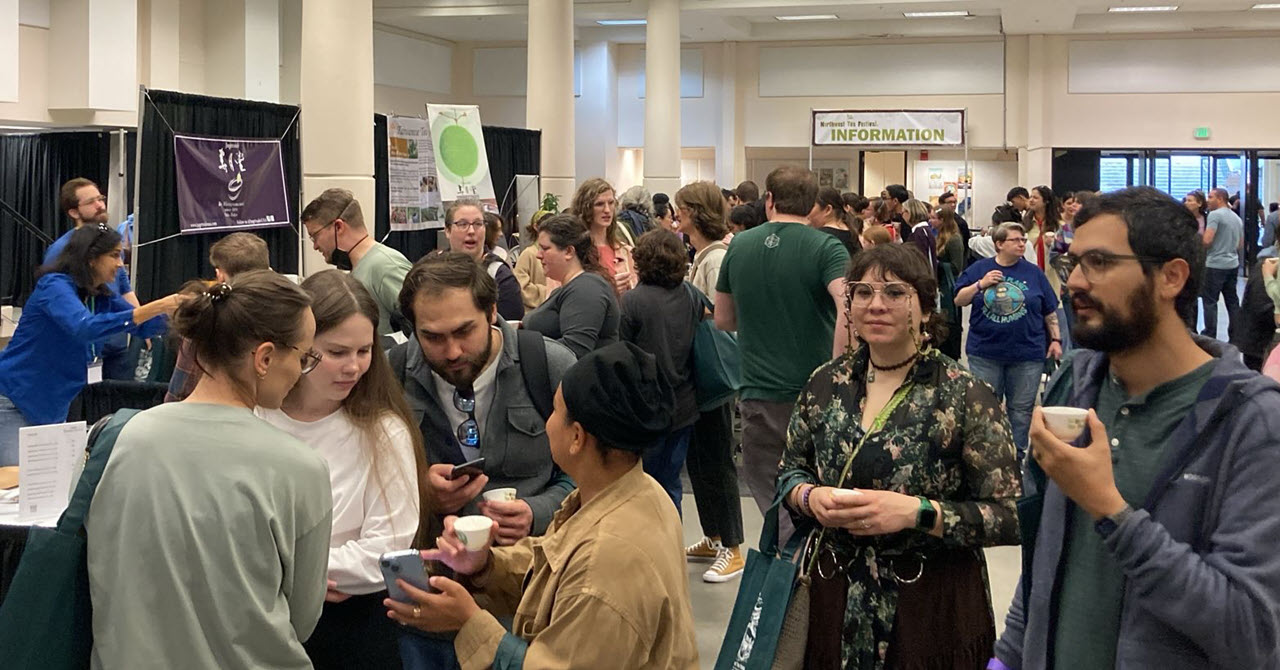
Andrew: Well, we’re at the Seattle Center now. For the 15th year, we have actually outgrown two of the venues, and we’re now in the largest Hall. Seattle Center is kind of a center for the city and for the community, made famous by the World’s Fair, of course. So it’s a vast room, and we’re able to accommodate a lot of tea lovers. We try to keep the flow going very, very well because of the size of the room, and we do limit the number of actual vendors we have, there’s never really a crowd at any one table. And things flow very, very well. Doesn’t matter if you’re in the front of the room, the back of the room, there are people interested in what’s there, tremendous diversity. We’re fortunate that people have been coming for many, many years, some right local here in this greater Pacific Northwest, but others from all over. It’s a reunion. It’s a reunion of friends.
Virginia: We’re bringing the largest number of vendors we can fit into the hall this year, and along with our returning vendors we have a handful of new people. Seattle Center is a good venue for the festival since it is easy to get to and can accommodate the numbers we bring in over the two days of the festival.
Dan: So, who attends these events? Which groups are the most loyal and most likely to show
Andrew: I’m amazed by the people I see every year, year after year. Tea is so universal. We’re connected with some college clubs, and we have people of all ages. It’s a really good mix. I don’t have specific demographics. I think it’s essential we collect them. However, the people who do attend, do so with a passion. They line up ahead of time. They want to get in there right away. They’re very happy to be there. Some of them dress up. We get some people who come in costumes. We have everything from the romantic period to steampunk. So people are really into it. And everybody comes with their own passion. And just as people are very different, the passion for tea is very, very different. They have some favorite booths. We usually get about 60, 70% retention in terms of vendors, maybe a little higher this year. So people know I want to go taste Puer with him. I know they have the best oolongs from Taiwan, and I know I’m going to discover something new. There’s always something new for people.
Virginia: There is a dedicated core of people who attend the festival every year. They keep up with us on social media and sign up for tickets as soon as they are available. Of course there are always new people, but we always see the regulars every year.
Dan: How does this year’s program differ from previous years?
Andrew: Well, for one thing, everything is free. You pay your admission, and you come in; all the presentations, workshops, and T-bar activities are included with admission. I wanted to really emphasize that, and what I try to do is get as diverse a selection as I possibly can to attract people. The Tea Bar will offer the finest teas from the high mountains of Yunnan. But there’s also something called strange and unusual teas you’ve never heard of. We’re going to have fine matcha and we’re going to have someone discussing what are the different grades of ceremonial matcha. But we also have somebody talking about, what will tea and tea look like in 2050 and 2075 and we also have someone talking about tea in the age of Jane Austen, you know. So we’re going to be looking at traditional English style, and we’re going to be looking at, well, what are we going to be drinking? What is the market going to have for us? It’s important that we consider the future, and we must focus on, how are we going to bring people who are casualty drinkers into the tent, and who are those people going to be? There are so many new things happening all the time. Flavor tea. Flavor teas, milk teas, things would I mean, it’s just an extension. Tea has always had things added to it, but it’s crazy. Now what’s going on, but what I like to say is they all have tea as a last name, bubble tea, last name is Tea, Milk Tea, last name is tea. Once you’re in that tent, we want you to see all the opportunities you have to move to the kind of specialty tea that we really focus on.

Virginia: As Andrew said, all of the individual presentations and workshops will be free this year, and one thing to note is that we made it possible to bring more presentations and workshops than we did last year. The lineup is interesting, with a wide variety of topics and experiences for attendees to observe or participate in.
Dan: Andrew, will you tell us a little bit about the special events at this year’s festival?
Andrew: Well, this year, we are partnering with a wonderful movie called Tea, the drink that changed the world, which is right within the comfort zone that I have for educating people about tea. It’s a historical journey. It’s a geographical journey, and it’s accompanied by beautiful footage produced by Christy Way, an experienced filmmaker, and we’re going to be doing a couple of special events around Chinese New Year, inviting people to a special location in Seattle, and we’ll be doing behind-the-scenes about the movie. We’ll be doing brewing of the teas that we see in the movie. We’ll talk about the tea wear and the culture about the movie. We’re also going to be bringing back a program that we used to have, which was a year long program where people would do small tea tastings. This goes back about 10 years. We’re going online. There’s a great community on Zoom and other platforms like that, which meet with some regularity to discuss tea, and the plan is to make this into an ongoing educational endeavor. People from all over the world have shown an interest, including those from England, China, and other parts of Europe, as well as the United States. And what we want to bring. Learning is a monthly visit to some expert in some area of Camellia sinensis tea, growing, processing, and spreading the word. So we want to have a year-long connection, not just the festival. We want to have a year-long opportunity, and we’re working on that. When the festival ends, a lot of that energy will go toward that. Have a couple of people that maybe we’ll kick it off with. Stay tuned for more words. I’ll tell you something. I’m going to partner with our local tea festivals. I’m in contact with Portland, I’m in contact with uh, Chicago, I’m in contact with San Francisco, and maybe there’ll be some synergy here where we can work together to bring this new educational opportunity to as many people as we can reach
Dan: I’m excited about that. You know, they just started a new festival called the Northeast Tea Festival in Boston, and I was privileged to be part of the Paris Tea Festival four weeks ago in Paris. And when Prague held its tea festival, the lines went around the block. It took half the day to get everybody into the hall to enjoy the festivities. So it’s a very good thing for tea to see folks get together and sample new styles of tea and meet the people who are involved in making the tea and marketing tea. Could you tell me a little more about the Tea Bar?

Andrew: Well, the Tea Bar a special area at the tea festival for informal 15 to one hour sessions where people can get off their feet and sit for a very focused tasting the Tea Bar was created by the wonderful wacko tea Association. Laurie and Charles Dawson pioneered it, and we have some passionate individuals who will be hosting. We also have a very special event, called the Tea Pet Party. People are invited to bring their own tea pet, you know, little clay figurines that we like to put on our tea table and bathe with tea. Well, the tea pet party invites people to bring their own tea pets, or we will bring our own tea pets there too. People will talk about tea, talk about all the accouterments, all the beautiful things that go on a tea table, and how a tea pet can become very important.
We put out the word to people from the festival, those I knew, and asked if they would like to do a 45-minute hosting session. And we got a pretty good selection of people, young and old, and I invited them to bring whatever tea they wanted to discuss, or I would be happy to make the IT world aware of my teas available for them. So the diversity there is pretty strong. You know, we encourage people to talk about what they’re passionate about. I didn’t assign you do this. You do that. You do that. If you have an interest and a passion, that’s what I want to give you a place to discuss and explore it with others.
Virginia: The Tea Bar is a big hit with attendees every year. The hosts will keep all the tables busy with tastings throughout the day, both days, featuring a variety of high-quality teas to experience. Unlike the tastings at vendor booths, guests at the Tea Bar will sit down and spend more time in a focused tasting, with hosts providing them with a lot of good information about the teas.
Dan: Is there anything I’ve missed that you’d like to emphasize?
Andrew: Yes, I want to extend an invitation to volunteer. It’s always been a volunteer organization. Right now, we have 12 people who are year-long volunteers, each with a specialty in ticketing, graphic art, facilities, you name it, and each of those people has been working for a while in that specific area. That’s part of the tea festival. That’s how we get the 100 to 120 people who come to the festival for two days to give their time to help with everything from ticket sales to vendors. Those volunteers are very important, and we encourage you, if you wish, to jump on our website; it’s a straightforward process. If you do a shift of six hours, you get admission. You. Get a cup, you get a bag, you get all kinds of goodies. And we have some student clubs, we have some schools, and we have a lot of regular people who come back all the time to volunteer.
What I’m saying is, without volunteers, this wouldn’t happen. So we are grateful to them forever.
Sharing is Caring: Please forward this post to a friend in tea.