


Japanese tea ceremony masters transform tea making and serving into an art. Japanese tea schools, or sects, use various procedures, teas, and environments for their ceremonies. One constant, however, is that of combining delicious tea with tranquility. Tea ceremonies became significant in Japanese culture over a thousand years ago. Today, many practitioners are adapting the ancient ceremony to reflect social changes. A contemporary branch of the ceremony, the table-style ceremony, retains significant traditional elements.
A modern setting for traditional values
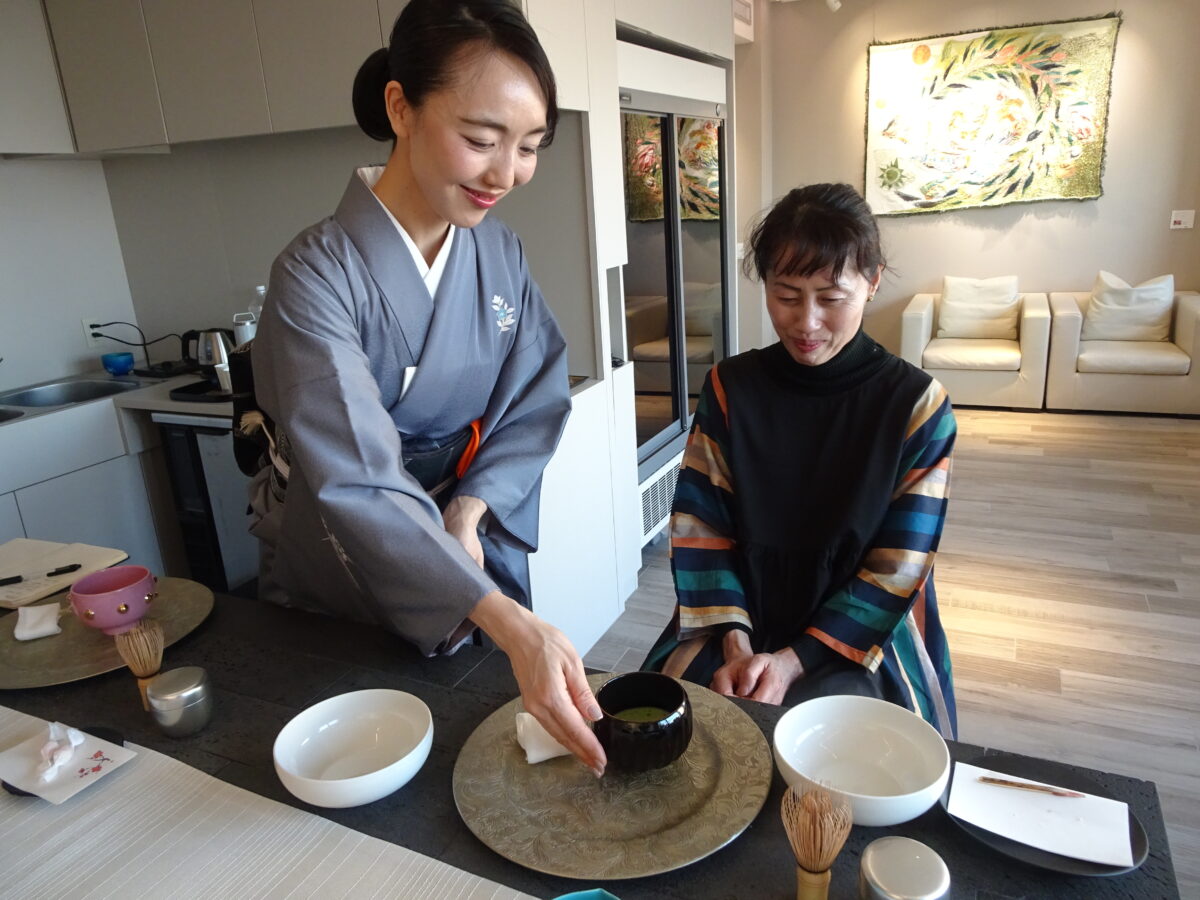
A wooden or bamboo structure in a rustic, natural setting is the iconic setting for tea ceremonies. But I met tea master Yoko Hoshino on the 31st floor of a luxurious Tokyo hotel. Wearing a silk kimono, she led my wife and me into a modern-art decorated room. We sat on fashionable chairs at a chic table instead of kneeling on the floor. She used a hi-tech German kettle instead of a charcoal kettle to heat the water. Nonetheless, she expressed centuries-old values as she served and introduced the way of tea.
Sadō
Smiling widely, Hoshino-san spoke about the values represented during a tea ceremony. Every movement and moment during the tea ceremony has a reason. These are all part of Sadō, which, in English, means “the way of tea.” It is not just a tea-drinking ceremony, she explained. It carries lessons for daily life. Sadō is a mindful practice associated with Zen Buddhism.
Sadō or chanoyu
Tea enthusiasts, even tea professionals, sometimes use the words chanoyu and sadō interchangeably. Hoshino-san clarifies “chanoyu leans toward the act of hospitality” – sharing tea, creating a moment, developing relationships. “It is relational and experiential. Sadō, however, feels like something that gradually shapes one’s being. It is not only an art to be practiced, but a path to be lived. Over time, it refines one’s posture, one’s breath, one’s awareness – quietly influencing how one stands in the world.” Texts on Japanese tea culture often describe sadō as a moral path.
Wa-kei-sei-jaku
Whether traditional or contemporary, authentic Japanese tea ceremonies are based on the principles of wa-kei-sei-jaku. Wa means harmony. Kei means respect. Sei stands for purity. Jaku denotes tranquility. Japan’s renowned tea master Sen Rikyu (1522-1591) taught these principles. Hoshino-san instills wa-kei-sei-jaku throughout her ceremonies. For instance, she expresses harmony by choosing flowers that match each season. Harmony is also the result of peaceful interactions between the tea host and guests. In a tea ceremony, all participants are treated equally. This shows respect. The host’s intention to create an uncluttered, simply peaceful environment and keep tea utensils clean shows purity. Purity of mind is also found when one focuses all five senses on the tea ceremony. A calm, refreshing tea ceremony promotes tranquility. Tranquility arises when harmony, respect, and purity exist.
Otemae
Otemae is another essential Japanese word to understand regarding Japanese tea culture. Hoshino-san explained that otemae means “the art and performance of preparing and presenting matcha” in the tea ceremony. Hoshino-san’s hand and arm movements were as graceful as those of a ballerina. Her otemae represented wa-kei-sei-jaku.
The tea ceremony and its sweets
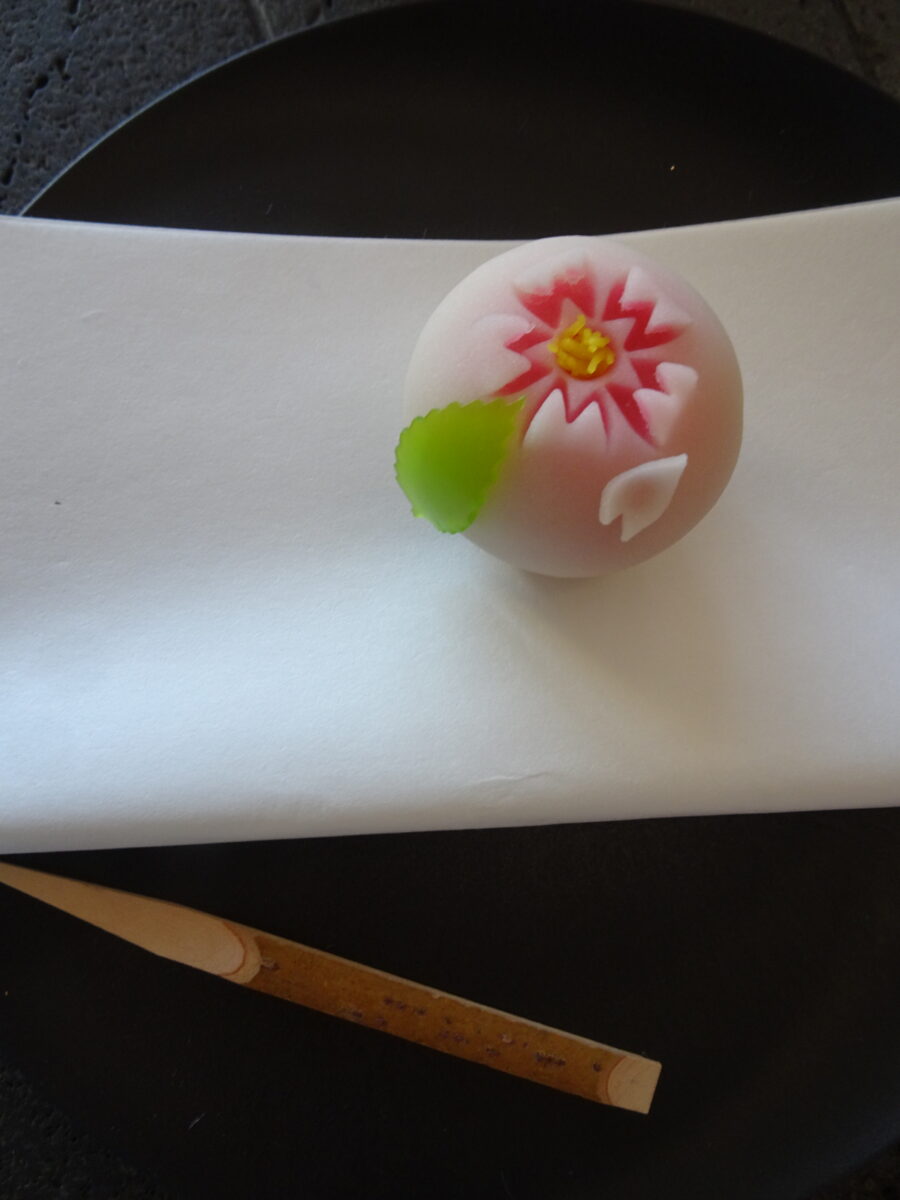
Before we drank tea, Hoshino-san served sweets so intricately crafted that eating them felt wrong. They were shaped like colorful camellia flowers, including delicate stamen. Nearly all tea ceremonies include Japanese confectionery, called wagashi. Our individually crafted confections contained sweetened white bean jam, Chinese yams, and glutinous rice flour. The savory, umami flavors pair exquisitely with green tea. The sweets represent elements of Japanese culture, including wa-kei-sei-jaku. She chooses ones that harmonize with the seasons. The camellia-flower-shaped wagashi represents the change from winter to spring. Hoshino-san shows respect for guests by considering and choosing flavors and shapes that might please them. Purity is expressed through the immaculate white serving paper. Tranquility comes when participants apply all five senses mindfully to experiencing wagashi and tea together.
Why table-style tea ceremonies?
Cultures and their ceremonies are never static. A variety of formal and informal tea gatherings and tea schools already exist. Table-style tea ceremonies are a recent development with a history of less than twenty years. Japan’s population is rapidly ageing. Many older Japanese folks and non-native Japanese people cannot comfortably kneel for long. This new style allows more people to understand Japanese culture, especially sadō.
My impressions of the table-style tea ceremony
As a tea lover in my mid-sixties with knee issues, I appreciated sitting at a table. Numb toes and stiff knees weren’t distractions. My concentration and awareness deepened. Over three decades in Japan, I have attended numerous tea ceremonies. This was one of the best. The comfort factor played a part. Another reason was the tea master’s character. Most of the time, she smiled widely, effusing her passion for otemae and sadō. Her explanations of the way of tea were clear and enthusiastic. Her heartwarming sincerity was palpable. Engrossed in the ceremony, my senses felt heightened. The wagashi and matcha flavors flooded my mouth. My eyes were engrossed by the ballet-like movements of her hands preparing tea. The barely audible waterfall-like sound of bamboo whisk tines stirring matcha is a special memory. As was the warmth of the tea bowl and the aroma of fresh matcha.
Where to find table-style tea ceremonies in Japan
My experience with tea master Yoko Hoshino was at Park Hotel Tokyo. The Shiba Park Hotel also offers them. A search of the internet will help you find similar-style tea ceremonies across Japan.
See Related
Mexican Couple Shares Their Love of Japanese Tea Culture | Greg Goodmacher


2 Comments
Leave a Comment
You must be logged in to post a comment.
Beautifully written and informative.
Hello Bernard, Thank you for your kind words about the story. I appreciate your response.