


Ancient Text Leads to the Discovery of Long-Lost Tea Cultivar
In the winter of 1980, the People’s Government of Chong’an County (崇安縣) was still engaged in the ongoing work of collecting famous tea varietals. One day, “Meizai” (妹仔), the worker responsible for guarding the mother trees of Dahongpao (大红袍), told the team about an extremely precious tea tree. He wasn’t sure if it still existed, but insisted they try to find it.
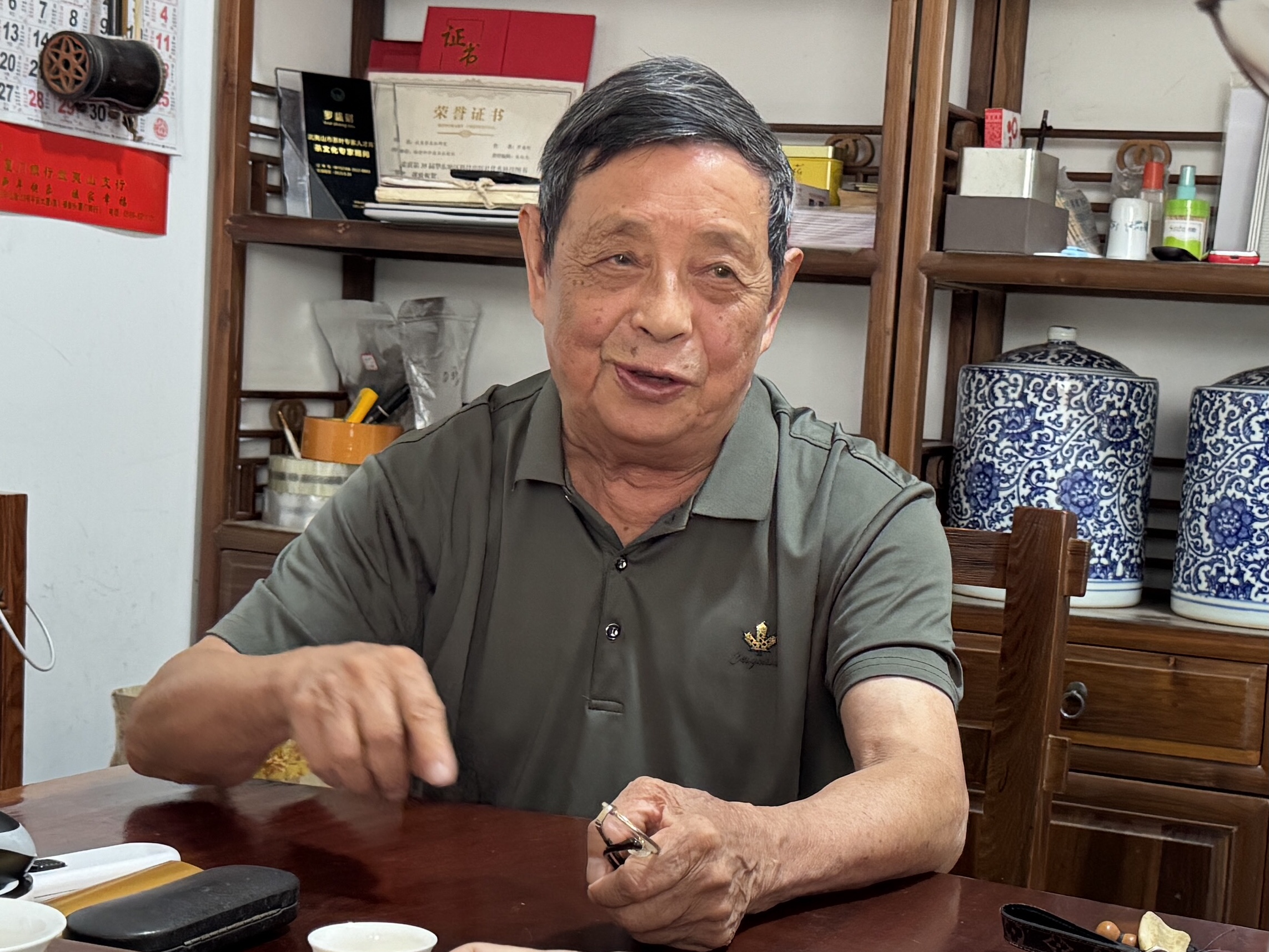
Mr. Luo Sheng Cai 羅盛財eagerly asked about the tree’s location and characteristics, prompting Meizai to share a story from his past.
Meizai’s master was a monk at Tianxin Yongle Temple (天心永乐禅寺), a man who deeply loved tea. The temple housed many tea trees, and in his youth, the master learned planting and tea processing from his own teacher, an old monk, and thus inherited genuine skills. When the old monk grew old, the affairs of the temple tea were entrusted to Meizai’s master, and Meizai became his assistant. One day in May 1949, the master secretly dug up a tea tree from Jiulongke (九龙窠) by its roots and transplanted it to a high, concealed rocky niche for protection, telling no one.
On his deathbed, the master entrusted this tea tree to Meizai’s care, urging him to protect it. Sadly, Meizai only managed it for just over three years. Due to subsequent land reforms and collectivization, he hadn’t been able to tend to it for many years. This tea was of exceptional quality, historically used by the temple’s abbot specifically for Buddhist offerings and important receptions.
Hearing about such a fine, famous varietal, everyone was thrilled and immediately decided to search for it.
A Few Days Later

A few days later, during a farm production inspection, Comrade Liu Huixiang (刘惠祥) from the team took a worker from the Guilin Tea Factory into the mountains to search. Following Meizai’s directions, they climbed high, scouring the area repeatedly from top to bottom, left to right. After over half a day with no sign of the tree, fatigue turned to disappointment. They suspected the varietal might have died from long-term neglect. When reporting the inspection findings, Liu Huixiang mentioned this unsuccessful search to Mr. Luo.
Identifying the Tea
Mr. Luo immediately speculated, based on the timing, location, and secrecy, that this mysteriously relocated tree was no ordinary tea. Could it be a legendary Dahongpao mother tree? This was significant; they had to get to the bottom of it. Subsequently, they approached Meizai together for more detailed information about the planting spot and features. Meizai told them five stones were arranged along the lower edge of the original planting site. This was a major clue. With this specific marker, their confidence soared. They discussed methods, eager to head into the mountains immediately to find the mysterious bush.
Finally, a free Sunday arrived (the farm’s enterprise management was usually busy). They had planned the previous day to set out early. Their party of four – Comrade Liu, Mr. Luo, and two other farm workers – brought hoes and brush knives to the hillside Meizai indicated. It was a steep, high, overgrown slope nestled between two cliffs northwest of Jiulongke, about 200 meters from the platform of the Dahongpao mother trees. Covered in thorny brambles (Rosa laevigata), scrub, and reeds, it showed no signs of cultivation. Standing there, one risked slipping with any misstep. Fortunately, prepared with tools, they managed the climb relatively easily.
They decided to divide the roughly 330-square-meter slope into sections for a thorough clearing. If the varietal still lived, they were determined to find it that day! After over two hours of cutting and clearing, still no tea bush was found. The upper, lower, and side areas were cleared, their hands bloodied by thorns. Only the central section remained. They continued working there.
Drawing on the Experience
Mr. Luo paused, carefully observing the slope, recalling Meizai’s hints, and guessed that the central part was likely the spot. Drawing on past experience finding old famous varietals, he selected a spot, pushed through the brush, and carefully identified plants while clearing. Under a large bramble, he spotted half of a stone protruding and felt a surge of excitement. Digging beside it with his hoe, he hit another stone. Digging further revealed a third. He immediately called Liu and the others over. Working together – digging, cutting, clearing – they uncovered five stones lined up in a row, clearly placed to retain soil. This had to be the planting site!
But where was the tea tree? They scoured every plant on the less-than-4-square-meter patch above the stones, finding no tea. Had the varietal truly died? Even without the tree, there should be traces. They voiced their thoughts, searching incessantly. Mr. Luo focused his gaze on the ground-level thicket. There, amidst the thorny branches, he spotted leaves resembling tea. Careful examination confirmed it – it was tea, hidden within the brambles! After years of neglect, the rampant thorns had overwhelmed the tea tree’s space.
Discovering the Dahongpao
The tea bush had exceptionally thin, soft leaves. Only one slender branch bore four leaves, their shape somewhat resembling Shui Xian tea. Elated to finally see the sought-after bush, they carefully dug it up, making the hole wide and deep to minimize root damage. After removing the surrounding brambles, the entire plant was revealed – connected to the frail branches was a rootstock roughly the size of an egg! Witnessing this, Mr. Luo was immensely moved. Unthinkingly, he echoed Mr. Guo Moruo’s exclamation upon seeing the Boat Coffins at Nine Bend Stream in 1962, calling out: “The famous varietal truly exists! Regret only that we meet so late!”

They carefully transplanted the uprooted tea bush to a slope near the Jiulong Jian (九龙涧), directly opposite the Dahongpao mother trees. Then dug a large pit, laid chicken manure from the mountain keeper’s coop at the bottom, filled it with fresh soil brought from the mountains, gently planted the bush, watered it thoroughly, and instructed Liu Honggen, the worker who had replaced the ailing Meizai in guarding Dahongpao, to tend to this plant meticulously. They assigned it the code: 「JM056」.
Course Correction
From then on, every time the team visited Jiulongke, they inevitably checked on this varietal’s survival. Winter passed, spring arrived. In 1981, the transplanted old bush sprouted new buds. By summer, new branches and shoots had grown. Come autumn, while not yet lush, the bush had regained its vitality. Seeing the successful transplant filled Mr. Luo with indescribable joy.
However, the more he looked, the less it resembled Dahongpao. It didn’t match any of the four existing types of Dahongpao, nor the legendary descriptions.
By the winter of 1982, the transplanted bush was two years old and beginning to flourish. Several team members went to the varietal plot in Jiulongke to examine it closely: leaves long-elliptical, color dark green, leaf margins slightly wavy, leaf tips slightly bent and drooping, apex obtuse-pointed. Its morphological traits and phenology clearly differed from both the original and the copy types of Dahongpao. Both Mr. Huang DaoQing (黃道清) and Mr. Liu HuiXiang (刘惠祥) confirmed that it was not Dahongpao.
Discovering the Laojunmei
Mr. Luo wondered: What tea, other than Dahongpao, could the master and disciple have valued so deeply? “Solving the bell requires the one who tied it.” Only by asking Meizai again could they hope to understand the past. Meizai was now convalescing at home, no longer guarding Dahongpao. He was overjoyed to hear they had found the bush. Cradling a branch Mr. Luo brought, he examined it repeatedly, as if reuniting with a long-lost relative. Excitedly, he repeatedly affirmed, “Yes, this is it.” He told them his master never called this tea Dahongpao.
Only once or twice, while his master served tea to guests, he overheard him mention that this tea was very ancient, written about in Dream of the Red Mansion《紅樓夢》, named something like “X Jun (军 or 君) Mei (眉 or 枚)”. He hadn’t caught it clearly then and didn’t dare ask. Because Dahongpao was a tribute tea, the temple used another unique, rare, and precious varietal specifically for Buddhist offerings and important receptions.
Hearing this, the team seemed to have a lead. They asked Teacher Zhu from the farm’s middle school for help. Teacher Zhu, an avid literature enthusiast, recalled something upon hearing their vague tea name and promised to check.
 The next day, Teacher Zhu brought Dream of the Red Mansion, opened it to Chapter 41, and told Mr. Luo: the book mentions two teas. One is “Liu’an Tea” (六安茶), which Grandmother Jia (贾母) refuses to drink. The other is “Laojun Mei”. Both the character count and the sound seemed close. Mr. Luo repeated “Laojun Mei” to Meizai. Hearing it, he confirmed definitively: “Yes, that’s it, Laojun Mei.”
From then on, this hard-won famous old varietal, cataloged as [JM056], officially gained the tea name [Laojun Mei] 老君眉 – C. sinensis cv. Laojunmei.
See Related
The Culture of the Sense: Tea and the Sensory Experience | Horacio Bustos
Anytime is Tea Time in Chazhou | Adeline Teoh
Selling Tea in Italy: Forgetting the Noise of the World | John Smagula


One Comment
Leave a Comment
You must be logged in to post a comment.
Fascinating narrative!