


Legend has it that tea began as a fateful accident. In 2737 B.C., Chinese Emperor Shennong was boiling water to drink under a lush Camellia sinensis bush. When a soft breeze carried a leaf from the bush into the Emperor’s pot, the Emperor was intrigued and drank the brew. This rudimentary infusion was the birth of tea and tea tradition.
Since then, tea – “A Gift from the Gods,” has grown deep cultural roots in China. To this day, there is a reverence for tea in Chinese culture. It has remained an artifact of China’s ancient tea tradition. Over time, the development of trade routes such as the Tea Horse Road has induced the gradual globalization of tea, assimilating the beverage into numerous international cultures.
Across the globe, many nations possess a unique tea narrative, many of which largely remain unpublicized. As a tea sommelier and enthusiast, I wish to give a voice and homage to these histories and traditions, while speaking on behalf of my own – the Russian Jews, the Norwegians, and the Irish.
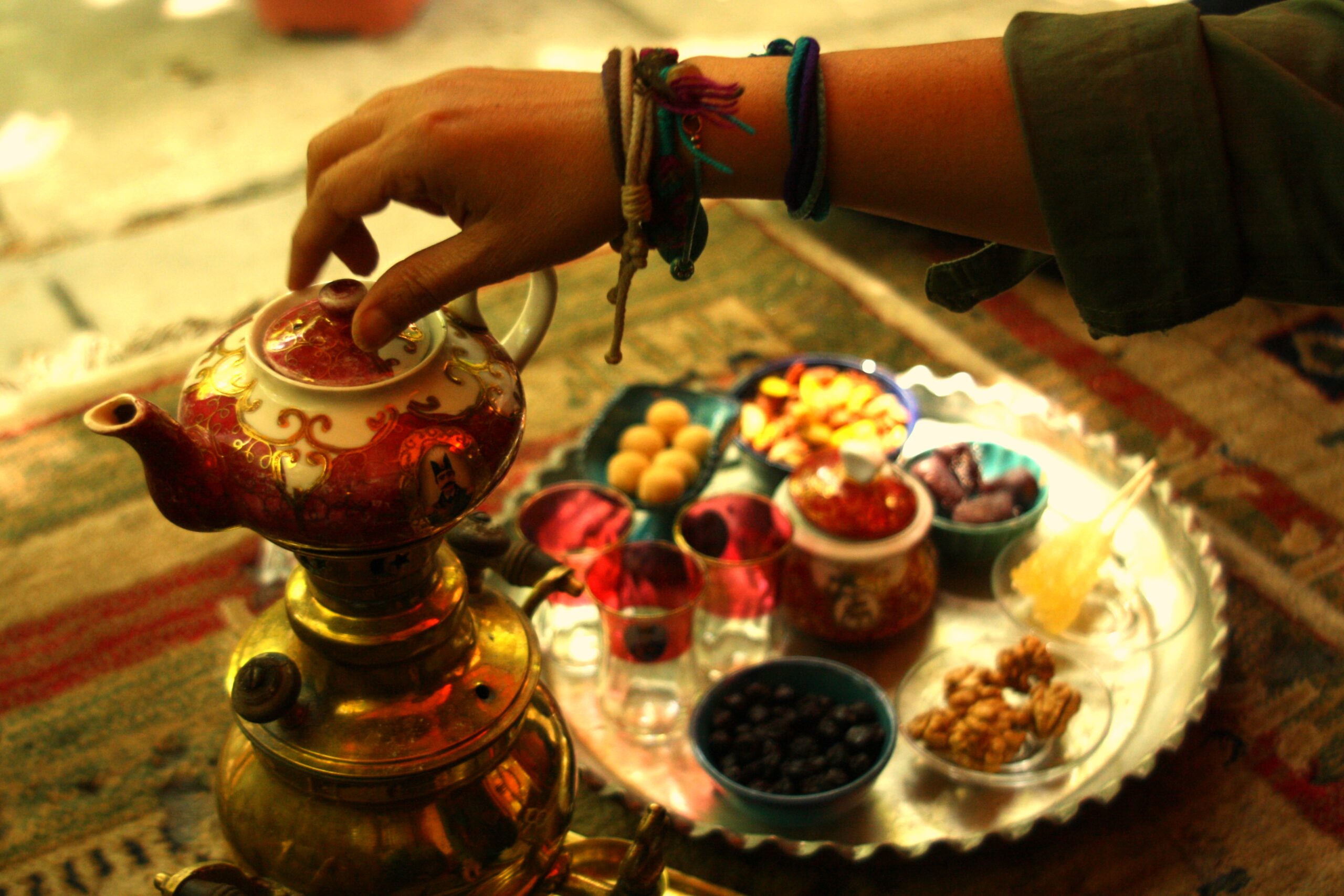
Russia
My paternal relatives were Ashkenazi Jews, originating from Russia. Alongside the changing political landscape in Russia, from Tsardom to the Revolution, the tea tradition had evolved since its introduction in the 1600s. In 1638, the Ruler of Mongolia gifted cakes of tea to Tsar Michal, as the Mongolia-Russia relations solidified. Initially, tea was reserved for the upper class. The Russian Jews were quick to adopt tea into their culture, likely because several prominent Russian tea merchants were Jewish. As stated in the Jewish Chronicle, “Tea is a Jewish drink, traditionally replenished from the samovar in the corner while we discuss a talmudic conundrum. Coffee never resolved anything.”
As tea grew in popularity in Russia, so did undercurrents of antisemitism, and by the early 20th century, my family was forced to emigrate to Canada. Despite the persecution present in Russia, the fire in the Russian spirit did not subside. And atop that fire was the samovar. Samovar, roughly translating to “he cooks”, is an ancient contraption, born in Tula, Russia. The Russian samovar is a metal water heater, often made of brass, and fitted with a spout. While tea brewed atop the samovar for hours on end, ian ntimate conversation was held.
With the establishment of the USSR in 1922, tea was stripped of its bourgeois caste. The production of samovars declined substantially. A renewed use of the podstakanni – a tall tea glass with a metal holder – replaced floral-patterned china. This teaware became the preferred conduit for Zavarka (or Chifir), a brutally strong Russian tea. Because of its high caffeine concentration, many consider prolonged consumption of this tea detrimental to one’s health. Zavarka was so potent that it could induce intoxication, and perhaps speaks to the Russian proverb, “Drink tea, forget your sorrow”.
Norway
Tea arrived in Scandinavia in 1685. Through neighboring maritime ports and British relations, tea was distributed across the parcellations that comprise Scandinavia. In the early years of tea in Norway, my maternal great-grandmother from many generations ago, Sara Abrahamsen, left her family and her Jewish faith to become a Protestant. After learning of Sara’s disownment, Queen Louise Fredrikke of Norway compassionately chose to rear Sara herself. Although family records preserve few details of Sara’s royal upbringing, she belonged to the elite noble circle that enjoyed exclusive access to tea. During the 1700s, the Royal House served tea with summer fruits and sweet cake following dinner. Gradually, tea consumption seeped into broader society, and by the 19th century, tea was an accepted beverage among modest Norwegians.
In the early 21st century, racism towards the followers of Islam immigrating to Norway took root. In 2011, centers against racism proposed an initiative called Tea Time, where newcomers and Norwegians met to share cups of tea. Tea was the tool of choice in the fight against racism because tea bears significance in Islamic culture and universally represents hospitality and gathering. The Tea Time campaign was highly successful, with over 3,000 teas held over the span of two years. King Harald V, Queen Sonja, and Crown Princess Mette-Marit of Norway supported Tea Time, emphasizing the gravity of the racial problem and the project’s significance.
King Harald V stated in reference to the initiative: “It was clear to all that our similarities far outweigh our differences. I think this is often the case, whether our neighbor comes from Hønefoss or from the Himalayas. Our differences do not necessarily have to divide us. Conversing with a neighbour over a cup of coffee or tea can help us to better understand our individuality and appreciate the resources inherent in our diversity”.

Ireland
Var. Assamica tea, originating from India, arrived in Ireland in the 17th century. Irish tea is classified by the temperature of the water, the strength of the brew, the excessive consumption, and the addition of milk. In a classist nation, accessibility to tea was an issue more complex than the popularity of a beverage. People didn’t imbibe tea broadly until the 19th century. This democratization of tea marked a significant shift in Irish society. It became a beverage that transcended class boundaries, a unifier in a land marked by social and economic divides.
In 1845, the fungus, Phytophthora infestans, carried on the wind by spores, devastated the Irish potato crop. In the culmination of the Irish Potato Famine in the 1850s, black tea, alongside bread, became the staple substitute for potatoes. The Irish Potato Famine devastated Ireland, causing a mass exodus, including that of my own family. My great-great-grandfather Moore immigrated to Canada in the early 1900s. He returned to Ireland a few years later to take an Irish bride, before settling in Canada. In 1904, my namesake, Eily Moore, was born. The Moores left Ireland behind to start a new life, but unfortunately, they neglected their tea tradition.
In Ireland, however, the mass consumption of tea had increased. As Ireland recovered from the famine, the nation was left with an extreme dependency on tea, which concerned even the British Empire. Working-class Irishmen were falling ill with vomiting and indigestion, attributed by the British Medical Journal to be due to excessive tea consumption. The Gaelic expression “Marbh le tae marbh gan é”—meaning “dead with tea, dead without it” – describes the centrality of tea and its surrounding tea tradition in Ireland.

Tea of Our People
Through persecution, royalty, and famine, my predecessors immigrated to Canada. Canada is a fusion of cultures, containing many nations encompassed within its identity. As a result, it doesn’t possess its own distinct tea culture. Growing up in Canada distanced me from the history of my Russian, Norwegian, and Irish ancestors. The importance of uncovering the tea history of these nations spans beyond a personal level; it is part of the broader diasporic tea narrative. This is just one account. Tea has survived time, racism, politics, plague, and war, remaining as a piece of humanity within a cup. And its story is important because it is the tea of all our people.
See Related
Could 2026 be the Year Coffee Drinkers Embrace the Tea Leaf | Bhavi Patel
Tea in Brazil: Innovations in Wellness, Flavor, and Culture | John Smagula
The Culture of the Sense: Tea and the Sensory Experience | Horacio Bustos



3 Comments
Leave a Comment
You must be logged in to post a comment.
The article is interesting. I am curious why Zavarka (or Chifir), described as a brutally strong Russian tea, had or has such a high caffeine level.
Hi Greg, thank you for your interest! Zavarka is brewed for a long time, sometimes even all day. Longer brewing time increases both the bitterness and caffeine content, as the brewing process releases caffeine molecules and tannins (compound that gives the bitter taste) into the infusion. Cheers!
This was a beautiful piece of storytelling. I really appreciated how you wove together personal family history with the broader cultural journey of tea across Russia, Norway, and Ireland. It shows how something as simple as a shared drink can carry memory, migration, and identity across generations.