


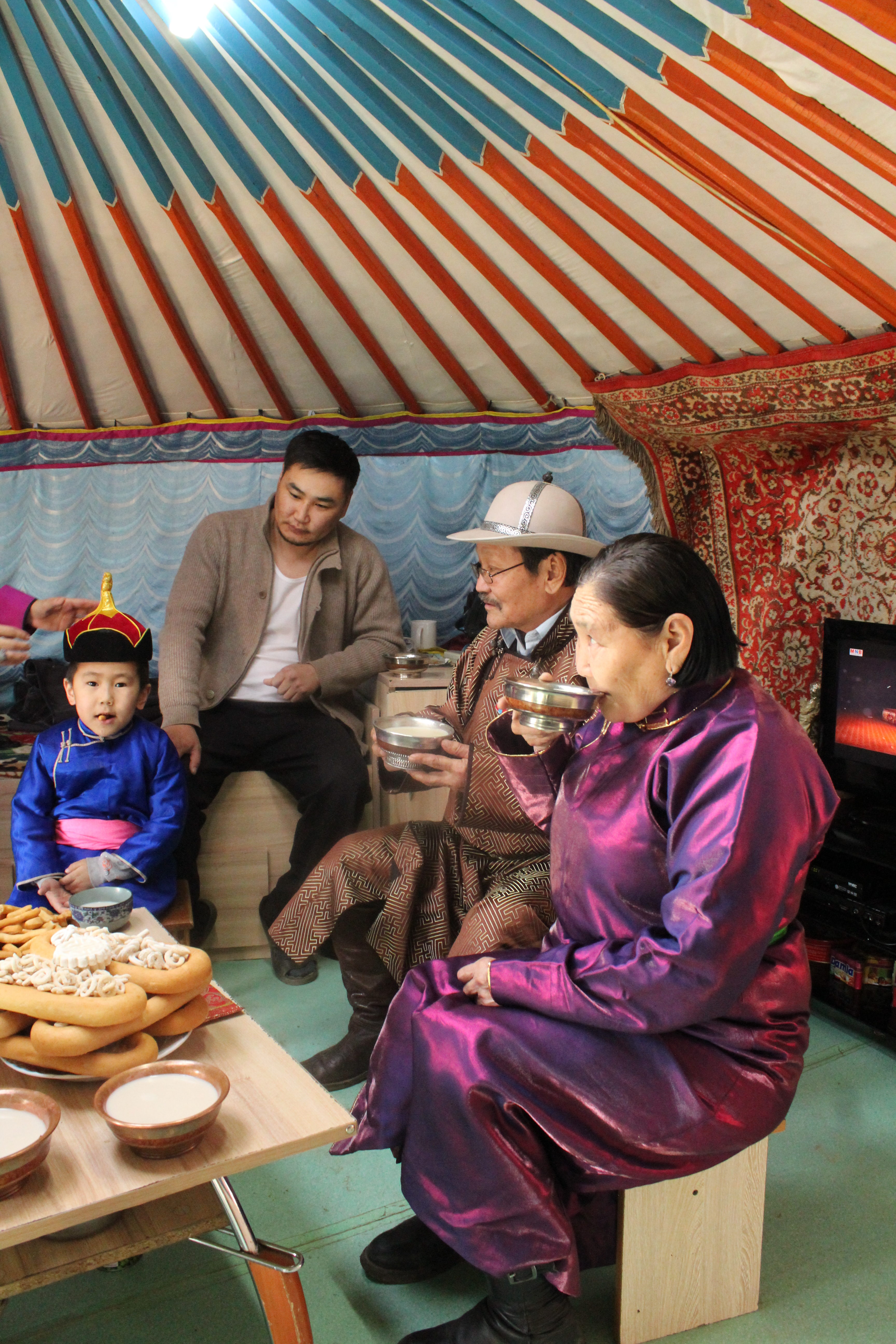
How climate, mobility, and necessity shape Mongolia’s traditional tea—and why it challenges conventional ideas of what tea “should” taste like.
ULAANBAATAR, Mongolia
Most tea drinkers expect clarity and aroma. In Mongolia, tea is something else entirely—nourishment shaped by climate, movement, and survival.
In the cup, that shift is immediate: richness replaces clarity, and salt and fat transform tea from a beverage into something closer to sustenance.
Mongolia is the most sparsely populated country in the world. The nomadic way of life shapes Mongolia more than any other country. Its 1.2 million-square-mile plateau (3.2 million square kilometers) is home to all who roam the vast steppes. Three-fourths of the country is pasture land, with the rest divided between forests and the Gobi Desert. The economy depends largely on animal husbandry. Herders call sheep, goats, cattle, horses, and camels their “five gems.”
Technology is embraced—satellite communications and portable power are widespread. Shepherds today are as likely to ride trail bikes as stout ponies, but the heritage of tea is timeless.
A stimulating hot beverage is critical in the harsh climate, where the average altitude is 5,180 feet above sea level, and temperatures swing from -40°C to +40°C.
Breakfast in Mongolia is drunk, not eaten.
Tea (tsai) is generously blended with Mongolian milk (tsu) and various kinds of butter to withstand extreme cold.
In the cup: the added fat softens bitterness, increases body, and delivers sustained warmth—qualities valued as much for endurance as for taste.
Mongolians rarely drink pure water, preferring instead drinks produced with a mixture of milk from cattle, camels, horses, yaks, goats, and sheep.
Tea does not grow in Mongolia, which has traded with China for centuries and more recently with Russia.
Nomadic herders of the Western mountainous regions prepare a thick, salty tea that can substitute as a light meal, while herders along the Eastern steppe drink a thinner, non-salty tea brewed from loose leaves.
Tea tradition
The day begins with the brewing of milk tea (suutei tsai) before sunrise in the large circular tent known as the ger (yurt). A caldron is placed on the fire, always facing north, the location of every home’s Buddhist shrine. Yellow butter is put into the caldron and, as it melts, tea leaves pried from a compressed brick are added. Some recipes call for green tea, others use black tea leaves. The mixture is then fried. Next, water is added, and a heavy lid is placed on the caldron. The mixture is boiled and well stewed, stirred frequently with a large ladle. Subsequently, small amounts of salt are added to make it tasty, and then a quart or more of cow’s milk is added to reboil. The lid is then closed for a while. As the boiling milk tea starts to spill out, it is ladled well again. The tea and milk soon dissolve into a thick, buttery drink. The technique calls for raising the ladle of boiling milk high before pouring it back into the caldron at least 10 times. Elders say that the more you ladle, the more delicious the tea. Once completed, the milk tea is skimmed or strained to separate the used leaves. The brew is transferred to a large kettle and served all day. Tea remaining in the caldron is sometimes made into a soup called banshtai tsai.
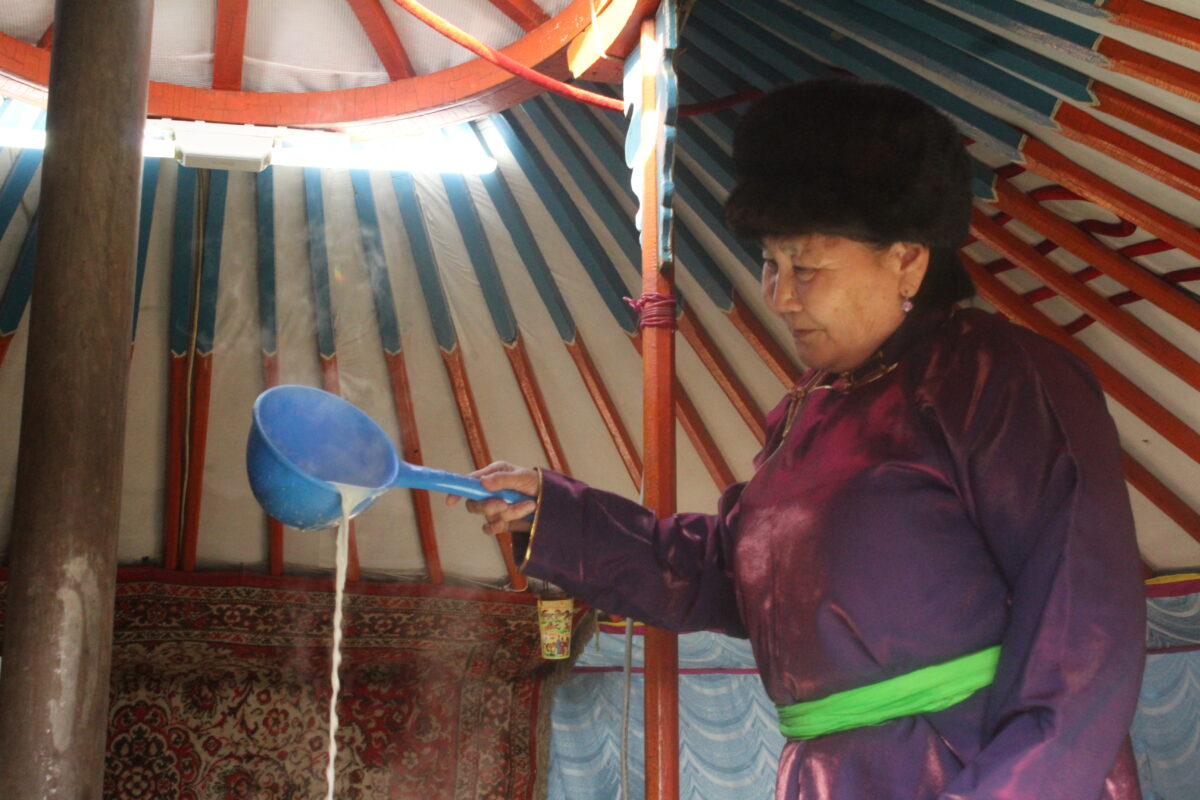
Watch: Preparing Mongolian Milk Tea in the Field
Click here to see how it is done.
Brick tea from Georgia is consumed nationwide; a change in suppliers, forced by the Soviet Union following the Soviet-Japanese War of 1945, was introduced in antiquity. Mongolia was wrested from China’s control by the Soviets, who successfully defended the country against Japanese occupation. A peaceful revolution in 1990 led to the adoption of a new constitution in 1992 and the formation of the first permanent parliament. The “People’s Republic” was dropped from the country’s name after the collapse of the Soviet Union. Presidential elections followed in 1993. The country is now governed by a multi-party system and operates under a market economy.
Pouring tea
Pouring tea is a ritual. Every Mongolian wife takes the first cup of tea from the caldron and goes outside to pour it upward, offering it as a tribute to the sky. Mongolia is known as the “Land of the Eternal Blue Sky” (Mönkh khökh tengeriin oron) because it enjoys more than 250 days of sun every year. A spray of tea is then offered to the mountains and the steppe. Spraying tea is a sign of worship and respect for Mother Earth. Natural environments such as mountains and rivers are widely respected in the country. When Mongolians perform this tradition, a wooden spoon tied with a “khadag” is used. The khadag (khata) is a long ceremonial scarf, usually of silk, used to show their highest appreciation. A blue khadag symbolizes the sky, and white represents milk (and a pure heart and soul). Women must cover their heads, usually wearing a hat for the early-morning ceremony. Returning home, a wife then places a small cup of tea in front of the framed image of Buddha. She offers the tea to her husband and, thereafter, to everyone in sequence from old to young. Tibetan Buddhism dates to the 16th century and is the dominant religion in the country. Most families have a framed picture of Buddha or the Dalai Lama in their homes. In the early 1900s, there were 750 monasteries in Mongolia. At the time, a third of the adult males were monks, but a purge by the Communist regime left only 110.
Visitors are always greeted with tea
The country is famous for its hospitality, especially in the rural areas. In Mongolia, any incomer will be offered tea without being asked whether they like it. It is proof of the locals’ generous attitude. When offered a cup of tea, it is taken with the right hand, the left hand placed under the right elbow. To avoid offense, recipients must drink the tea before placing it on a table. If a visitor is not offered tea, villagers will say that the household has “no tea, no face.” When serving tea, the spout of the kettle (or the mouth of the thermos) must not be directed to the door. Those seated for tea are served clockwise. Milk tea is often served with boortsog (biscuits fried in bouillon fat that remains from cooking meat) or dumplings.
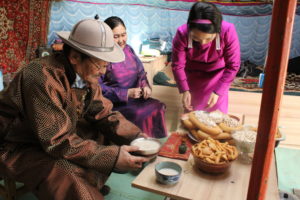
Milk tea is widely used during the Lunar New Year festivities. Each guest receives a cup of tea before every meal. When someone goes for a long trip, his or her family members spray tea or milk on the traveler’s road the minute the trip begins. This is a courtesy that expresses their wishes for the traveler’s safety and well-being.
Whenever a herding family sees a nomadic caravan, they bring the caravan tea and dairy. This is evidence of hospitality and good manners, and enables the travelers to relax for a while. The addition of milk and salt softens bitterness and increases body, turning tea into something closer to a sustaining broth than a beverage. Because milk tea is white, it is considered a symbol of good deeds.
In Mongolia, it is prohibited to waste milk and milk tea. If milk is accidentally poured on the floor, people show regret, touch the milk with their finger, then touch that finger to their forehead. In modern times, urbanites still show respect for milk tea, and if a family member, relative, or close friend gets sick and is hospitalized, they visit the patient, bringing milk tea and a meal.
Mongolians drink tea frequently. So it is common that households brew tea several times a day and keep it in a large thermos containing two to three liters.
Once you see tea used this way, it becomes clear that “flavor” is not the primary goal in every tea culture. In Mongolia, tea is structured around function—warmth, calories, and endurance. The cup reflects that purpose.

Many types of tea
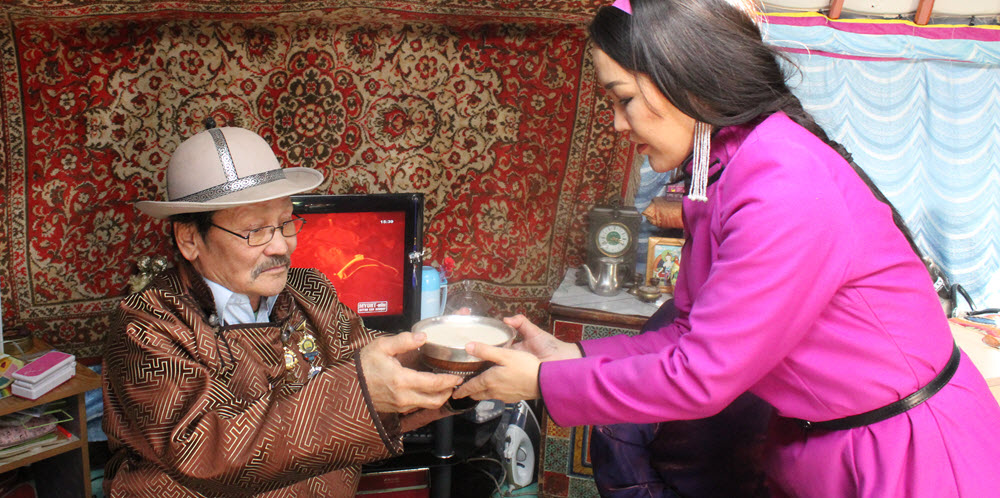
There are two types of tea: milk tea and non-milk tea (brown tea). Mongolians prepare tea in 40 different ways, reflecting the traditions of various ethnic groups and their preferences for herd animals. Whether yak, camel, or even horse milk is used, the recipes are high in calories to prevent herders from freezing during winter or from getting hungry. The most popular tea is made with cow’s milk, but there are at least 15 variations of cow’s milk tea, depending on the ingredients and brewing techniques.
Here are some key ways Mongolians prepare their tea:
“Khiitstei” tea – This variation calls for adding flour while the butter melts in the caldron. The tea is fried and boiled as described above. Some families prepare brown tea separately first and add it to the caldron while butter and flour are being fried. Then milk is added.
Tea with yellow rice – In this recipe, yellow rice is added as the butter melts, then fried.
Tea with white rice – Rice is also used. Some add flour to the rice to thicken the tea.
Tea with dumplings – First, dumplings are prepared. The tea is then brewed without milk. Flour is added to “khiitstei” tea, and the mixture is then brought to a boil. Subsequently, salt and milk are added. After boiling and stirring, dumplings are added, and the mixture is re-boiled. This tea can be a medicine for tiredness.
Tea with “borts” (dried meat) – The recipe begins as “khiitstei,” but two spoons of dried meat are ground and added before frying. Tea without milk is then poured, and the mixture is brought to a boil. Yellow or white rice may be added. Once the rice is ready, milk is added, and the mix is reboiled.
Tea with bone – Marrowbone, whirlbone, and even the head bone of sheep are used. This method is considered medicinal and a key to removing stress. The bones are usually added separately while the milk tea is boiling.
In addition, various ingredients such as barley, salt, nettle, and dill are applied to make milk tea tasty.
Click here to see an authentic Mongol Suutei Tsai Recipe, often paired with Boortsog (deep-Fried dough twists) and Khuushuur (savory meat-filled dumplings). Banzan: Assorted side dishes (pickles, vegetables, etc.), Guriltai Shol: Hearty noodle soup with mutton, Borts: Dried meat strips, Aaruul: Dried milk curd cheese, or Byaslag: Mongolian cheese
Modern tea
Urban households brew milk tea in a kettle on the stove rather than in a cauldron over an open fire. Every local restaurant and canteen serves milk tea as its main drink, typically priced between MNT500 and MNT1000 (about 20 to 40 cents), with higher-end restaurants offering more refined versions.
Today, several firms are adapting traditional milk tea for modern use. Packaged blends—combining tea with milk solids, butter, salt, and grains—allow preparation with only hot water, extending the reach of these traditions beyond the steppe while preserving their functional role.
In 2016, IKH TAIGA began producing a packaged milk tea called “Nuudelchin.” Ingredients include barley, yellow butter, salt, milk, and other plants. This processed tea can be consumed by simply adding hot water to a cup. The company’s CEO, Mrs. Suvd Shagdar, said the tea will help sustain the ceremony and traditions of Mongolian tea for future generations. She is seeking recognition by the United Nations Educational, Scientific, and Cultural Organization (UNESCO) to register the tea as a physical example of Mongolia’s cultural heritage.*
Mongolia’s tea traditions are one expression of a broader truth: tea adapts to the needs of the people who rely on it. In Mongolia, tea is built for endurance—warmth, calories, and resilience. In other regions, those same decisions lead somewhere very different.
Tea takes shape differently in every context. Explore two very different outcomes: Black Sea Georgian Tea by Michael Denner, How climate, history, and post-Soviet recovery shape a very different expression of tea, and Pile Fermentation: The Process Behind Shou Pu’er by Hongkuan Huang, which explains why controlled microbial fermentation transforms raw leaves into deep, earthy, full-bodied tea.
Editor’s Note: Discussions with UNESCO are ongoing regarding the nomination of the Great Tea Route, which connects Mongolia, China, and Russia. Revised, links refreshed April 2026.


2 Comments
Leave a Comment
You must be logged in to post a comment.
Nice piece. I clicked through to the recipes inspired to bring authentic Mongolian food into our kitchen tonight —> just off to fetch my half medium sheep!
Very interesting introduction to a different culture.