

Zhejiang Province, China and Tea Heritage
A young boy raced past – a blue streak circling the courtyard and bounding up the temple stairs in untied shoes, his shouts breaking the quiet outside the Chan Buddhist meditation hall.
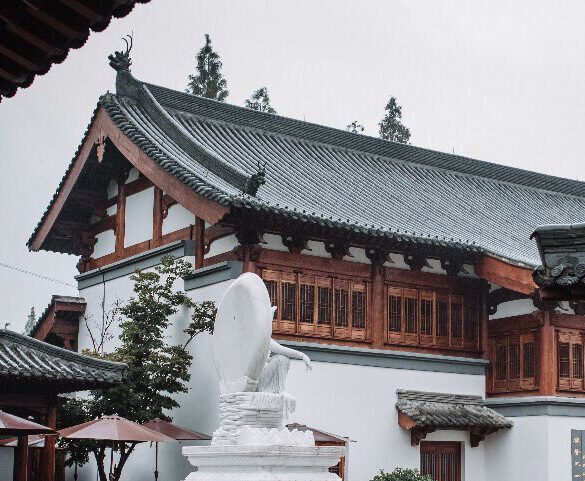
The prayer hall is neither gilded nor imposing like the grand Jingshan Temple complex it serves. Instead, it is a place of stillness—a place where tea has been welcomed for centuries.
The structure standing today is a magnificent reconstruction of a monastery that once contained more than a dozen meditation halls. High in the mountains above Hangzhou in Zhejiang Province, Jingshan sits in mist and pine forest. At the foot of these mountains lies West Lake and the famed tea gardens of Dragon Well (Longjing). In the Song dynasty, the nearby capital city was known as Lin’an.
Tea and Buddhism have shared this mountain for a very long time.
Beginning in 618 AD, the Tang emperors ruled China for nearly three centuries, forty years longer than the United States has existed. During this remarkable era, Lu Yu (733–804 AD), later known as China’s Sage of Tea, visited this monastery. Here, he studied tea under the master Zou Fuzi, absorbing the knowledge that would eventually shape his timeless work, The Classic of Tea.
Lu Yu elevated tea from a regional drink to a refined cultural practice. His memory is still honored every May during the Sage of Tea Festival in nearby Yuhang, where monks reenact the tea banquet that helped shape the culture of tea.
Jingshan represents a milestone in that story. It was here that the Way of Tea (Cha Dao) became intertwined with Chan Buddhism, expressed in a daily ritual known as the tea banquet.
Westerners often imagine monks through a European lens – ascetic figures rejecting worldly pleasures. But the monks of Jingshan had a different relationship with tea.
Afternoon Tea Traditions
Afternoon tea was a daily ceremony.
A drum summoned the monks. The rhythmic beating continued until everyone had taken their place, seated quietly with their favorite pitch-black Jianzhan bowls close at hand.
Fragments of these bowls—along with shards of celadon pitchers once used to heat water—still lie scattered in the soil around the temple grounds. These ceramics belong to one of the most celebrated traditions of the Song dynasty (960–1279).
The monks described the experience of tea in ways that felt both simple and profound.
Sitting quietly through the night, enjoying fine tea, they said, was one of life’s greatest pleasures. Before drinking, the monks listened to readings and recited Buddhist poetry. On clear evenings, they prayed outdoors on the same stone steps where we stood talking, looking out into the misty mountain night.
Morning brought what the monks called a tea feast—simple food accompanied by freshly prepared Mo Cha, a powdered tea whisked into a luminous white foam.
Hundreds of years later, that same preparation would inspire Japanese monks to grind their own tea into powder. They then whisk it into what we now know as matcha.
Just then, the young monk gently intercepted the boy who had raced through the courtyard. He guided the child to sit beside him on the stone steps. He softly shaped the boy’s small hands into a gesture of prayer.
In that quiet moment – mountain mist rising, temple bells faint in the distance – I understood something essential.
This is my vision of peace: people of goodwill gathered across centuries, sharing civility, health, and happiness.
This is the power of tea.