

A bowl of matcha can feel light, foamy, and refreshing. It can also feel dense, glossy, and syrup-like. The
difference often comes down to one choice: usucha or koicha.
Both preparations use the same two ingredients: matcha powder and water. Yet they create very
different drinks. Usucha, often translated as “thin tea,” uses more water relative to matcha. Koicha, or
“thick tea,” uses less water and more powder.
These styles come from chanoyu, the Japanese way of tea (1). Today, usucha also appears in homes,
cafés, and modern matcha routines. Koicha stays closely tied to formal tea settings and high-grade
matcha.
Where the terms come from
The words usucha and koicha are old and literal. Usucha (薄茶) means “thin tea.” Koicha (濃茶) means
“thick tea.” Both terms come from the development of chanoyu, the traditional Japanese art of preparing and serving powdered green tea (1). Tea master Sen no Rikyū (1522–1591) helped normalize this practice in the 16th century (2).
In a traditional tea gathering, or chaji, koicha serves as the central moment. Usucha follows as a lighter, more social close (1). Schools such as Urasenke and Omotesenke still teach both styles today. The two preparations carry different roles.
Preparing thin tea and thick tea
Usucha is the lighter and more common style. A typical bowl uses 1–4 grams of matcha. The water then ranges from 50 to 80 milliliters (3, 4). A bamboo chasen whisks usucha briskly. The motion disperses the powder and pulls in air. That air can form the familiar layer of fine green foam.
Koicha uses much more matcha and much less water. Many recipes call for 4–7 grams of matcha with
30–60 milliliters of water (3,4). The maker kneads or slowly blends the mixture. The goal is not foam; it is a viscous suspension. The chasen folds the powder and water into a dense, glossy suspension. The result is not simply a stronger usucha. It is a different physical system in the bowl.
Why one bowl pools, the other foams
Matcha is not steeped and removed like loose-leaf tea. The whole powdered leaf stays in the bowl.
Reducing water does not only make the drink “stronger.” It concentrates every suspended particle,
dissolved compound, and aroma molecule.
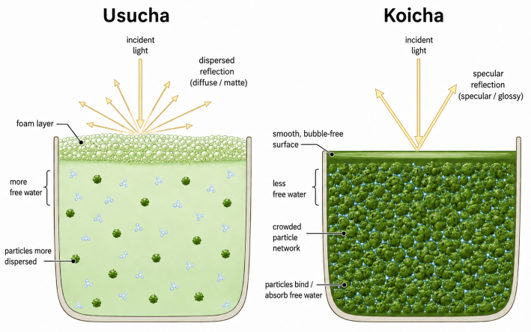
In usucha, water gives the particles room to disperse. The whisk moves quickly. The chasen pulls air into the liquid and breaks it into small bubbles (5). Foam in usucha is not random. It forms within a narrow window of ratio and stabilizer chemistry. Bubbles need surface-active compounds to hold their walls together. Tea contains several. Ni and colleagues studied tea foam in 2024 (5). They found soluble protein and certain amino acids correlated with stronger foam. Some catechins helped stabilize bubbles, while others worked against them.
Too little matcha may not provide enough surface-active material to build stable foam. With a bit more matcha, foam can improve because there are more proteins, amino acids, and other dissolved
compounds available to help stabilize bubble walls. But after a certain point, the system flips. More
powder means more particles competing for the same small amount of water. Some water sits around
the particle surfaces instead of moving freely through the bowl. The mixture becomes thicker and more crowded. The whisk has less free-moving water to work with, so air is harder to draw in and break into fine bubbles. That is the shift from usucha toward koicha.
Differences between the two styles
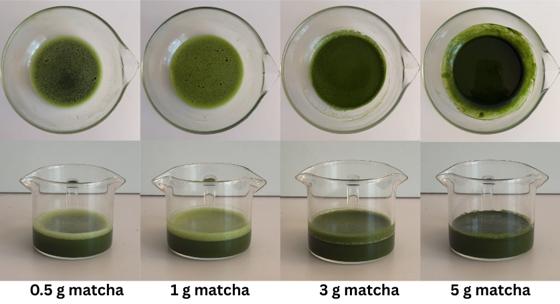
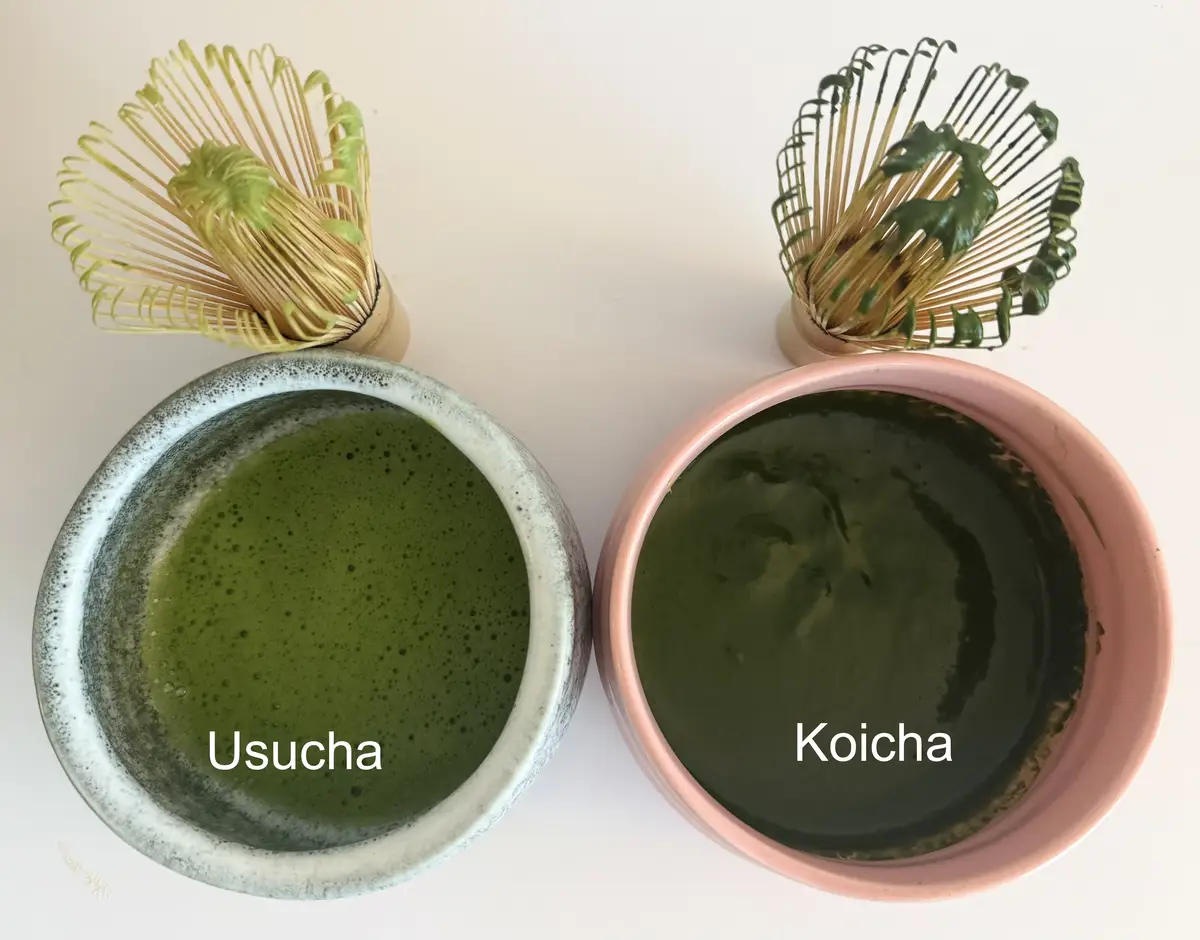
The two bowls also look different. Usucha appears matte and bright green. Its foamy surface is full of curved bubble walls. Each wall scatters light in many directions. The diffuse scatter gives the surface a soft, opaque surface finish. Koicha appears glossy and reflective. With no foam, the surface stays smooth. The dense suspension of pigments and particles catches light more directly. The bowl looks polished, almost lacquered. Koicha also coats the mouth more than usucha. That coating comes from concentration, particle crowding, and viscosity.
Why koicha demands higher-grade matcha
Concentration changes taste. Catechins are the main polyphenols in green tea. They contribute bitterness and astringency. Liu and colleagues studied major green tea catechins using electronic tongue technology (6). They found that bitterness and astringency rose as catechin concentration rose. Ester-type catechins tasted more bitter and astringent than non-ester types. These include EGCG, ECG, and GCG.
The study also reported taste thresholds (6). ECG crossed bitterness at 0.044 mg/mL. EGCG crossed at 0.09 mg/mL. GCG crossed at 0.13 mg/mL. Astringency thresholds ranged from 0.06 to 0.09 mg/mL.
Now apply that to a bowl. Koicha uses several times the powder of usucha, often in less water. The catechin concentration jumps. Compounds that sat below sensory thresholds in usucha can move past them in koicha. Bitterness and astringency intensify.
This is why koicha calls for higher-grade matcha with less bitterness. The thick style magnifies the full chemical balance. Umami, sweetness, and aroma also concentrate. So do bitter and astringent notes.
Amino acids help offset the bitterness. Theanine, glutamic acid, and aspartic acid contribute umami in green tea. Liu and colleagues found these amino acids interact with ester-type catechins (6). They reduce catechin bitterness at some concentrations. The best koicha matcha has enough umami, aroma, and smoothness to support the catechin load. Lower-grade matcha tastes harsh because koicha gives flaws nowhere to hide.
Preparation styles, not regions
Koicha and usucha are preparation styles, not growing regions. The terms describe how the tea is made in the bowl. They do not describe where it grew.
Still, some regions have strong links to matcha and tea practice. Uji and the entire Kyoto prefecture are especially associated with chanoyu and high-grade matcha. Other Japanese regions also produce matcha today. They include Nishio, Yame, Shizuoka, and Wazuka. A tea may suit usucha, koicha, or both. Producers often recommend only higher-grade matcha for koicha.
Usucha and koicha are just one example of how much preparation changes matcha. The ingredients may be the same. The experience is not.
References
(1) Brekell, Per Oscar. Beginner’s Guide to Japanese Tea: Selecting and Brewing the Perfect Cup of Sencha, Matcha, and Other Japanese Teas. Tuttle Publishing, 2021.
(2) Handa, Rumiko. “Sen no Rikyū and the Japanese way of tea: Ethics and aesthetics of the everyday.” Interiors 4.3 (2013): 229-247.
(3) Ippodo Tea. “Koicha: Thick Matcha.” https://global.ippodo-tea.co.jp/blogs/explore/how-to-make-koicha
(4) Senbird Tea. “How to Prepare Matcha: Usucha vs. Koicha.” https://senbirdtea.com/blogs/the-tea-life/usucha-vs-koicha
(5) Ni, Z., Chen, W., Pan, H., Xie, D., Wang, Y., & Zhou, J. (2024). Biochemical insights into tea foam: A comparative study across six categories. Food Chemistry: X, 23, 101596. https://doi.org/10.1016/j.fochx.2024.101596
(6) Liu, Z., Ran, Q., Li, Q., Yang, T., Dai, Y., Zhang, T., Fang, S., Pan, K., & Long, L. (2023). Interaction between major catechins and umami amino acids in green tea based on electronic tongue technology. Journal of Food Science, 88(6), 2339–2352. https://doi.org/10.1111/1750-3841.16543