


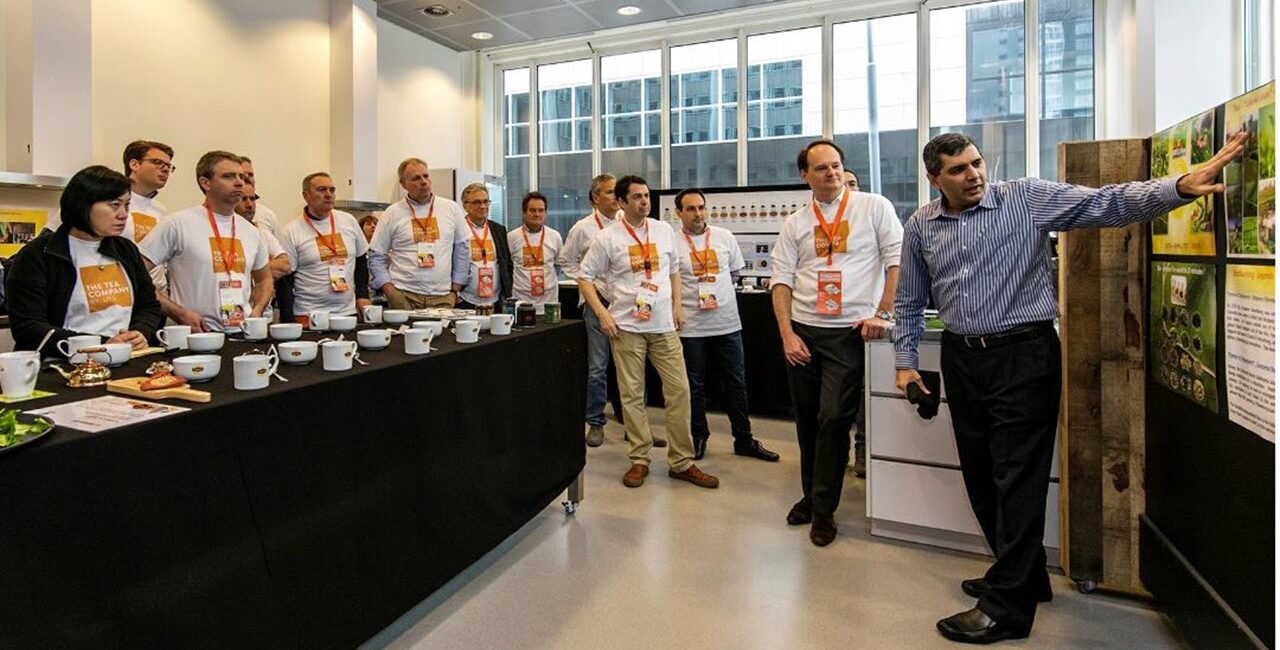
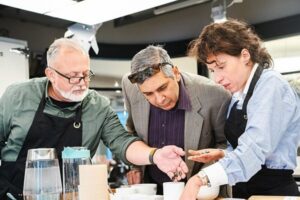
Master taster and master teacher Kurush Bharucha leads a session at Unilever’s Rotterdam offices.
Kurush Bharucha has spent the past 39 years of his professional life in tea, all with Unilever/Lipton Teas & Infusions. He is a specialist tea taster and judge, buyer and blender, trainer and educator, product innovator and developer, sommelier and storyteller. His rich ingredient knowledge and product (and ‘palate’) expertise span multiple tea origins across all the main growing regions in Asia, Africa, and South America. His cross-functional roles have been in Supply Chain, Quality, Procurement, Tea Plantations, and R&D – having spent 19 years in India, eight years in Dubai, and 12 years in the UK. His most recent role was as Lipton’s ‘Global Tea Expertise Director’, at its International Innovation Centre in Bedfordshire, UK working with Lipton, Pukka, PG Tips, Tazo, T2 and other brands. In Lipton, he also played the role of a ‘Tea Ambassador’ – by championing a tea culture, instilling belief, infusing passion, and building Tea capability across the business. He adds, “By a strange quirk of serendipity, even my family name (Bharucha) ends in cha!”
When would you say you decided to pursue tea tasting as a professional skill? Did working as a Taster represent a shift in what you initially thought to be doing as a career? What first interested you about tasting?
I got into tea (and tea tasting) in 1985, as a young 20+ year old – and quite by accident! (To be honest, nobody can think of becoming a tea taster. You couldn’t plan for it – it’s not something that an Ivy League University offers a Course in, nor is it often advertised, nor will college career advisors ever say ‘Tea Taster’ !)
I was about to graduate from St Xavier’s College (University of Bombay) with a degree in Economics when I casually applied for a ‘Management Trainee – Saleroom’ job advert – by a company called Brooke Bond – that I saw on my college Notice Board. (I had no idea then that the Brooke Bond Group was one of the largest tea companies in the world or that Unilever had just acquired it!) From what I best recall, it promised the exciting opportunity to travel and learn – and be paid for this!
Fast forward three months, I’d got the job, and the next thing I knew, I’d traveled nearly 2,000 km east to the City of Calcutta – India’s City of Tea, where I joined the Saleroom. I had thought this would have to do with sales. But, guess what, the ‘SALEROOM’ (as I later discovered) actually referred to the Auction ROOM where teas were SOLD! It’s where the trade converged each week to buy teas in a public auction. In effect, I had joined the Commodities Department of one of the biggest tea companies in the world – with tea tasting underpinning all the ‘value’ of its tea buying and blending operations. (It seemed then that the company’s success was founded on its astute buying and judicious blending of tea and not on its selling!)
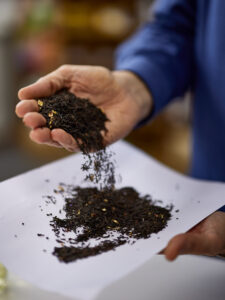
From there on, it was taste/taste/taste – always alongside my more experienced seniors. It was fascinating to discover the dazzling diversity of Indian tea – hearing tea descriptors such as smoky/spicy/sweet/soft/strong or bakey/brisk/brassy/bouquet/biscuity. And to think that all this variety came from a single plant – Camellia sinensis – how awesome was that! I was utterly fascinated – one plant, six families, 2,000 varieties, and 5,000 years of history! I could never imagine that such a profession could even exist! I understood that tea tasting as a profession, really needed no degree or qualification. Instead, it was like playing golf – you were always competing against yourself. This was a battle that I felt I could win if I truly committed to it. I stayed positive, and I stayed on.
There was no looking back. I was sucked into the art and craft, the magic and logic of tea – our ‘nectar of nature’. I began to see tea as ‘not just raw material, but raw potential’!
This was my first job, and I’ve never needed to work anywhere else since. Over my four-decades long career, Unilever (Lipton/Brooke Bond) is the only company I’ve known, and tea is the only category I’ve worked in. Tea wasn’t just what I did – it seemed to define who I am. As my close friends light-heartedly joke, “Kurush doesn’t drink tea to wake up, he wakes up to drink tea!” and “If he won the lottery tomorrow, he’d still be doing tea!”
Having said this, I remain a student of tea, with a deep respect for the traditions of the craft, but equally, with an innovative eye on its ongoing evolution. It’s funny but true – the more you think you know about tea, the more you realize how little you know!
Are there some teas (tea styles) that resonate? Are there teas that you are better at describing, even if they’re not your personal favorites? If so, why do you think this is the case?
In my long career (of sips and spills!), I’ve always been the keenest student of the width and depth of black oxidized teas manufacture (Orthodox rolled, rotovaned, or CTC). These ‘amber elixirs’ take me to a ‘happy place’, always bringing a smile to my face, when I taste them.
Styles I’ve best studied, understood, and admired include my ‘Selection of Six’ :
- Yunnan: China Golden tippy, with delicious hints of astringency & maple sweetness
- Keemun (the ‘Burgundy’ of Tea): From China’s Anhui province, with multi-layered hints of nuttiness & cocoa-chocolate
- Darjeeling (the ‘Champagne’ of Tea): Himalayan terroirs with aromatic flavors combining the best of floral/fruity/muscatel (often, almost verging on Oolongs)
- Assam: Second flush orthodox with chunky golden tips and a taste that best combines a malty assertiveness and honey-caramel overtones
- Uva – Peak season, highgrown, rotorvane, dry-weather, ‘wintergreen’ signature aroma, and a heady ‘balm-like/minty mentholated’ taste and flavor.
- Rwanda CTC: High-grown, premium, bright golden cups having sparkle and shine and cups that are invigoratingly fresh, brisk, and flavoury.
These six teas resonated compellingly at all my consumer tastings, showcasing their awe-inspiring pedigree as enabled by their artisanal Black tea manufacturing styles. Drinker’s faces would light up when discovering these flavors for the first time. And even more so when they heard about their unique ‘leaf-to-lip’ journeys. While manufacturing style was one fascinating facet, there was so much more to holistically to the story of all of their 6Ps – i.e., not just processing but also provenance, plantation, plucking, product, and people.
Needless to add, manufacturing styles (representing both ‘graft’ and ‘craft’) are only part of any tea’s story. At the end of the day, every tea is a combination of both, the hand of God and the hand of man. In other words, the magic happens at the ‘sweet spot’ of terroir and technique, nature and nurture, farm and factory, pedigree and processing.
While always highlighting the role of artful processing, I ALSO always romance black tea’s naturalness and simplicity. While people talk about the various processes of black tea manufacture, viz., withering, maceration, oxidation, firing, sorting, and packing. I strip this down to basically say – all that’s removed is moisture… and all that’s added is air. That’s how pure, simple, and natural it is to turn green leaves into made black tea! (I sometimes use the analogy of the ‘browning’ of an apple or banana when left exposed, after taking a bite from it)
A final build on ‘styles’ and ‘craft.’ Make no mistake as to the ongoing expertise of the Chinese in this area. China is the only country making all sux styles of tea – white, green, yellow, oolong, black and Pu’erh. Tea makers, across its 16 tea-growing provinces, manipulate the leaf like nowhere else – to form every shape and continually look to coax out every innovative nuance from the bush. No wonder, then, that it’s oft-said that there are more teas in China than there are wines in all of Europe!
“Tea is a work of art and needs a master hand to bring out its noblest qualities.” Okakura Kakuzo, The Book of Tea (1906)
Which teas were initially the most challenging to you? Are they still daunting? Or have you made peace with them and reached a mutual understanding? How so?
Japanese greens were quite challenging to me. To start with, my work allowed me very little exposure to this origin, but even after tasting many a sencha, bancha, matcha, gyokuro. and kukicha, I must admit that they are still daunting. I still struggle to appreciate the nuances WITHIN each of these sub-families. (Yes, ‘sun grown’ Senchas and ‘shade-grown’ Gyokuros are relatively easier to understand; it’s the variation within these that is quite complex.
Given its tiny crop (1% of global tea), the short season (from April for 6 months), singular green leaf ‘fixing/enzyme inactivation’ process of steaming, and coming from a single cultivar (Yabukita, for 75% of its harvest), one would think this origin was not so complex. Clearly not!
Personally, these green teas were a s-l-o-w-l-y acquired taste. In my early years, I struggled to understand their texture (light to heavy, sometimes like a viscous broth), their flavors (herbaceous-vegetal and/or sea-weedy or fishy), their sensorials (smooth to sometimes slightly astringent), and their tastes (sweet to umami).
I’ve now made my peace with this ancient tea origin, which has grown tea for over 1,000 years! Over time, the taste of Japanese teas has grown on me.
Will you share some insights about how you developed your tea vocabulary with readers? What was the process like for you in going from identifying ‘something familiar’ to perhaps relating it to a memorable experience or place to being able to put a specific term to it?
As regular consumers of food and drinks, we all have a fair understanding of tastes, flavors, and textures – be it the smoothness of chocolate, the tang of citrus, the surprise of strawberry, the fire of ginger, the sweetness of honey, the bitterness of coffee, or the subtlety of cinnamon.
 In the mid-80s (pre-internet!), we were also pointed to a few reading references that explained tea descriptors. (I recall The Ukers Tea Book, ISO 6078: 1982 Black Tea Vocabulary, and FAO of the UN, Rome Bulletins on Tea.) Today, of course, there’s a proliferation of books and online content for self-study and learning.
Travel — to a plethora of producing countries and consuming cultures — played a big role in broadening my tea vocabulary. While there is certainly a broad strand of a tea vocabulary that is shared globally, I was captivated by the subtle nuances experienced, depending on where I was in tea’s ‘Leaf to Lip’ consumer journey. Tea Producers, brokers, traders, importers, wholesalers, big brands, niche specialty shops, street shops serving tea, RTD manufacturers, start-ups… each had their own ‘TEAminology’ appropriate to their business.
Another tip to help grow a vocabulary is to be constantly curious and ‘simply see whats out there’, on supermarket shelves/online. Study the on-pack artwork to see the language of its description.
Also, to build your vocabulary, always think 360. The very term ‘tea taster’ is a misnomer. It seems to suggest that we use just one of our senses – taste. When, in fact, we are making a comprehensive product evaluation using four of our five senses. We use our eyes/nose/fingers/palate to tap into our senses of sight/smell/touch/taste, respectively. So, incorporate elements of SIGHT (size, style, shape of leaf… or color, clarity, depth of tea liquor in cup), SMELL (scent and aroma), and TOUCH (dry, crisp, spongy) too, into your vocabulary arsenal.
Another tip is to think figuratively to understand a point. For example, in my early days, a very thick/viscous Assam tea was explained to me as ‘a cup in which you could stand your spoon!’ While not literal, the mere mental imagery of this summarised it perfectly, staying with me to this day.
It’s also worth remembering that one’s tea vocabulary is not just about words; it’s also visuals — rituals, ceremonies, and imagery from OTHER languages and cultures — that one can leverage through association. For example, Zavarka = strong tea concentrate in Russia, or Karak = a hearty tea in the UAE or Dilnesheen = is a pleasant cup in Iran or Taaza = invigorating freshness in India or Danedaar = granular tea leaf in Pakistan or Tavsan kani = a desirable cup color resembling rabbit’s blood (!) in Turkey… one could go on.
Did you actively seek opportunities to build vocabulary? What were some of your exercises?
And tea is no different. A few have their own flavor wheel – a visual compass that de-mystifies the product and profiles its sensory attributes. These tools are a diagrammatic lexicon that maps the landscape of Tea’s flavor directions. Combining scientific rigor and artistic representation, they aim to break down taste experiences into individual elements, helping experts pinpoint nuances that the average palate might miss. Over many years, I have similarly developed my own ‘cognitive/mental map’, which I use to help understand the fascinating tapestry of Tea. So, using Black Tea as an example, I start with a broad ‘family’ direction but then search stronger – for more, yet subtle, possibilities (for, e.g., a ‘Fire’ sensory direction on a Wheel could further sub-divide into biscuity, smokey, ashy, roasted, burnt).
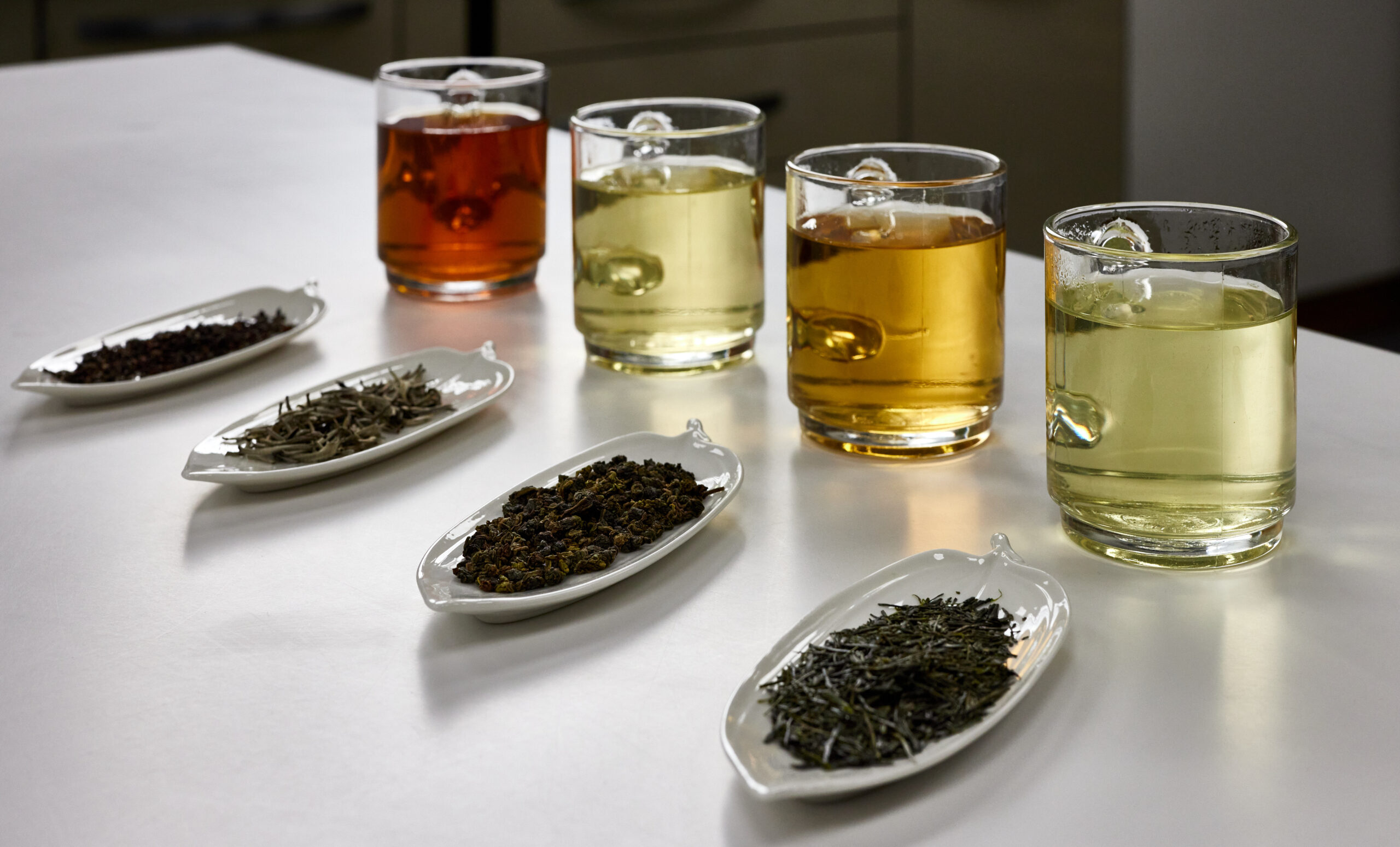 Broad families of flavors include florals (e.g., jasmine or rose), Fruits (e.g., peaches or grapes), vegetables (e.g., freshly cut grass or herbaceous), aquatics (marine or seaweed), woody (e.g., cedar or bark), Spicy (e.g., peppery or cinnamon), and so on.
From an early age, what’s important is to try to cultivate the habit of ‘assigning words to taste.’ When offered to taste 2 or 3 cups of tea, drinkers very emphatically tell you which they like but then struggle to tell you why they like it (i.e., they lack the vocabulary to describe it).
Based on my journey, I’d advise anyone who wishes to build one’s tea flavor vocabulary to initially step back and internalize a few ‘ground rules’ of sensory appreciation, such as
- Understanding basic tastes (viz., sweet, sour, salty, bitter, umami)
- Understanding that our nose is far more sensitive than our mouth when it comes to detecting flavor
- Understanding that our sense of smell is responsible for about 80% of what we taste (think of how our food tastes dull when we have a stuffy nose; this is also why tea tasters can’t do their job when they have an acute cold!)
- Understanding that Taste + Aroma + Texture = Flavour
- Understanding that the sense of smell is linked to our limbic system – where the brain stores memories and processes emotions. This is why scents make us feel calmer (e.g., lavender, sandalwood) or trigger a sense of nostalgia (e.g., the fresh scent of pine trees reminding one of the winter holidays)
- Understanding the difference between bitterness and astringency
- Guard against common pitfalls in language use (for example, many consumers use the word ‘bitter’ to describe a tea they don’t like – and not necessarily because it tastes bitter !)
What advice would you give consumers seeking to refine their taste in tea?
As more brands and establishments invest in the quality of their recipe ingredients, tea will continue to gain respect. Today, more premium-quality teas are sold in an endless flair of flavors than ever before. This may seem overwhelming for many consumers who wish to refine their tastes in Tea.
Having said this, here are my simple ‘10 point’ tips:
- Ensure a foundational understanding of our ‘nectar of nature’ (what tea is, where it grows, how it is made, how it is enjoyed, etc.) – so that it provides a good framework for one’s upcoming ‘voyage of discovery.’ Read a book/go online, or take a ‘Tea 101’ Course.
- It’s probably a truism to say this, but it tastes a lot. I’ve always believed the best way to learn about tea is to taste it! Be intentional. And ‘experience the experience.’
- If possible, taste with a friend. Trust your gut. Be honest – there’s no right or wrong.
- Know the very basics: Use good quality water, don’t re-boil, and brew at the recommended length of time and temperature.
- Use good-quality tea (when I joined the industry, the phrase ‘It pays to buy good tea’ was stenciled on one panel of every wooden tea chest). I can’t emphasize this enough.
- Work your tastings up from light to intense (e.g., white, green, oolongs, and blacks). This will allow your palate to acclimate and prevent it from getting overwhelmed at the start.
- Taste as ‘families’ (for, e.g., a range of oolongs one afternoon). This will allow you to take comparative notes and spot your preference. Contrast is an excellent tutor.
- Understand that there is no perfect tea – only perfect for your palate! Yes, ‘Beauty lies in the eye of the beholder’ or put differently ‘its horses for courses’.
- If you still haven’t nailed your favorites, it’s simply because you haven’t found the right one. It 100% surely exists! Carry on having fun, sipping, and savoring.
- A moment of truth dawns. But be warned — once you’ve discovered your newfound ‘nectars of nature,’ there’ll be no going back to what you drank before!
Is there a particularly unique tea specialist role that you loved?
One of my key responsibilities in my last few years with Unilever/Lipton was to own the company’s ‘Tea expertise’ capability. This included overseeing the tasting capability of its global cadre of up to 70 (including ‘apprentices’) tasters! Unlike most Tea companies having their tasters in 1-2 locations, Lipton’s spread and scale required tasters to be located in over a dozen countries — some in our tea gardens in Kenya/Tanzania; others in our buying offices in Africa/Sri Lanka/India/Vietnam/the Americas; still others in blend-recipe roles servicing packing factories; and more still in R&D product development roles. Together, they taste over 10,000 cups each week – to keep the company’s blends ‘on form.’
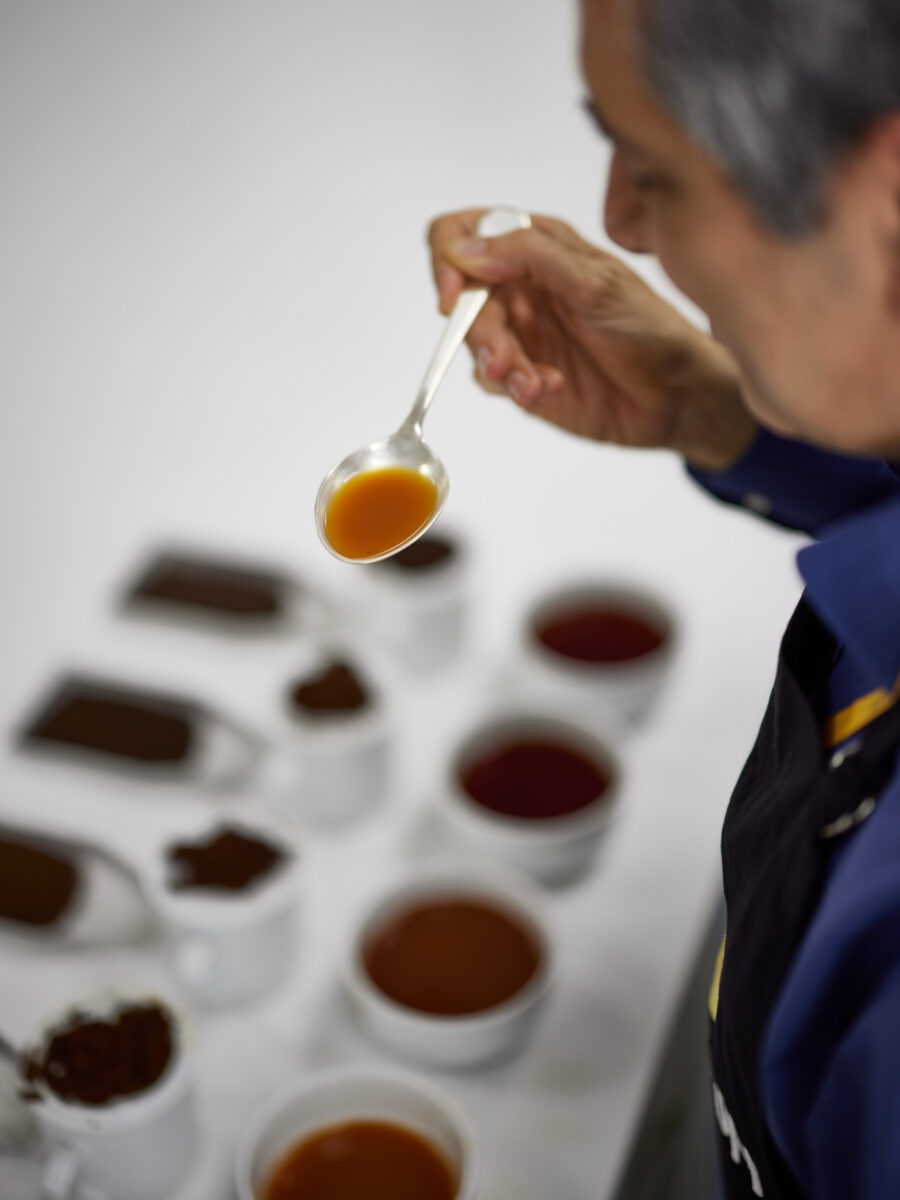 It is vital that all tasters are uniformly ‘calibrated’ to a targeted level of high proficiency, so that all their palates can consistently operate, as ‘human instruments’. In effect, for all to ‘sing from the same hymn sheet’ – when they taste and fingerprint teas using our unique classification and categorisation language called ‘Tealingo’.
As the company’s ‘Tea Quality Standards’ ombudsman, I truly enjoyed owning and leading this vitally important Global Taster Calibration Programme, which nurtured, protected and grew our specialist skill base.
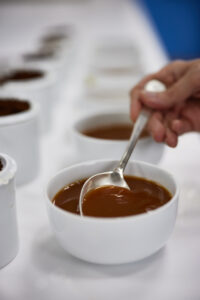
While tea cupping looks subjective, we continually ‘objectivised subjectivity’ and ‘quantified quality’ – by building rigor and robustness into our training and benchmarking standards. Tasters were regularly put through monthly ‘multi-origin’ sample assessments – requiring them to blind taste and fingerprint teas in Tealingo – capturing elements of ‘dry leaf’ (i.e., size, make, shape, style, attractiveness), ‘cup color’ (i.e., clarity, depth, brightness), and ‘Taste’ (i.e., flavor, aroma and mouthfeel).
My mantra was clear: Practice makes perfect, so perfect your practice.
Over time, Apprentice tasters strove to proudly qualify as Operational tasters (after challenging internal struggles), finally earning a formal License-to-Taste Graduation Certificate, along with their very own pure silver, name-engraved tasting spoon—as a token of recognition for their efforts and ongoing use throughout their careers.
Nothing gave me more pride than to build and embed this program of ‘always-on’ learning and training and to see the joy on taster’s faces – when they ‘graduated’ – with the Certificate and silver spoon in hand! As the team well recognised, ‘You win or lose, at the tasting table’.
I love days when my only problem is a 2nd flush in Darjeeling or a 2nd flush in Assam! This sums up my 2 ‘favorite’ Speciality teas, which always get my attention and affection! Sipping and savoring these feed my soul, nostalgically taking me back to India – where my tea journey started.
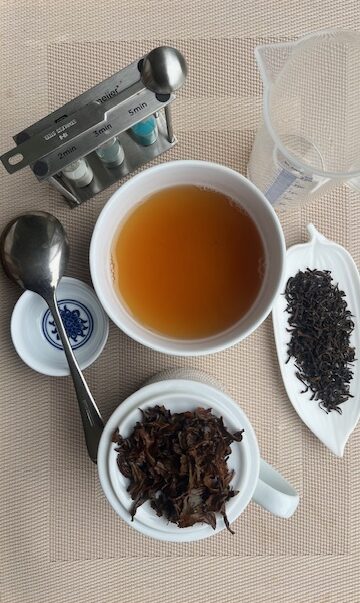
FTGFOP1 Muscatel Darjeeling 2nd Flush (2024) from Margaret’s Hope
Tea Type: Black oxidized, ‘fine’ picking in summer (May-June)
Dry Leaves: A fairly large-size tea grade (‘Wholeleaf,’ in industry parlance). Traditionally gentle, ‘orthodox’ manufacturing style. An attractively charming mixture of relatively black and dark brown leaves. Uniformly wiry and stylishly twisted. It is rolled harder and oxidized longer (than its 1st flush/Spring counterpart… but that’s for another day!).
Infused wet leaf: Brightly unfurled and beautifully unfolded; black and brown shoots faithful to the leaf grade. With pronounced flowery ‘nose’ and an elegant gardenia bouquet!
In-cup ‘liquor’: Light yellow-brown, with shades of amber. Clear, pretty, and transparent.
Aromas: Between the cup and the lip is this tea’s intoxicatingly fragrant aroma, which has notable fruity and flowery top notes. It is so naturally scented that it almost qualifies as a top-end China or Formosa Wulong!
Body: Medium, with a mellowing/smoothness/softness on the palate, with hints of a refreshingly pleasing astringency.
Flavor: The ultimate expression of rounded, velvety, and mellow sensorial. The fruity character has hints of sweetness – reminiscent of ripe peaches, muscatel grapes, and summer flowers. Desirable, delicate, and divinely heady. Not only does the flavour ‘dance on one’s tastebuds’, but it also beautifully endures in the mouth after swallowing. Such a lingering ‘finish’ is testimony to its high pedigree.
Preparation: 2-3 grams per 150-200 mL of freshly drawn water. Ideally, brew in a teapot!
Brewing Time: 2 to 3 minutes
Brewing Temperature: 185-195 degrees F or 85-90 degrees C
Ideally, it should be with a Continental (not English!) Breakfast or as an Afternoon Tea (with cucumber finger sandwiches/cookies/biscuits). A recommended food pairing is frozen milk, pear-based desserts, or cream cheese sandwiches.
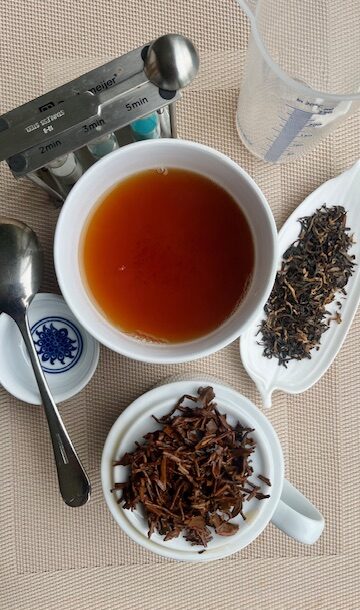
FTGFOP1 (Tippy) Assam Orthodox 2nd flush from Mangalam
Tea Type: Black oxidized, ‘fine’ picking in summer (May-June)
Dry Leaves: A fairly large sized grade (‘Wholeleaf’, in Industry parlance). Representative of a classical Black tea ‘Orthodox’ manufacturing style, where the resultant leaf has a rolled, wiry, and twirling physical style, with an abundance of ‘golden tips’ that further add to its pedigreed credentials and endorse its ‘Rolls Royce’ look. These ‘tips’ are both twisted and chunky, and come from the finely harvested ‘buds’, which oxidise to form this exquisite and elegant, bright yellow colour. The tips are clear evidence of careful plucking and diligent manufacture, connoting top-quality, premium, seasonal 2nd flush, and indicative of this tea having a high polyphenol and caffeine content.
Infused wet-leaf: Long, unfurled, tawny shoots, having an attractive rich ‘coppery’ brown color.
In-cup liquor: Clear and sparkling, with an intense depth of red-brown and rich amber hues.
Aromas: Its top notes have a light honey and malty character (think ‘bittersweet caramel’), reminiscent of toast spread with dark honey. It is strong, sophisticated, and assertive.
Body: A ‘sappy’ texture with useful mouthfeel, viscosity, heft, guts, and punch. Put simply, full-bodied yet smooth, laced with sharpness.
Flavor: Honey and malty, strong and robust, with hints of raisins and caramelized sugar. This is a characteristically bold and brisk ‘Assam flavor’ at its recognizable best. A specific ‘P126’ (P=Panitola) clone varietal is a key driver for this unique flavor, linked with the golden tip.
Preparation: 2-3 grams per 150-200 ml of freshly drawn water.
Brewing Time: 4 minutes
Brewing Temperature: 195-205 degrees F or 90-95 degrees C
Creaming cups: A unique way of confirming the high pedigree of such peak 2nd flush Black Assam Orthodox tea is to allow the ‘liquor’ in the tasting bowl to cool after having sipped it ‘hot.’ Over time, the liquid will develop a thick and bright layer of ‘cream’ on its surface (it will look like a teaspoon of milk is added to it !). This natural ‘creaming down’ is essentially a precipitate that is suspended in the bowl – indicative of the really high amount of ‘goodies’ and soluble solids/polyphenols in this tea.
Ideally, a morning tea par excellence! A ‘picker-upper’ and as commonly believed in India, you haven’t woken up fully if you haven’t sipped Assam Tea! (I’d always recommend drinking it black to preserve the purity of flavor. Many add a dash of milk to induce a creamier taste and dial down (just a tad) the astringency. It still works beautifully! A recommended food pairing is fried foods and/or rich, strong dishes such as steaks or mutton/lamb tagine dishes.
Photos courtesy Kurush Bharucha
Listen to Dan’s interview with Kurush Bharucha here


9 Comments
Leave a Comment
You must be logged in to post a comment.
such a marvelous article. I so relished every word.
Thanks Paula. I’m glad you liked my responses 🙏😀
This article is very useful.
Am so glad you found it useful,, Greg 👍
Excellent interview and the notes were very useful!
Thank you Angelos 🙏
Encyclopaedic Kurush, This article should be a must read for new apprentices as also someone like me who has been in the industry for the past 40 years.
Sreekumar
What a great interview! I would love to have Kurush Bharucha as my mentor and guide at Nuxalbari. Thank you for sharing your insights and wisdom.
Kurtis
During your initial days in Kanhan I was in the production and love to see you here with a deep insight of tea tasting. Love you
Pranay Mallik