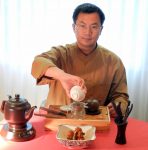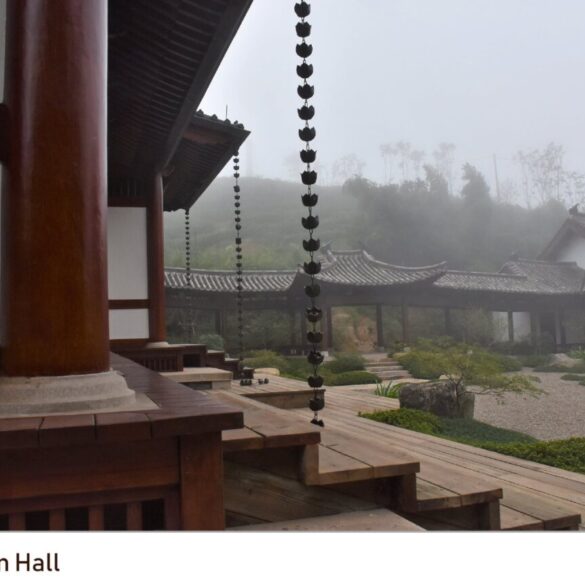

Long before matcha became synonymous with Japanese tea culture, monks in China were already whisking powdered tea in black-glazed bowls during the Song dynasty. This tea—known as Mo Cha (末茶)—was prepared in Chan Buddhist monasteries such as Jingshan Temple, where formal tea banquets combined meditation, ritual etiquette, and scholarly conversation. Visiting Japanese monks encountered this culture in the 12th and 13th centuries and brought back its techniques to Japan, where the practice evolved into matcha and eventually the tea ceremony. While powdered tea culture later disappeared in China, its legacy survives through these Japanese traditions, making Mo Cha a crucial link in the shared history of tea across East Asia.
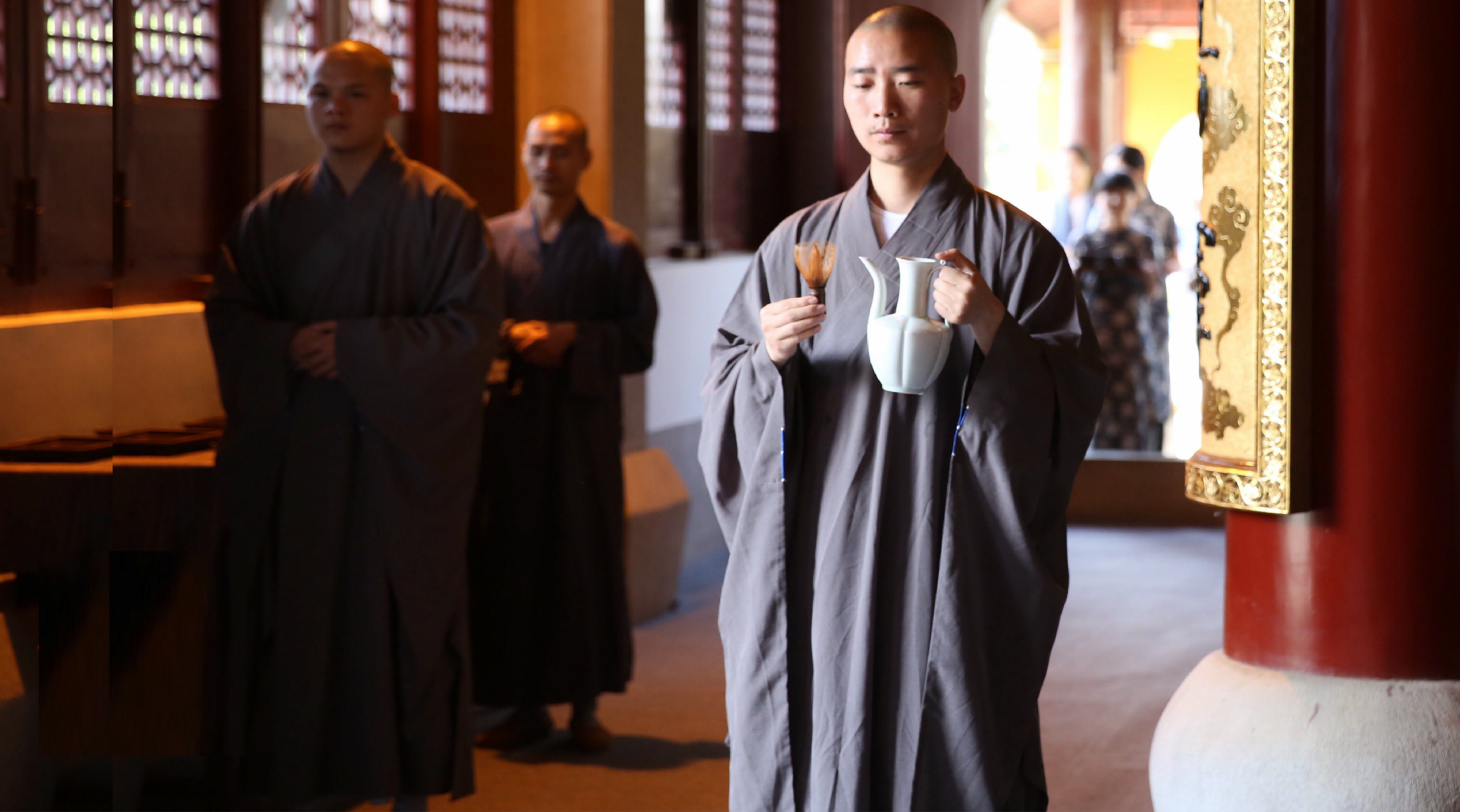
Monks at Jingshan Chan Temple near Hangzhou recreate the historic Tea Banquet (茶宴, Chá Yàn) each year, demonstrating the Song-dynasty preparation of Mo Cha, a powdered tea whisked to produce a bright white foam. The ceremony follows monastic ritual procedures recorded in the 12th-century temple regulations and reflects the tea culture that visiting Japanese monks encountered while studying Chan Buddhism in China. These gatherings combined incense offerings, the preparation of tea using Jianzhan bowls, and discussion of Buddhist texts and poetry. The tradition is widely considered a cultural origin of Japan’s matcha practice and the later development of the tea ceremony (chanoyu).
What is Mo Cha?
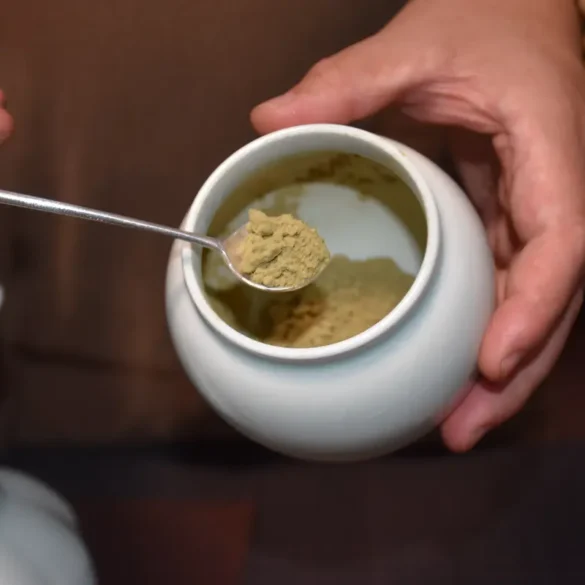
Mo Cha (末茶) is a powdered tea ground either from dried, steamed green tea cakes—when convenience or larger quantities dictate—or from freshly steamed tea leaves. The Japanese adopted the latter method. The Japanese name Matcha (抹茶) is a slight variation of the name Mo Cha, emphasizing the grinding effort by adding a prefix signifying “hand” to the character.
When whisked with hot water, Mo Cha forms a pale white foam on the surface of the tea. During the Song dynasty, it was served in steep-sided black-glazed Jianzhan bowls, whose dark surfaces highlighted the foam’s color and texture.
Mo Cha Inspires Japan to Grind and Froth Tea
Jingshan Temple Tea
Tea has been cultivated at Jingshan Temple since the Tang Dynasty (8th century). By the 11th century, Jingshan tea had become one of the four most famous teas, according to the Northern Song tea scholar Ye Qingchen, a respected tea taster of the period.
The Song dynasty (960–1279) marked the high point of powdered tea culture in China. Tea was both a major domestic commodity and an important export, contributing significant tax revenue to the state. During this period, the method of whisking powdered tea directly in a bowl—closely resembling the preparation of modern matcha—became widely practiced.
Tea preparation during the Song dynasty was called diancha (点茶). Powdered tea was put in a bowl, and hot water was then whisked to create a fine foam. The process focused on texture, color, and foam stability, which later became key aspects of Japanese tea culture.
The methods used to produce powdered tea changed multiple times throughout Chinese history, and historians still debate how monks prepared and drank tea in the 12th century. Poems written by monks at Jingshan Temple describing their tea banquets (茶宴, chá yàn) offer valuable clues.
These accounts show that the tea used in the ceremonies was Mo Cha (末茶)—a powdered tea made from either steamed tea cakes or freshly steamed leaves. The Japanese later adopted the practice of grinding freshly steamed tea, and they maintained the technique after it declined in China.
Imperial Tea Culture
The process for producing the tea cakes used to make Mo Cha was described in the Daguan Chalun (Grand Treatise on Tea), written in 1107 during the reign of the Northern Song emperor Huizong (r. 1101–1125).
Huizong described a demanding sequence of production steps:
- Plucking the tender tea buds
- Steaming the fresh leaves
- Grinding the leaves
- Pressing them into cake molds
- Drying the finished cakes
The text also includes one of the earliest references to the chasen, or bamboo tea whisk. The treatise notes that tea was served in black-glazed Jianzhan bowls, whose dark surfaces allowed the tea’s white foam to stand out dramatically.
This elaborate system of tea cake production eventually disappeared. The founding emperor of the Ming dynasty (1368–1644) abolished tribute tea cakes, arguing that their production was overly complicated and costly. Loose-leaf tea replaced powdered tea in China, while the earlier method continued to develop in Japan.
Today, modern technology—mechanical grinders and controlled steaming—makes the production of powdered tea practical again, allowing historical methods to be studied and recreated.
Tea and Chan (Zen) Buddhism
Tea had long been associated with Buddhist monastic life. During the Tang dynasty, tea became a staple in temples because it helped monks remain alert during meditation and long periods of chanting.
Believing that Cha Dao (the Way of Tea) and Chan Buddhism were closely connected, monks incorporated tea into their daily ritual life. Tea banquets became part of temple culture and were codified in the Baizhang Chan Buddhist Shrine Rules, which regulated monastic conduct.
Jingshan Chan Temple, located north of Hangzhou in present-day Zhejiang Province, was founded in 742 CE by the Chan master Faqin.
Local records describe the temple’s earliest tea cultivation:
“Master Faqin planted several tea plants and plucked tea leaves as an offering to the Buddha. From the following year on, tea plants flourished among the valleys of Jingshan, renowned for their unique fragrance and flavor.”
By the Southern Song dynasty, Jingshan Temple had reached the height of its prestige. The emperor Xiaozong became a lay disciple of the Chan master Zonggao, honoring him with the title Da Hui (“Great Wisdom”). The emperor’s calligraphy inscribing the temple name “Wanshou Jingshan Temple” remains carved in stone there today.
At that time, Jingshan was considered the foremost of the ten great Buddhist temples of the Southern Song. Its tea banquet ceremonies were regarded as the most refined temple rituals of the era.
It was in monasteries like Jingshan—where powdered tea was whisked into luminous foam during the famous tea banquets—that Japanese monks first encountered the practice that would later evolve into matcha.
The Jingshan Tea Banquet
The Jingshan Tea Banquet, sometimes described as a tea ritual or tea gathering, was a formal ceremony governed by monastic regulations written in 1102.
Tea played an essential role in daily temple life. For example, afternoon tea was a regular ceremony attended by all monks.
The tea banquet followed a carefully ordered sequence:
- Invitations were issued and seating arranged.
- A drum was sounded to announce the beginning of the gathering.
- Guests entered the tea hall and greeted the host according to ritual protocol.
- Incense was offered before the Buddha statue.
- Diancha, the preparation of powdered Mo Cha, was performed at a special tea table.
- Fencha, the sharing of tea, distributed the prepared bowls among participants.
- Incense offerings were repeated before drinking.
- Discussion followed—often commentary on Buddhist texts or poetry.
- Guests formally thanked the host and departed.
The preparation of Mo Cha required specialized utensils. In total, twelve implements were used, each given an honorific name, collectively known as the “Twelve Gentlemen of the Tea Ceremony” (十二先生).
When prepared properly, Mo Cha produced a dense white foam. The quality of the foam indicated the tea maker’s skill: the brighter and longer-lasting the foam, the better the preparation. Experimental reconstructions of the ancient method suggest the foam could stay stable for several hours.
Transmission of Mo Cha to Japan
The connection between Jingshan Temple and Japanese tea culture was forged in the 13th century.
In 1235, the Japanese monk Enni Ben’en (円爾弁円) traveled to Jingshan to study under the renowned Chan master Wuzhun Shifan. During his years there, Enni learned not only Buddhist teachings but also the ritual practices surrounding tea.
When he returned to Japan in 1241, he carried with him tea seeds and the ceremonial rules of the Jingshan tea banquet.
Enni later traveled to Shizuoka, where he taught the cultivation of tea. Today, Shizuoka remains Japan’s largest tea-producing region.
The tea culture introduced by Enni gradually evolved into what is now known as Chadō, the Japanese Way of Tea.
Early Tea in Japan
Tea was known in Japan centuries before the arrival of the powdered tea culture.
According to Sen Sō-oku’s History of Chanoyu, the earliest official record dates to 815 CE, when Emperor Saga visited Sûfukuji Temple in Ōmi Province.
The abbot Eichū personally prepared tea for the emperor after a Buddhist ceremony. Saga was so pleased that he rewarded the monk with a ceremonial robe.
Following this event, tea cultivation began near Mount Hiei, and tea drinking spread among aristocrats and monks.
At the imperial court, tea was sometimes served as hikicha, flavored with amazura syrup, incense wood, or ginger. It was valued for restoring energy after long sessions of chanting or religious ceremony.
In 1191, the Japanese monk Myoan Eisai (1141–1215) returned from Song China carrying tea seeds and knowledge of powdered tea preparation.
At this stage, however, tea remained largely an aristocratic beverage, not yet part of everyday life for the general population.
War, Migration, and Cultural Transmission
The fall of the Song dynasty to the Mongols (Yuan dynasty, 1271–1368) led to profound cultural change. Many Chinese Chan monks traveled to Japan, carrying with them elements of Song culture that were later lost in China.
This led to the organization of monastic temples, ritual practices, and a disciplined daily rhythm of Zen monastic life, which included the preparation of powdered tea.
In Japan, these traditions were preserved and refined.
Within Zen monasteries, tea drinking—known as charei—became a reflective pause in the daily schedule of study, meditation, and ritual.
Over time, the powdered tea of Song dynasty China—Mo Cha—evolved in Japan into Matcha, forming the foundation of the Japanese tea ceremony that continues to this day.
From Mo Cha to Matcha
68 CE
The first Buddhist temple in China was established in Luoyang, marking the early spread of Buddhism that would later shape Chinese tea culture.
741 CE
Chan monk Guoyi establishes the monastery on Jing Mountain near Hangzhou, which eventually develops into Jingshan Temple, a major center of Chan Buddhist practice and tea ritual.
8th Century (Tang Dynasty, China)
Tea culture spreads widely across China. Tea scholar Lu Yu (733–804) writes The Classic of Tea (Cha Jing), establishing tea as a refined cultural practice.
815 CE — First Recorded Tea Drinking in Japan
Japanese Emperor Saga is served tea by the monk Eichū at Sūfuku-ji Temple near Lake Biwa. The emperor orders tea cultivation near the capital, though the practice remains confined to monks and aristocrats.
10th–13th Century (Song Dynasty, China)
Powdered tea known as Mo Cha (末茶) becomes fashionable among monks, scholars, and the imperial court. Tea leaves are steamed, pressed into cakes, ground into powder, and whisked with hot water to produce a pale foam served in black-glazed Jianzhan bowls.
1191 — Eisai Returns to Japan
Japanese monk Myoan Eisai (1141–1215) returns from Song China carrying tea seeds and knowledge of powdered tea preparation. He promotes tea drinking among monks and aristocrats and later writes Kissa Yōjōki (1211), the first Japanese treatise on tea.
1235–1241 – Enni Ben’en Studies at Jingshan
Japanese monk Enni Ben’en (1202–1280) studied Chan Buddhism at Jingshan Temple near Hangzhou under the master Wuzhun Shifan. There, he encountered the temple’s tea banquet rituals, where powdered tea is whisked during formal Zen gatherings.
1241 – Zen Tea Practices Return to Japan
Enni returns to Japan, bringing Zen monastic regulations and tea practices associated with Jingshan Temple, and later founds Tōfuku-ji in Kyoto.
1279 – Fall of the Song Dynasty
The Mongol conquest brought the Song dynasty to an end. Political upheaval and religious pressure led many Chinese Chan monks to travel or seek refuge in Japan, carrying with them monastic customs, literature, and tea practices that influenced emerging Japanese Zen institutions.
14th–16th Century – Birth of Chanoyu
Powdered tea becomes deeply embedded in Japanese Zen culture. Tea masters such as Murata Jukō and, later, Sen no Rikyū refined these practices into the aesthetic form known as chanoyu, the Japanese tea ceremony.
Although powdered tea traditions largely disappeared in China after the Ming dynasty shifted toward loose-leaf brewing, they survive in Japan as matcha, preserving techniques rooted in Song-dynasty tea culture and monasteries such as Jingshan.
Key Figures in the Transmission of Powdered Tea
Eisai (1141–1215)
Promoted tea cultivation and powdered tea drinking in Japan; author of Kissa Yōjōki.
Enni Ben’en (1202–1280)
Studied at Jingshan Temple and transmitted Zen monastic tea rituals, linking Song-dynasty Mo Cha traditions to Japanese matcha culture.