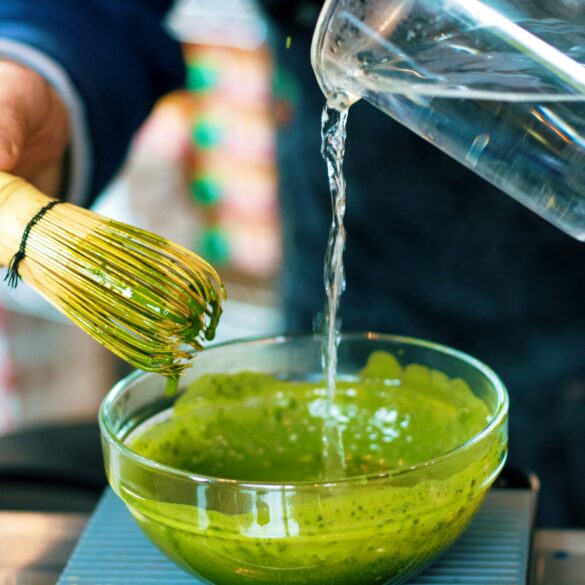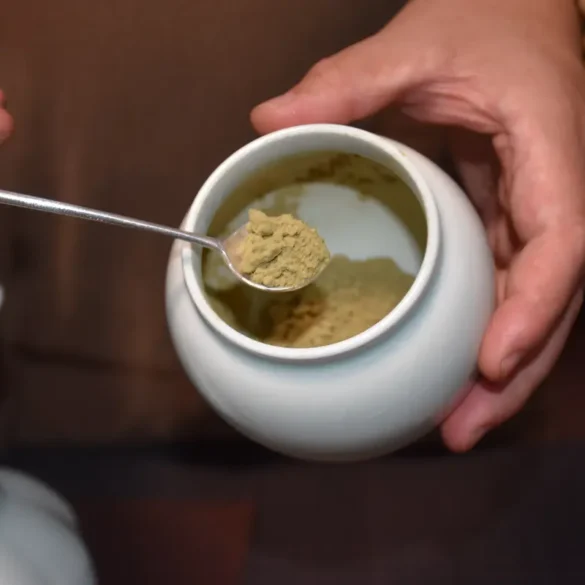


The powdered tea culture of the Song dynasty depended not only on tea itself but also on the bowl in which it was prepared. The preferred vessel was Jianzhan (建盏)—a black-glazed tea bowl produced in the Jian kilns of Fujian Province.
These bowls were not merely decorative objects. They were functional tools designed specifically for diancha, the whisked preparation of powdered tea.
During the Song dynasty, tea drinkers judged the quality of powdered tea by the color and persistence of the foam created when the tea was whisked. A dense white froth indicated skillful preparation and high-quality tea.
Song tea authorities—including the statesman and tea writer Cai Xiang—noted that bright tea foam appeared best against a dark background. Jian bowls, therefore, became the ideal vessel for tea competitions and formal tea gatherings.
Features of the Jian Matcha Bowl
Several features made Jian bowls particularly suited to powdered tea preparation:
Dark iron glaze
The deep black surface highlighted the white foam of whisked tea.
Thick ceramic walls
The heavy body retained heat, allowing the foam to remain stable longer.
Wide interior shape
The slightly flared form allowed the whisk to move freely during preparation.
Many Jian bowls developed distinctive kiln patterns created during firing, including:
- Rabbit-fur (tuhao) streaks
- Partridge feather (zhegu ban) spots
- Oil-spot glazes
These natural effects were highly prized and came to be associated with refined tea culture.
When Chan Buddhist monks traveled from China to Japan in the 12th and 13th centuries, they carried these bowls with them. In Japan, they became known as tenmoku bowls, named for Mount Tianmu in China, where Japanese monks often studied.
The bowls quickly became treasured objects within Japanese tea culture. Some Song dynasty Jian bowls imported to Japan are still regarded as national treasures today.
Ironically, while powdered tea culture declined in China after the Ming dynasty banned tribute tea cakes in the 14th century, Japan preserved both the tea preparation method and the bowls designed for it.
As a result, the aesthetics of Song dynasty tea—dark bowl, bright foam, and whisked powdered tea—survive most clearly today in the Japanese practice of matcha.