

Key Takeaways
- Scientists have identified a wild tea plant in southern China whose dominant stimulant is theobromine, the same gentle compound found in chocolate, not caffeine.
- This plant, called Zhuyecha or “bamboo-leaf tea,” grows in a remote village in Guangxi Province and has never been formally studied until now.
- Its caffeine content is so low it barely registers, while its theobromine levels are up to 13 times higher than those found in commercial tea varieties.
- Despite its unusual chemistry, Zhuyecha produces a complex, pleasing aroma with floral, fruity, and fresh green notes.
- The discovery opens exciting new possibilities for low-caffeine specialty tea, selective breeding, and health-focused tea products.
The Tea That Nobody Had Heard Of
Somewhere in the lush hills of Guangxi Province in southern China, local villagers have been living alongside a remarkable tea plant for generations. They named it Zhuyecha. The name translates to “bamboo-leaf tea,” because its long, narrow leaves look more like bamboo than the rounded leaves of the tea plants most of us know. They brewed it and they appreciated it. However, they largely kept it to themselves. Now, for the first time, scientists have put Zhuyecha under the microscope, and what they found has the potential to change how we think about tea altogether. The study was published in Plants in May 2026 and is titled, “Morphological and Chemical Characterization of a Novel Wild Tea Plant Resource with Naturally Low Caffeine and High Theobromine from Guangxi Province, China“.
A Tea Plant Unlike Any You Have Seen Before
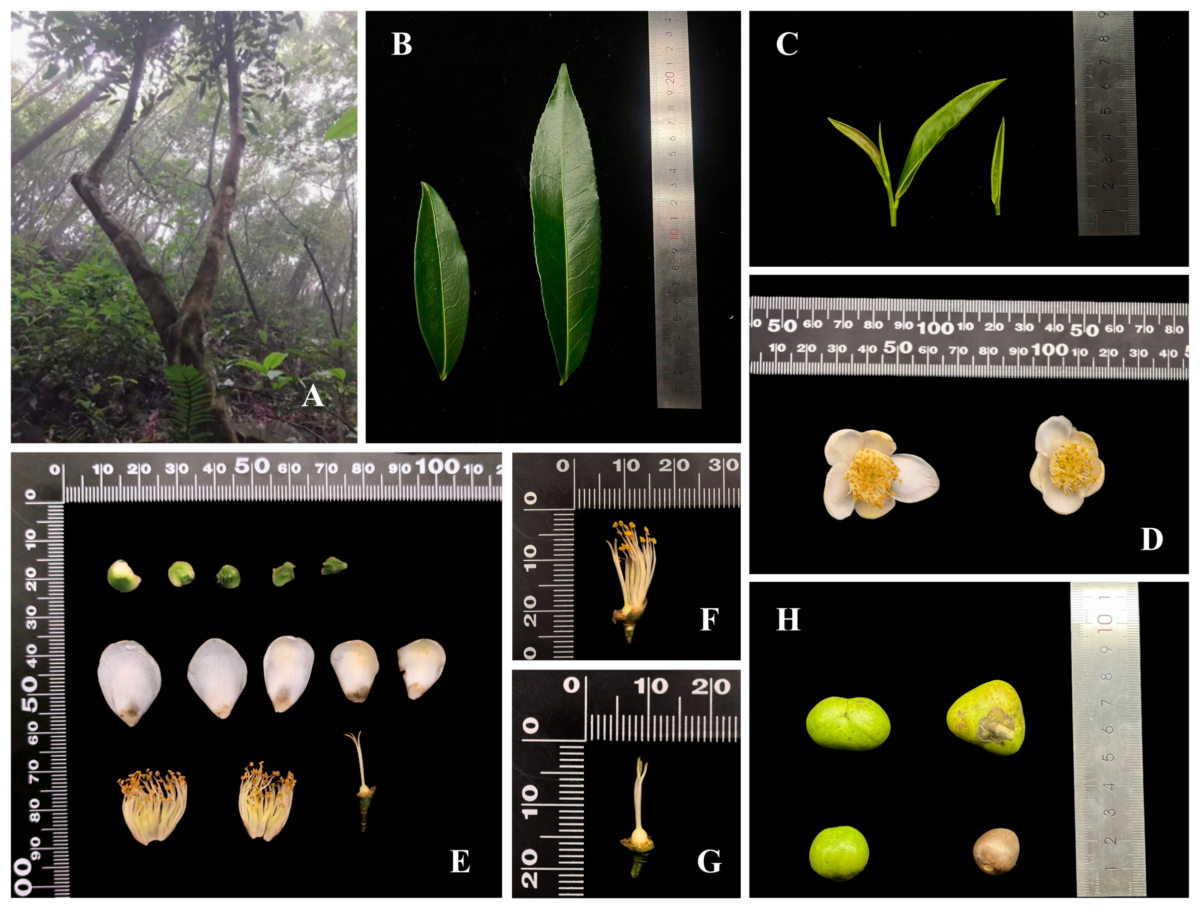
Most tea plants grown commercially are compact shrubs, trimmed and shaped for easy harvesting. Zhuyecha is different. It grows tall, upright, and tree-like, what botanists call an arbor type. Its leaves are long and lance-shaped, stretching up to 19 cm, and the spring buds are robust and barely fuzzy. It flowers in mid-October with small white blooms barely 3 cm across.
What particularly interests botanists are two quiet details: the ovary inside the flower is completely smooth, and the style splits into three distinct lobes. These are not minor cosmetic traits. They are diagnostic features that place Zhuyecha within a botanical group of wild tea relatives called Ser. gymnogynae, a line of ancient, mostly wild tea species within the greater Camellia family. Close relatives within this group include Rongjiangcha, Tulecha, and Tufangcha, all wild teas with documented roots in Guangxi. Zhuyecha appears to be a previously unrecorded member of this botanical family, and that matters enormously for the genetics of tea.
Meet Theobromine: Tea’s Quieter Stimulant
Here is where the story takes a genuinely surprising turn. Every tea drinker is familiar with the brisk, alerting lift that comes from a morning cup. That feeling is largely produced by caffeine, which is by far the dominant stimulant in every major cultivated tea variety in the world.
Zhuyecha has almost none of it.
When scientists measured the caffeine content of Zhuyecha leaves, the highest reading they found across all twelve wild plants sampled was just 1.40 mg/g. The three commercial comparison varieties in the same study each measured above 30 mg/g. That is a difference of more than 20 times.
What Zhuyecha has instead is theobromine, in extraordinary quantities. Theobromine is the primary stimulant in cacao, and it is what gives dark chocolate its calm, sustained energy rather than the sharp jolt of caffeine. In Zhuyecha, theobromine made up between 96.58% and 98.60% of the total alkaloid content in the leaves, reaching concentrations of 31 to 43 mg/g. The three commercial teas contained only a fraction of that. For a tea plant to be so thoroughly dominated by theobromine rather than caffeine is, in the words of the researchers, distinctly different from any other tea composition pattern studied to date.
This matters practically as well as scientifically. Theobromine produces a gentler, longer-lasting sense of alertness without the anxiety, jitteriness, or sleep disruption that some people experience with caffeine. For the growing number of tea drinkers who love the ritual and flavors of tea but are sensitive to caffeine, a naturally low-caffeine tea with this kind of aromatic richness is a genuinely compelling prospect.
The Chemistry of the Cup: What Gives Tea Its Character
Beyond alkaloids, tea gets much of its flavor and health appeal from compounds called catechins, the antioxidant-rich polyphenols that give green tea its clean, slightly astringent taste and black tea its body. Zhuyecha does contain catechins, but at lower overall levels than commercial varieties. The total catechin content in its leaves ranged from 40 to 55 mg/g, compared to 113 to 170 mg/g in the comparison teas.
Interestingly, the types of catechins present in Zhuyecha actually follow a similar hierarchy to cultivated teas, with EGCG (epigallocatechin gallate) dominating, followed by ECG. EGCG is among the most researched tea compounds for its antioxidant properties, so its presence as the lead catechin is noteworthy, even if the overall quantity is lower.
Zhuyecha also showed significantly higher levels of gallic acid, a phenolic compound with documented antioxidant and anti-inflammatory properties, at two to five times the concentration found in the comparison varieties. Taken together, the chemical picture of Zhuyecha is not that of a lesser tea, but of a differently arranged one, with its own distinct nutritional personality.
What Does Zhuyecha Actually Smell Like?
Aroma is where this wild tea plant reasserts itself most confidently. Researchers used a technique called headspace solid-phase microextraction, essentially a very precise method of capturing and analyzing the gases that rise from fresh tea leaves, to identify 150 individual volatile compounds across the 12 Zhuyecha plants sampled.
Of those, 22 compounds were identified as the primary contributors to the plant’s overall scent profile. Three compounds emerged as the most potent, each contributing so strongly to the aroma that they cleared the highest measurable threshold with ease: linalool, hexanal, and trans-beta-ionone.
Linalool will be familiar to anyone who has ever smelled lavender or fresh floral tea. It is one of the most common and pleasing aromatic compounds in high-quality teas. Hexanal and (E)-2-hexenal contribute fresh, grassy, and fruity green notes. The result, according to the researchers’ aroma analysis, is a scent profile that spans floral, fruity, and fresh green attributes, with linalool as the defining dominant note. For a wild, unprocessed plant that has never been cultivated or optimized, this is a remarkably inviting aromatic canvas.
Why This Discovery Matters for the Future of Tea
The significance of Zhuyecha extends well beyond the curiosity of one unusual wild plant. Wild tea germplasm is an invaluable resource for tea breeders. As the researchers note, wild relatives of Camellia sinensis sometimes carry superior traits that have been lost or never existed in cultivated varieties, including resistance to pests, adaptation to climate stress, and distinctive chemical profiles.
Zhuyecha’s near-complete absence of caffeine alongside its high theobromine content, repeated across all twelve individual plants sampled, suggests this is a stable, heritable trait rather than a random anomaly. This makes it genuinely useful for breeding programs aimed at developing naturally low-caffeine tea cultivars without chemical decaffeination processes. It may also find a home in the rapidly growing functional tea market, where products targeting sleep quality, stress relief, and gentle energy are in high demand.
A Wild Discovery With a Long Future
Zhuyecha has likely been growing quietly in its Guangxi hillside village for centuries. However, it was known only to the people who lived alongside it but was unknown to science. Now its chemistry and character have been documented for the first time. This opens the door for what comes next: formal botanical classification through DNA analysis, selective cultivation trials, and potentially, a whole new category of naturally low-caffeine, theobromine-rich specialty tea. For tea lovers looking for something genuinely new, and for an industry always searching for the next meaningful origin story, Zhuyecha may be one of the most exciting plants growing quietly in the hills right now.