


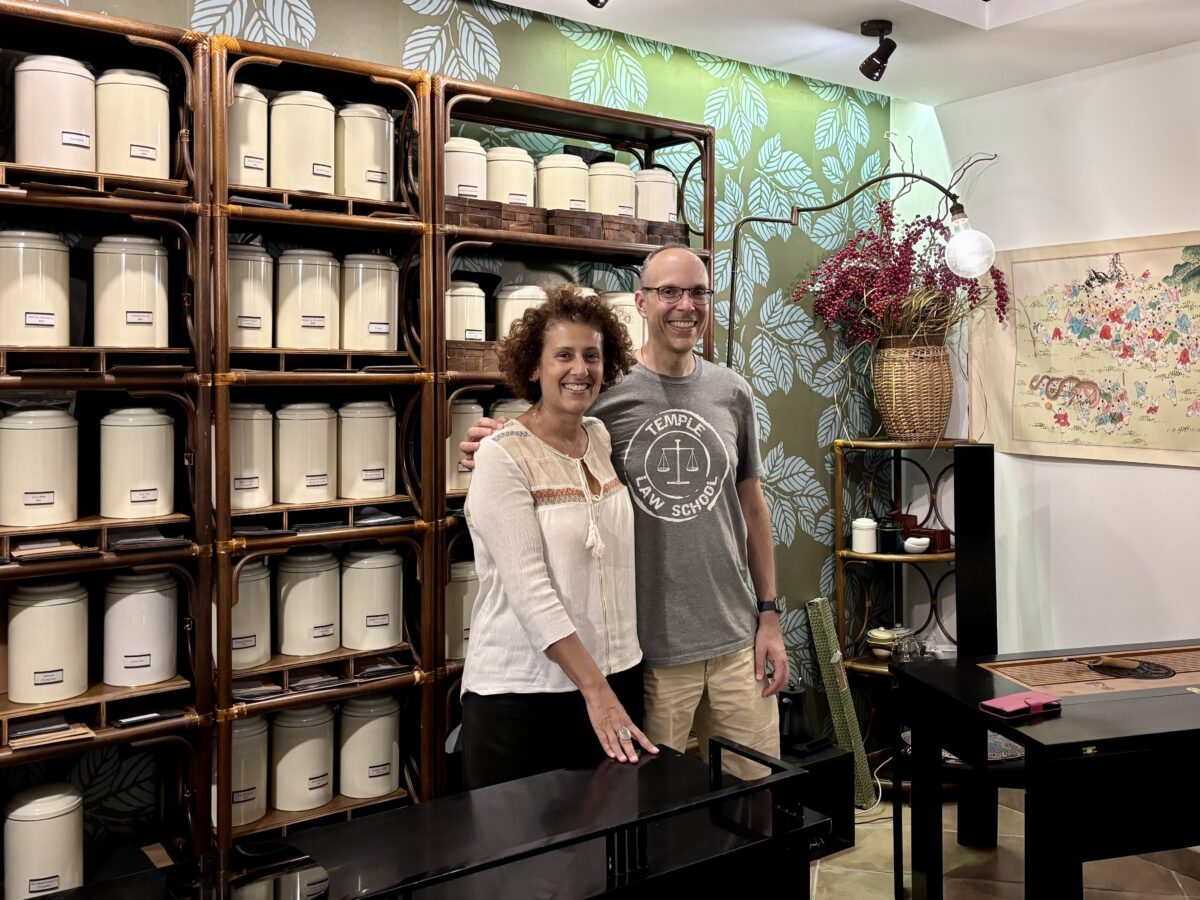
Tucked behind the Pantheon in Rome’s historic center, namasTèy is Rome’s largest specialty tea store. The owner and founder, Daniela Ferraresi, is a well-recognized tea sommelier. NamasTèy is located in the heart of one of the world’s highest coffee-consuming nations. For over 20 years, the Rome native has been making headway in promoting tea culture in Italy.
“From a young age, I developed an interest in Asian culture,” Ferraresi said. “This opened the world of tea to me. After college, I worked in the fashion industry, which was every bit as stressful, toxic, and competitive as portrayed in The Devil Wears Prada. During that time, tea helped keep me balanced, providing moments of respite, calm, and sanity.”
After eight years in the corporate world, Ferraresi began to pursue her passion for tea full-time. “I opened namasTèy in 2003 as a tea house that sold pure tea, blended teas, and chocolates.” Over time, she stopped selling prepared tea but expanded her product line to include coffee beans, tea ware, gifts, and currently 160 varieties of loose tea.
Consumer Preferences for Tea in Italy

“In Italy,” she said, “there is less confusion over the term ‘tea’ as in some other countries.” In Italian, tea (tè) is understood to be pure tea; tisanes (tisane) include leaves, flowers, seeds, spices, or roots; infusions (infusi) include hibiscus, dried fruit, or other flowers; and blends (miscele) include a mix of pure tea with flowers, fruits, or spices.
“Many Italians consume coffee and tea at bars,” she said. “The default tea offering is an individually wrapped Twinings black tea bag, placed in a cappuccino cup filled with water dispensed from the espresso machine’s hot waterspout. Many customers order tea by the color of the wrapper: red is Twinings English Breakfast and yellow is Twinings Earl Grey.”
Ready-to-drink sweetened teas are also available in Italy. They are commonly flavored with peach or lemon. “Italians prefer hot tea, Ferraresi said, “and preferably when the weather is colder. As a result, we tend to sell less tea from June to September. However, even though iced tea isn’t broadly popular, I do teach my customers how to cold brew in the warmer months.”
Consumers Seeking New Experiences in Tea
namasTèy only sells loose teas, and the store is divided into four sections. Blends, infusions, tisanes, and chocolates are on the left, and coffee beans and tea ware are on the right, as these items are most familiar to first-time visitors. Toward the back is a section of pure tea and another section of green tea kept in a temperature-controlled wine cooler.
Many of her customers are drawn to tea for the intellectual experience of learning about different teas, cultures, and steeping methods. Others look for a non-alcoholic sensory experience as an alternative to wine. And still others seek a substitute for coffee, reporting that coffee upsets their stomachs or has other adverse health effects on them.
“I offer master classes one Sunday every other month,” Ferraresi said, “on topics such as Fermented Teas: Pu’er, Matcha and other Japanese Teas, and the Golden Rule for the Perfect Cup of Tea. We also discuss how to pair teas with cheese, vegetables, and even the Italian Easter pie (torta rustica), thus bringing tea right to the Italian table.”
When visitors enter her store with no tea experience, she first introduces her own Earl Grey blend. The blend is made with bergamot oranges from the southern Italian region of Calabria. Earl Grey, she said, is an easy starter tea for Italians to accept. If customers already drink bagged tea, she steers them toward pure tea options based on their flavor preferences.
Popular Teas at namasTèy: From Pure Asian Teas to Innovative Italian Blends

Ferraresi’s best-selling pure teas are Japanese green teas, shincha in particular, and cooked pu’er. “The bright and vegetal notes of Japanese teas pair well with the Mediterranean Diet. Cooked pu’er works well for those who prefer the strong, bold flavors of coffee,” she said.
“I also show customers how easy it is to steep loose teas,” she said. “We start by using basic teacups with infusers. Over time, we add in Chinese lidded bowls (gaiwan), Yixing purple clay teapots, or ceramics.”
Her top-selling blend is her dessert tea (tè nel deserto). It has a unique Italian flair: black tea blended with licorice root, star anise, and Moroccan mint. “This blend is the perfect after-dinner digestif,” she said, “providing an alternative to Sambuca or amaro.”
Her most popular infusion also includes classic Italian flavors. Arturo’s Island (L’isola di Arturo) has orange, basil, and sunflower as its base. But her Black Forest infusion (Foresta nera), made with bilberry leaf, raspberry, strawberry, and elderberries, is also quite popular.
Many of her teas also showcase flavors that are not a traditional part of the Italian palate. Her top-selling tisane is her ayurvedic blend (miscela ayurvedica), made with ginger, cinnamon, and cardamom, among others.
Embracing Tea in a Non-Tea-Drinking Italy
Europe’s second-largest tea field is in Italy, 100 km (62 miles) northwest of Milan near the Swiss border. Located in Piedmont, renowned for its vintage wines, Gorgonzola, and white truffles, the Compagnia del Lago Maggiore nursery boasts over 20,000 Camellia sinensis plants. “I carry their pure tea and blends,” Ferraresi said, “which customers enjoy trying.”
As tea is not part of the Italian tradition, Ferraresi adopted this quote from the 16th century Chinese poet Tian Yiheng as her store’s motto: “We drink tea to forget the noise of the world.” She said, “Tea is a form of meditation, and preparation is a relaxing process. Tea will not be hurried, thus causing us to slow down and create a space for personal wellness.”
“In the end, I delight in creating a calm space amid the din of the world, as only tea can do,” she said.
namasTèy is located at Via della Palombella, 26 in Rome. To learn more and to see store hours, visit namastey.it.
See related