Tea Emissaries Eisai and Enni Ben’en brought powdered tea from China to Japan, weaving Zen practice, ritual, and cultivation into traditions that evolved into Japan’s iconic tea ceremony.
Read More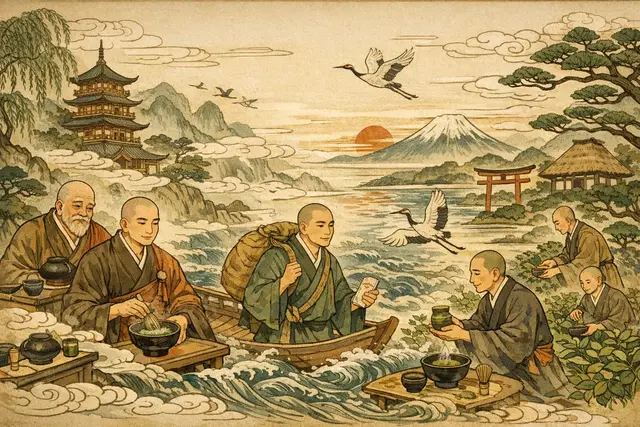



Tea Emissaries Eisai and Enni Ben’en brought powdered tea from China to Japan, weaving Zen practice, ritual, and cultivation into traditions that evolved into Japan’s iconic tea ceremony.
Read More
There are few seasonal variations for Indonesia’s teas. This is in contrast to areas like Japan or Darjeeling, where extremes in temperature and growing conditions throughout the seasons create drastically different profiles with each harvest.
Read More
Tea Journey writer, Diana Jendoubi, spent a year exploring Sri Lanka’s remarkable tea regions and shares her tales of the most extraordinary experiences, unforgettable stays, inspiring people, and delicious cups of tea through the country.
Read More
Sri Lanka celebrated its 150th anniversary of tea beginning in 2016 and culminating in the International Tea Convention and Expo in Colombo in August 2017.
Read More
Peekoh Tea founders Trevin de Silva and Vinod Malwatte felt that not enough high-quality Sri Lankan tea was being showcased to local consumers. “We wanted to focus on loose-leaf tea and slowing down. It would enable us to introduce Sri Lankans to the ritualistic side of tea drinking. where it takes time to brew a cup of tea,” says Vinod.
Read More
In the foothills of Mt. Fuji lies the village of Higashiyama where Chagusaba agriculture, a UN-designated Globally Important World Agricultural Heritage System, is a way of life for tea farmers.
Read More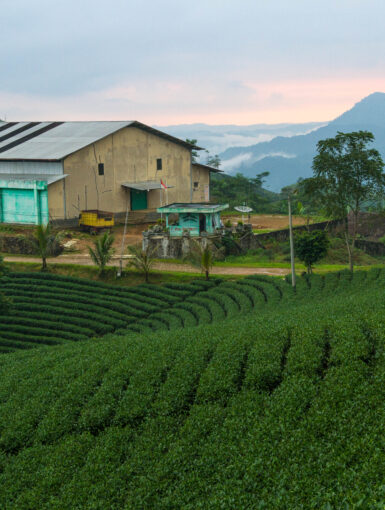
Of the thousands of islands in Indonesia, just two make up the heartland for tea production: Sumatra, the largest of the islands, and Java, the social, political, and economic heart of Indonesia. Both islands enjoy some of the highest average rainfall in the country, and feature a series of steep […]
Read More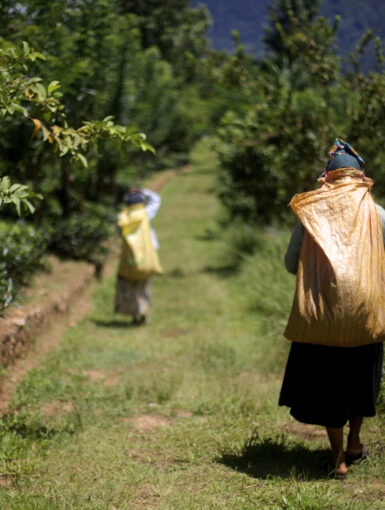
Sri Lanka celebrates diversity in tea. A new generation of Ceylon tea growers recently established an artisan tea collective to showcase exceptional teas produced to interest a niche domestic market and equally, the international market.
Read More
Parts of Nepal, Tibet, India and Bhutan are within view of Mt. Kanchenujunga a majestic icon whose five peaks look down on famous tea gardens in Darjeeling, Sikkim, Kalimpong, Pedong, Ilam, Hile and Taplejung.
Read More
At a very young age, Cotterman developed a passion for pottery, making pinch pots in the rocky Texas dirt of her yard. By the age of 12, she had her first formal experience with a throwing wheel during a summer camp class.
Read More
Long into the night tea grower Yihua Luo keeps a watchful eye over the new harvest roast. It is the critical final stage of the most intricate processing technique of any tea. He hasn’t slept in 32 hours.
Read More
In the households of Yixing, home of the celebrated purple clay teapots, ordinary potters are crafting something extraordinary.
Read More
Every tea taster dreams of discovering a remote, virtually inaccessible growing region producing exceptional tea. The discovery of Tai Ping Hou Kui was just such an experience for us.
Read More
The 45-day pile-fermentation process involves moistening large stacks of sun-dried crude tea leaves. The leaves are piled high and carefully monitored to produce a dark composted tea known as Shou Puer.
Read More
Smallholders are the backbone of the tea industry, especially in underdeveloped Nepal. Here’s the story of one Nepali smallholder: a widowed grandmother who has spent a lifetime in tea, nature, faith and family.
Read More
A lack of infrastructure, a lack of capital, natural disasters, a pandemic, and a very tough competitor at the border – these are the challenges faced by Nepal growers.
Read More
The Chinese tea industry, responsible for a third of global tea production, will remember 2016 mainly for the challenge of recovering from severe spring frost. Early spring tea was hit hard but the late spring harvest made up somewhat for the early losses. It has added up to overall lower sales compared to 2015, especially for the higher grades.
Read More
Meet Yongzhong Xie: born into tea, raised by tea and to a great extent, defined by his tea. A tea master and a task master, Mr. Xie demonstrates the art of manufacturing fine Keemun tea.
Read More
It’s never a bad year for tea in Southern China, home of Anxi and Wuyi wulongs and many more outstanding varieties. But a wet spring dampened this year’s harvest, especially in early May when heavy rain brought tragedy to the region. Recommendations from the region this year include two Dancong oolongs from Guangdong province, Rougui from Wuyi, and jasmine.
Read More
Jiangnan (literally means River South, refers to the area south of the Yangtze River in eastern China) region is the biggest tea producing region in China. With low hills, abundant rainfall, distinct four seasons, this region represents two-thirds of the total production of the nation. Interestingly, a handful of high […]
Read More
Photographs by Huiling Liang Jiangbei (literally means River North, refers to the area north of the Yangtze River in eastern China) region’s teas are little known outside of China. This region is located at 32 degrees north latitude, which globally speaking, is quite far from most tea producing regions. It […]
Read More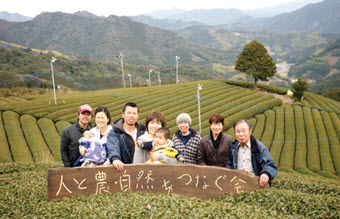
Tamiko Kinezuka: “We make tea with great effort, and hope you will drink our passion with your tea. As my father says, ‘Please taste the tea in one half of your cup, and the heart of its farmer on the other.’ “
Read More
Yiwu big tree puer has coarse stems and apparent long black strips. These big, slow-growing trees grow with minimal human intervention on the terroir of Yiwu Mountain in China’s Yunnan province, which boasts rich biodiversity. Fine white hair found on tea stems are an indication of its long domestication. The dry […]
Read More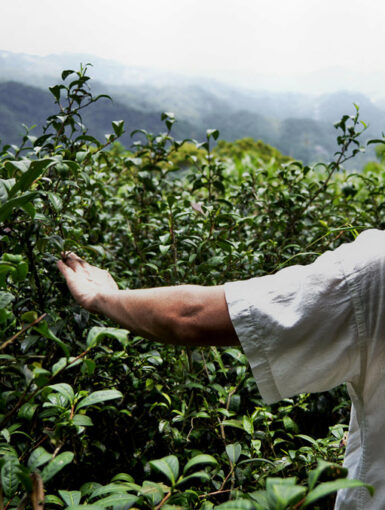
With Taiwan’s compact size and its modern transport and communication infrastructure, one can easily visit a tea grower anywhere on the island in less than a day’s journey by car, rail, plane or bus. Sophie Lin, operator of the Wisteria Teahouse in Taipei organized a press tour in July 2016 […]
Read More
Taiwan has teahouses of every sort, from Laoren (old man’s) style where common tea leaves are steeped in ordinary drinking glasses, to quiet Daoist establishments, to modern shops where scanning social media sites on mobile phones and laptops is OK.
Read More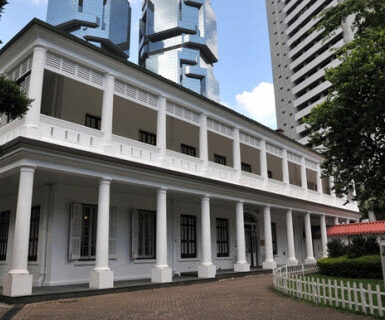
Nestled inside Hong Kong Park, the Flagstaff House Museum of Tea Ware, formerly known as Flagstaff House, was built in the 1840s. It is the oldest colonial building in Hong Kong still standing in its original spot. As a branch museum of the Hong Kong Museum of Art, it was […]
Read More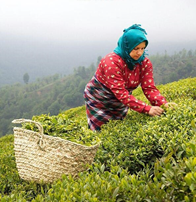
Tea first reached Iran by caravans traveling the Silk Road 450 years before the modern Christian era. Residents were largely coffee drinkers until the seventeenth century but now consume four times the world average for tea. The beverage is served hot at almost all social occasions and family gatherings. Imported […]
Read More
Originating in Yunnan’s large-leaf species, pu’er tea can be stored for many years. Its aroma diminishes gradually. A latent note is uncovered as volatile aromatic compounds with a low boiling point dissipate. A quality piece of new raw pu’er cake with proper storage will develop a clean and robust grassy aroma and then flower, fruit, honey, plum, almond, and woody aroma, finally expressing the epitomic vintage notes.
Read More
China’s southwestern region includes Tibet, Yunnan, Guizhou, Sichuan, and Chongqing. The southwestern region is the oldest tea producing region in China and the birthplace of Camellia sinensis. It is also called “the plateau” tea region. The majority of teas are grown at an altitude of 1,500 feet or higher. Many […]
Read More
Many tea connoisseurs wait for this first harvest each year, which is usually only available in very small quantities, and will most likely be gone within the first few months or even weeks of its harvest.
Read More