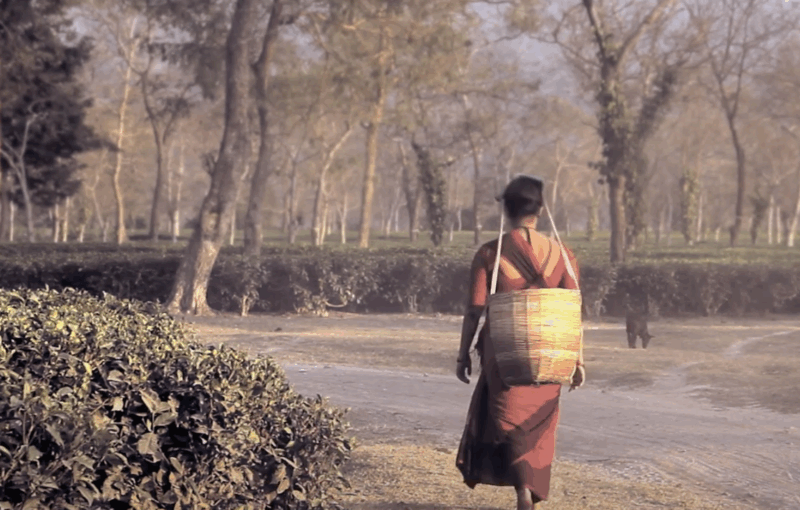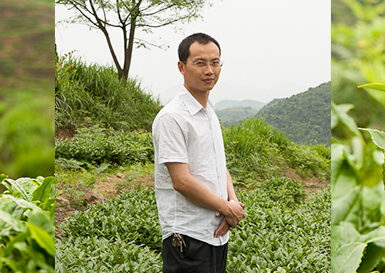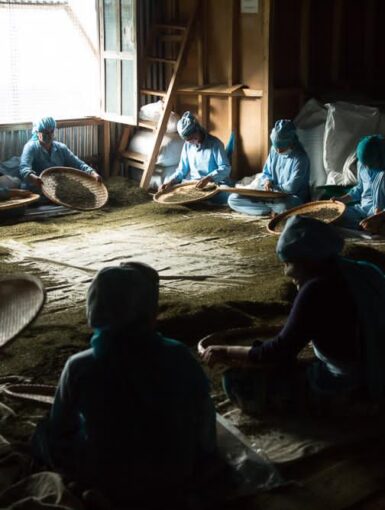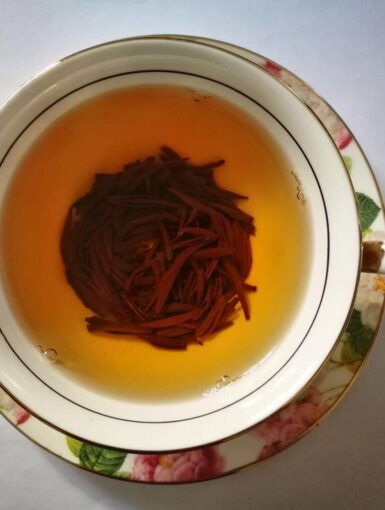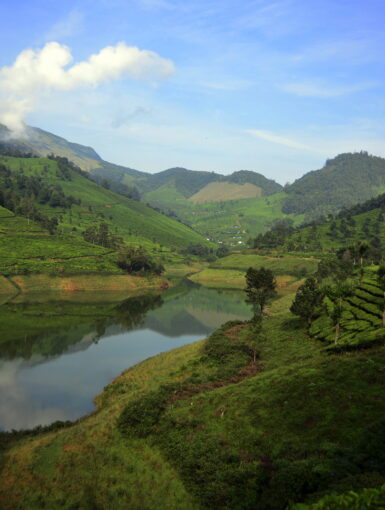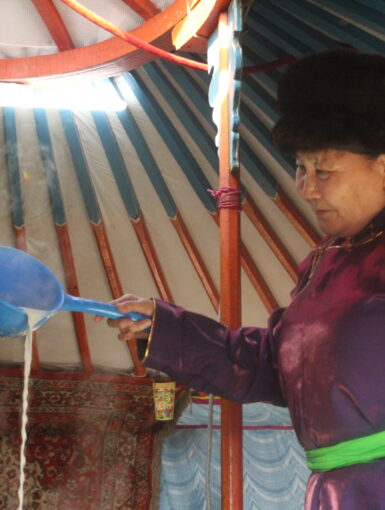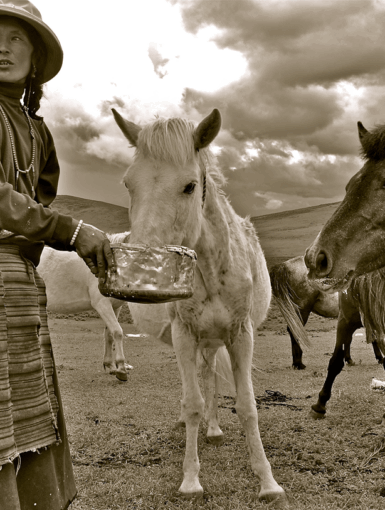

Tie Guan Yin oolong, the quintessential “slow tea of China,” is time-consuming to produce and meant to be savored slowly. In Anxi, Fujian, the birthplace of Tie Guan Yi, the locals, like organic tea grower Rong Feng Wang, are fiercely proud of their oolongs. Here’s Wang’s tea journey.
Read MoreAsia
A Heritage Tea for Modern Times
Tanyang Gongfu tea is experiencing notoriety as well as increased demand that dates to the 1980s when local growers collectively raised their production standard, earning a reputation for quality hongcha (red tea). The tea is grown in Fu’an which takes its name from a poem in which a Song dynasty emperor bestowed five blessings: “Lucky Heaven, Lucky Earth, Lucky Mountain, Lucky Water, and Lucky Tea.”
Read MoreRemote Farming During a Pandemic
The pandemic was the worst thing to happen to Nepal’s Kanchanjangha Tea Estate, but there is a silver lining. “It radically changed how we work,” says Nishchal Banskota, who manages operations via Zoom calls between Long Island, New York, and his family’s tea estate. It’s early morning for me and the end of the day for my father, but after nine months, he says, “I have more confidence that I can manage a farm remotely.”
Read MoreJapan’s Cultural Tea Bridge to Europe
The currents of Japanese tea culture are flowing outward to Europe. In the past 50 years, Europeans have been diving and delving into the green waters. What is it about Japanese tea that attracts Europeans, and how is it pouring into European culture?
Read MoreSri Lanka’s Artisan Tea Collective
Sri Lanka celebrates diversity in tea. A new generation of Ceylon tea growers recently established an artisan tea collective to showcase exceptional teas produced to interest a niche domestic market and equally, the international market.
Read MoreDestination Songyang China
Modern Songyang integrates the essence of mountain and river, the taste of the countryside, and the beauty of folk art and local customs. The terraced hillsides are typical of traditional tea-producing regions, but Songyang is also a model county for national tea industry development. Plantations cover 20,403 acres of plants used in making 76,000 metric tons of Yinhou and Xiang green tea.
Read MoreRoy Fong: A Chinese-American Journey
At age 6, on his way to school, Roy Fong would linger at a Hong Kong food stand where day laborers were making gongfu cha. Sometimes someone would offer him a cup, and he never forgot the wonderful aroma and taste.
Read MoreThree Mindful Tea Drinking Experiences in Japan
The originators of the Japanese tea ceremony believed that the simple activity of sharing tea with a friend was like the path of a falling cherry blossom. It is a fleeting encounter on a path that can never be exactly repeated.
Read MoreAdvocating Artisan Tea for Smallholders in Assam
The Tea Leaf Theory team is very lean, choosing to remain independent, bootstrapped, refusing certifications, they represent a new kind of startup, modern yet rooted in something traditional, ancient even. There’s the social impact but Tea Leaf Theory is not an NGO working for small farmers. “We want to make them entrepreneurs, not beneficiaries,” say co-founders Upamanyu Borkakoty and Anshuman Bharali.
Read MoreSikkim’s Temi Tea
Sikkim’s Temi Tea has protected and sustained its legacy. But it also made this legacy a part of its brand story, one that complements its topnotch tea.
Read MoreHow Chinese Describe the Aftertastes of Oolongs
What would rhyme have to do with a tea’s aftertaste? To understand the many layers of this play on words, it is important to know that Chinese singing and by extension Chinese poetry have a Yang (masculine) and Yin (feminine) rhyme system.
Read MoreForest Pick Wild Tea from Manipur
Three sisters from Manipur, India, and their brother launched Forest Pick Wild Tea about two years ago. Together they organized villagers to harvest tall-grown tea trees on a schedule, arriving with portable processing equipment to make artisan oolong, black, green and white teas. “Irrespective of the market size or market opportunity, Forest Pick Wild Tea is not another start-up, but an eco-system we are creating in which all the villagers participating will benefit.” — Julie Gangte
Read MoreThe Art of Earth and Fire
Jian Zhan teaware inspires poetic praise among its ardent lovers and devotees. Those who gain a genuine appreciation of Jian Zhan teaware find it impossible to shed their fascination with the history, science, art, and economics of these enchanting cups.
Read MoreAmazing Lessons on Japanese Tea at Cafe Seisui-an
Tea farmer, seller, event coordinator, gourmet, and nationally certified tea appraiser, Yasuhiko Kiya radiates love for his tea-growing neighborhood, Japanese tea, and his son, who will become the fourth generation to run the family business.
Read MoreContrasts of Japan / Stories from the Land of the Rising Sun
Far far away, behind the word mountains, far from the countries Vokalia and Consonantia, there live the blind texts. Separated they live in Bookmarksgrove right at the coast of the Semantics, a large language ocean. A small river named Duden flows by their place and supplies it with the necessary […]
Read MoreThe Faces of Indian Traditions
Far far away, behind the word mountains, far from the countries Vokalia and Consonantia, there live the blind texts. Separated they live in Bookmarksgrove right at the coast of the Semantics, a large language ocean. A small river named Duden flows by their place and supplies it with the necessary […]
Read MoreDestinations: Hoshino Village’s Tea Culture Museum
Hoshino villagers have experimented with growing, processing, and savoring tea for more than 600 years. The village’s Tea Culture Museum offers visitors a first-hand experience preparing artisan tea amid displays of ancient crafts.
Read MoreThe Gentleman Planter of Craigmore
Given that the Indian tea industry is struggling, Craigmore Tea Estate’s profitability offers important insights. The estate produces orthodox green and black tea, with the former exported and the latter sent to the auctions. Over the years, the balance has tilted to favor more green tea production to meet the demand.
Read MoreThe Studio: Muskan Khanna
Tea Studio celebrated its second birthday in August 2019. What it offers is a new model for processing tea in India. Small has not meant few teas. Nearly 90% of Tea Studio’s teas are exported to Canada, United States, Japan, and Australia. Teas are made to order, production is a modest 20 kilos a day.
Read MoreDestination: China’s National Tea Museum
China’s National Tea Museum, established in Hangzhou in 1991, is considered the epicenter of knowledge and appreciation of China’s most treasured beverage. Whilst there are small tea museums sprinkled across China
Read MoreCurios: Chinese Art Set in Stone
Consider owning a 470 million-year-old work of Mother Nature’s art, appropriately priced well over $500.
Read MoreKakuzo Okakura and the Cup of Humanity
Kakuzo Okakura first described Japanese tea culture to a readership in the U.S. in The Book of Tea in 1906. Since then, his book, his ideas, and Japanese tea culture have traveled across the world.
Read MoreRound the Bend
The Nine Bend River (Jiuqu Xi) is a masterpiece one hundred million years in the making, cutting through China’s oolong tea capital.
Read MoreIndia’s Oldest Manager in Tea
KOOMTAI, Assam – Forty years ago executives of Goodricke Group, which had just split from Duncan Brothers & Company Ltd., sent one of their best estate managers to Koomtai Tea Estate, a company-owned garden in Assam’s Golaghat district. His mission was to assess whether to sell off the unproductive property […]
Read MoreTea Discovery: Jin Jun Mei is a Wuyi Red Legend in the Making
Daniel Hong’s whimsical online profile picture has him adorning a Charlie Chaplin hat with an oversized black cardboard moustache.Chinese millennials don’t usually do whimsical, so I thought I might soon be meeting an over-the-top eccentric…
Read MoreTasting Notes: Jin Jun Mei
Red teas in China are experiencing a Renaissance. One of the most sought after of the high-end red teas is Jin Jun Mei – a fully oxidized tea created in 2006. It is made wholly of tea buds picked in early spring…
Read MoreHarvest Review: Assam’s Smallholders Inherit the Land
Jorhat, Assam The vast Brahmaputra Valley holds the world’s greatest concentration of tea. Commercial production began 180 years ago in a region that has 800 of the largest plantations in the world; employs 686,000 tea workers daily and is vast enough to harbor ancient tea forests that have flourished for […]
Read MoreTea Discovery: Crab Pincer Tea
Eons of evolution in the ancient tea forests of China has established a complex and delicate biomass. The gnarled, pale-grey and green trunks of the oldest trees are home to myriad adaptations of spiders, lichen, and the tree parasite known to locals as crab pincer, a tea mistletoe.
Read MoreOrigin India: Rimpocha the Legacy of Makaibari
Siliguri, West Bengal During his 47-year stewardship of Makaibari Tea Estate, one of India’s oldest and most celebrated tea habitats, Rajah Banerjee, 70, instituted innovations that continue to reverberate globally. The 1,100-hectare estate was both laboratory and classroom. “I was never an owner, just a steward in passing,” he says. […]
Read MoreOrigin India: Discovering The Wild Tea Forest of Assam
Pradip Baruah was born curious. He spends much of his time in the office and lab as chief advisory officer at the Tocklai Tea Research Institute (TRI) in Jorhat, Assam, but loves an adventure whenever the opportunity arises. In January he fulfilled one of his long held dreams on […]
Read MoreOrigin India: Kangra Valley
A scant 2,000 kilometers west of Darjeeling, on the opposite side of the Indian subcontinent, lays a scenic valley of the Indian state of Himachal Pradesh, a place steeped in Hindu mythology.
Read MoreTea and Terroir Through Time, China and France
The concept of terroir is still in flux, though trending toward a more widely accepted framework for an all-encompassing set of synergistic influences.
Read MoreOrigin India: Tamil Nadu and Kerala
The Western Ghats, South India Backbone of South India The six-hour drive south from Balanoor Tea Estate in Karnataka to the storied Nilgiri District of Tamil Nadu skirts Mysore city, engages with endless hills of shade-grown tea and coffee, then climbs to a plateau studded with charming agricultural villages producing […]
Read MoreOrigin India: The Deep South
Balanoor Tea Estate, Karnataka Piece of Cake His birthday was celebrated in a leafy residential section of Bangalore, one of India’s more modern, connected cities. Thirty members of the prosperous Kuriyan clan milled about the cavernous apartment in the condominium complex they erected 15 years ago. Venerable tea and […]
Read MoreTasting Notes: A Taste of Winter in South India
There is a revolution going on in South India, right under our noses. Up until the late 1980s perhaps, South Indian tea – from Karnataka, Tamil Nadu, and Kerala – was predominantly comprised of mid-grade CTC (cut, tear, curl) produced for the local market. In addition, there was a range […]
Read MoreRussia’s Dark Secret: Baikhovy Tea
Russian tea culture emerged from 17th-century Mongolian trade, evolving into a cherished tradition featuring samovars, baikhovy tea, and elaborate brewing rituals. Learn more about Russia’s tea culture and rituals, as Tea Journey writer, Mainbayar Badarch takes you through the history and culture of the region
Read MoreTime-lapse of Japan’s Shincha Harvest Tea
KYOTO, Japan — This time-lapse video captures the beautiful birth of this year’s shincha harvest. A special video camera, positioned at the Nakakubo Tea Farm, advanced a few frames every 5 minutes for about 30 days last month to show us the dance of the new leaves. The digital […]
Read MoreHarvest Review: Vietnam
Vietnam in 2017 ranked as the world’s seventh-largest producer of tea and fifth in exports. It has 124,000 hectares under production in around half its provinces, including the subtropical North and tropical South. This is roughly the same as Indonesia and three times the tea-growing acreage in Japan. Exports in […]
Read MoreHarvest Review: South Korea
Stephen Carroll is one of 42 Tea Journey tasters reporting on the 2016 harvest. Look for his posts on South Korea as the season progresses. The Republic of South Korea certainly keeps its tea and tea culture a secret. So secret that not even many South Koreans are familiar with […]
Read MoreHunting Down Wild Jin Jun Mei from Wuyishan
I began visiting tea markets to find companies selling interesting teas. I spent countless hours sipping teas at tea shops trying to find genuine wild tea. It proved to be difficult. Some marketers would claim to have authentic wild tea, but when I asked to see the mountain where the trees […]
Read MoreOrigin Mongolia: Making Nomad’s Tea
ULAANBAATAR, Mongolia The nomadic way of life shapes Mongolia like no other country. Mongolia is the most sparsely populated country in the world – its 600,000-square-mile plateau is home to all who roam the vast steppes. Three-fourths of the county is pasture land with the rest divided between forests and […]
Read MoreCountenance: Travelers Along the Tea Horse Road
Tea once traveled the most daunting journey of any plant on the planet. Few tea drinkers know the story of how tea spread to every nation from its origin in the mountains of China. Traders for 13 centuries loaded tea on the backs of yaks, mules, horses, sheep, and man. […]
Read MorePeekoh Tea and Smoke and Bitters: Raising the Bar
Peekoh Tea founders Trevin de Silva and Vinod Malwatte felt that not enough high-quality Sri Lankan tea was being showcased to local consumers. “We wanted to focus on loose-leaf tea and slowing down. It would enable us to introduce Sri Lankans to the ritualistic side of tea drinking. where it takes time to brew a cup of tea,” says Vinod.
Read MoreOrigins: Tea in Kuala Lumpur Malaysia
KUALA LUMPUR, Malaysia In a country where eating is more or less the national sport, tea is prominent on the nation’s menus — lots of it. Tea has been a traditional beverage for Malaysians for more than 150 years, particularly among Chinese immigrants although exactly when the habit took hold […]
Read MoreTea for Generations to Come
KITSUKI, Japan Small family-owned tea gardens are inseparable from the economic and social past of historical places such as Kitsuki, a scenic coastal city and authentic samurai town, home to a castle that dates to 1394. Tea permeates the culture here, having entered the fabric of Japanese society beginning in […]
Read MoreOrigins: Historic Ceylon
From the vibrant colors and culture of Colombo to the peaceful hillsides of Kandy, Sri Lanka is both a tea lover’s and traveler’s paradise. Formally known as Ceylon, this South Asian Island in the Indian Ocean is located 20 miles (32 kilometers) southeast of India. Its stunning beaches, exotic wildlife, […]
Read MoreOrigin India: Garden by the River
It took ten years for Rajiv Lochan to acquire and consolidate various plots into a single garden known as Doke Tea, an organic farm along the south bank of the Doke River in Bihar, India.
Read MoreOrigins: Kanchanjangha Organic Nepal Tea
RANITAR, Nepal Tea was a gift fit for their king that the humble people of Nepal have cherished since its arrival. Long before marketers labeled it organic, Nepal tea was grown with care. It was always the province of smallholders clinging to the mountain side like the trees they nurtured. […]
Read MoreHow to be a Tea Tourist in Kuala Lumpur
KUALA LUMPUR, Malaysia One of the great pleasures of traveling is taking time to enjoy tea in a new place in accordance with the customs of the local residents. These are our picks: Majestic Hotel, Kuala Lumpur: This Colonial hotel adjacent to the Botanical Gardens is oh-so-majestic if you wish […]
Read MoreSri Lanka’s Artisan Tea Collective
Sri Lanka celebrates diversity in tea. A new generation of Ceylon tea growers recently established an artisan tea collective to showcase exceptional teas produced to interest a niche domestic market and equally, the international market.
Read More